Toruko rice — “Turkish rice” — is Nagasaki’s one-plate argument that three lunches are better than one: a pork cutlet under demi-glace or curry sauce, a mound of pilaf, and a full portion of napolitan spaghetti, all on the same plate, all at the same time. It has nothing verifiably to do with Turkey, it was born in the 1950s in the port city that had been mixing other people’s cuisines for four centuries, and Nagasaki has never agreed on who invented it — which the city counts, correctly, as part of the dish.
One plate, three lunches
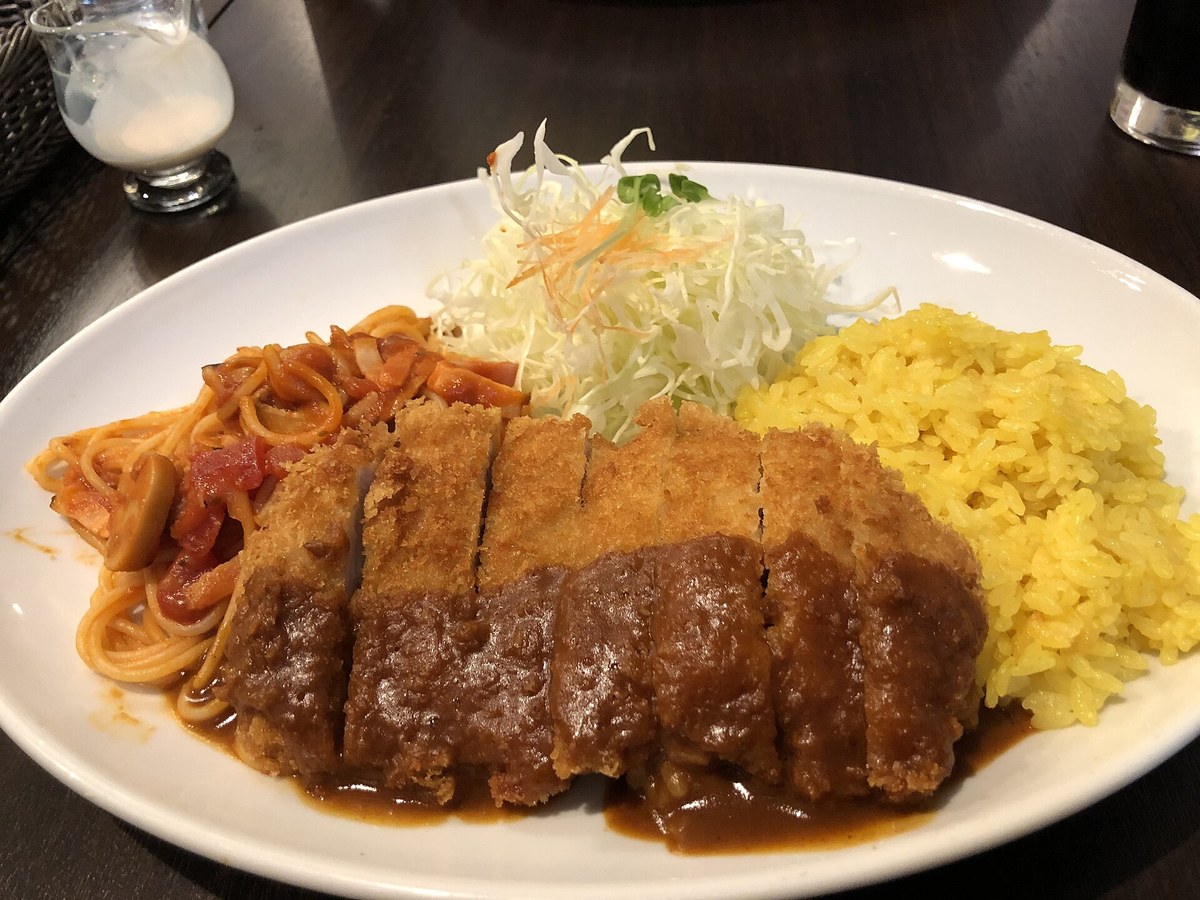
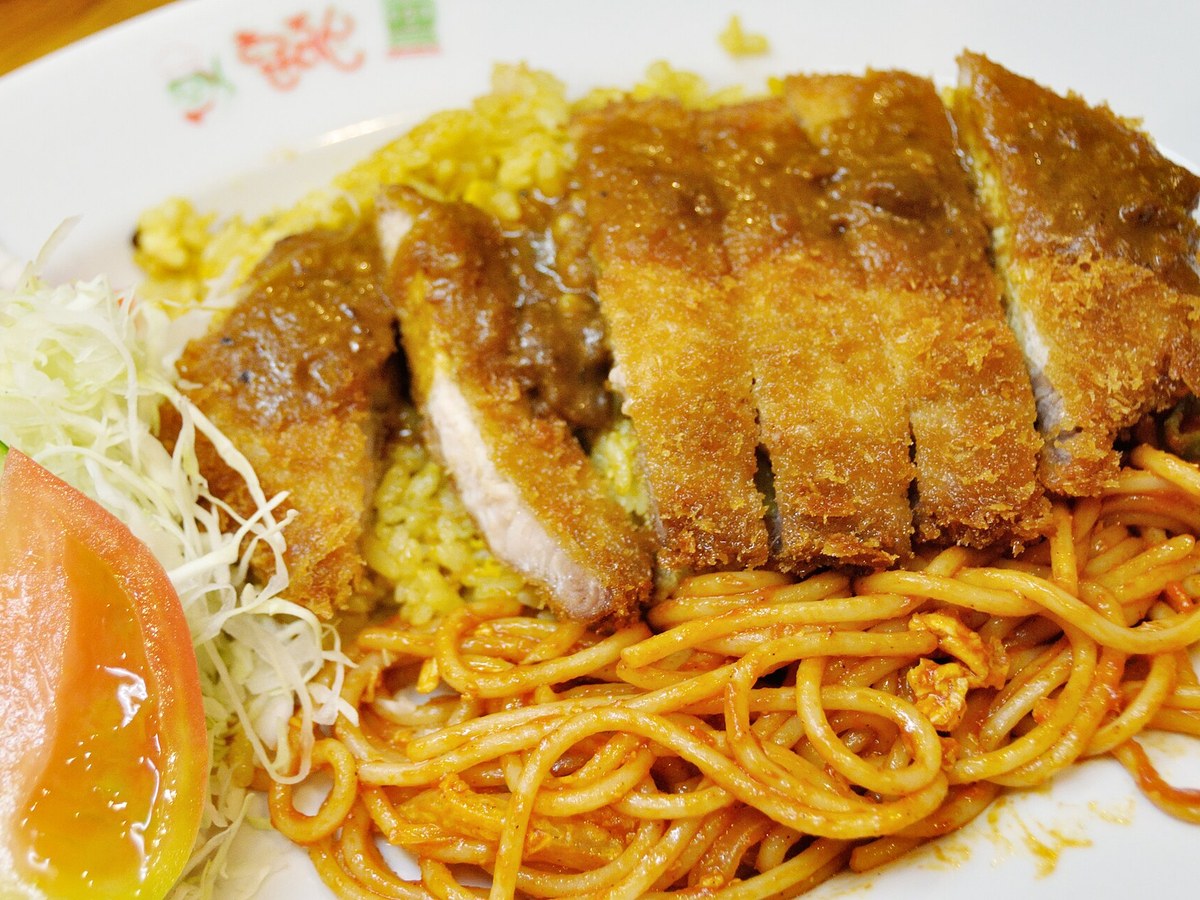
The constitution is stable even where everything else is argued about: tonkatsu, pilaf and spaghetti on one plate. The pilaf was originally a dry curry — curry pilaf — and may today be butter rice or fried rice; the spaghetti is napolitan, ketchup-red, as a rule; over the cutlet goes demi-glace or a curry sauce, house by house. Salad fills the remaining space. The result is routinely over a thousand kilocalories and is described in Nagasaki, with pride, as a grown-up’s children’s lunch — the okosama lunch rebuilt for dockworkers, students and anyone who cannot decide, which in Nagasaki means everyone.
This story’s two photographs are the constitution at two houses: Cafe Olympic’s plate — demi-sauced cutlet over yellow pilaf, napolitan and salad in their thirds — and Kitchen Seiji’s, the cutlet sliced over pilaf with a full napolitan portion beside it. No two Nagasaki houses build it alike, and the variation is the culture: the city’s toruko-rice shops are counted in the scores, their combinations in the hundreds.
The 1950s, and a name nobody can prove
The dish is placed in the 1950s, and the name’s origin is a genuine historical open question with named theories. The Restaurant Toruko theory: a Nagasaki yoshoku house of that name served the plate, and the plate took the shop’s name — the theory put forward by Tsuruchan, the 1925 café that serves the dish as its signature while itself declining to be called its originator. The Uehara theory credits the father of Bistro Bordeaux’s founder, a former ship’s cook who worked a US officers’ club in Kobe before Nagasaki. A third credits Matsubara, chef of the Restaurant Maruzen. The naming images — the plate’s tricolour, or Turkey as the bridge between an Eastern pilaf and a Western spaghetti with the cutlet standing between — are kept as theories, not facts, and this story keeps them that way.
What is documented is the eating: the novelist Nosaka Akiyuki loved Tsuruchan’s plate, and Sadamasaki, born in Nagasaki in 1952, remembered the toruko rice of his primary-school Sundays as a rare feast beside Yuketsu’s curry. By the time a dish is in a famous singer’s childhood memoir, it is no longer a menu item. It is a city’s furniture.
Tsuruchan and the old guard
Eat it first where the argument lives. Tsuruchan, in Aburaya-machi by Shianbashi, was founded in 1925 and is Kyushu’s oldest café; its “mukashi-natsukashi” toruko rice — the old-fashioned plate — is the city’s reference serve, eaten under a ceiling of visiting writers’ autographs and followed, by local law of custom, with the house’s eaten-with-a-spoon Nagasaki milkshake. Bistro Bordeaux carries the Uehara line; Cafe Olympic, this story’s first photograph, is the volume end of the tradition, famous for plates built to be shared and photographed.
The honest way to eat toruko rice is comparatively: the sauce is the house signature — demi at one door, curry at the next, a hybrid at the third — and the pilaf runs from dry curry to butter rice across the same street. Nagasaki people have a house the way Nagoya people have a tebasaki house, and for the same reason: the dish was designed, from its first plate, to be argued about.
Prices on the old menu
Tsuruchan’s own menu prices the classic plate plainly: the mukashi-natsukashi toruko rice at 1,380 yen, chicken toruko and seafood toruko at 1,380 yen, and the house’s “Shinsei” toruko rice at 1,780 yen. The 2026 Nagasaki guides put Tsuruchan’s range at 1,300 to 1,600 yen and the citywide standard for the plate at 1,000 to 2,000 yen — a full lunch trio for the price of one of its parts in Tokyo.
Order the classic first, at whichever house you choose, and order the milkshake after it if the house is Tsuruchan. Do not plan a large dinner. A toruko rice is not a course in a day’s eating; it is the day’s eating, on one plate, exactly as a 1950s port city intended.
Sources — checked 14 November 2026
- Toruko rice — the Nagasaki record (form, 1950s origin and the standing name theories)
- Tsuruchan, Nagasaki — the house menu (as carried on the Nagasaki Bus special page)
Checked 14 November 2026 (stored links re-fetched and judged per product): reserved where the page says so, with an editorial review note kept per product. Press, PR and travel use stays outside the grant.
Editorial review 2026-11-14