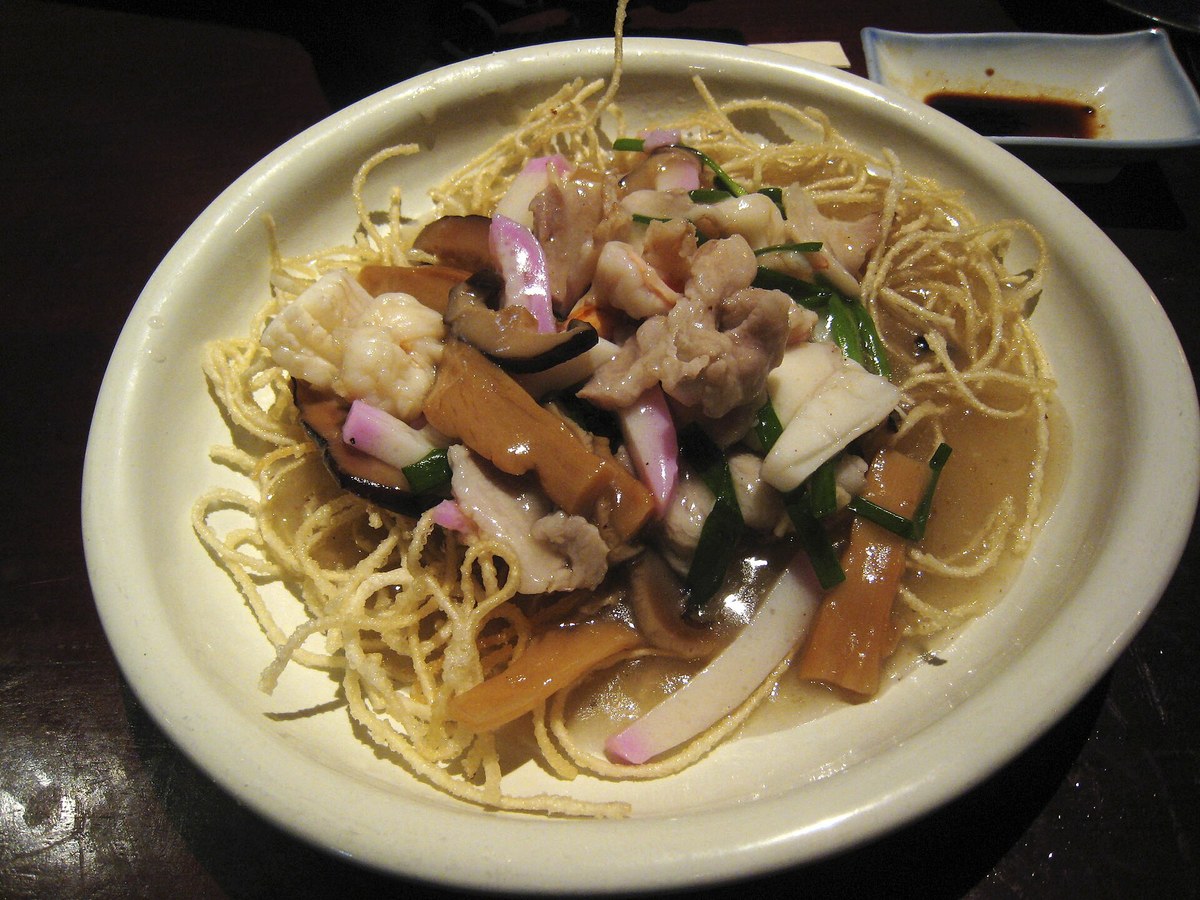
The name is a small lie told in Nagasaki: sara udon — 'plate udon' — contains no udon at all. What arrives is a wide plate heaped with either a nest of thin noodles fried until they crackle, or thick noodles pan-fried until their edges crisp, and over it the whole champon stir-fry — pork, prawns, squid, cabbage, bean sprouts and pink-edged kamaboko — bound in a thick, glossy sauce. The first bites crunch; the last are soft with sauce. It is champon's sibling, invented in the same Nagasaki Chinatown kitchens, and the argument about which noodle is correct has run for a century.
Champon, minus the soup
The relationship is exact. Champon simmers its thick noodles in a milky pork-and-seafood broth with the stir-fried toppings cooked in. Sara udon takes the same stir-fry — the same pork, seafood, cabbage, bean sprouts and kamaboko, in a thick, slightly sweet soy-and-pork-bone sauce — and pours it over noodles on a plate instead. One kitchen, one topping, two destinies: the bowl and the plate.
The plate offers a choice the bowl cannot. Hosomen sara udon uses thin wheat noodles deep-fried to a crisp nest — the more common style today, and the one visitors picture. The older style uses the same thick, springy noodles as champon, pan-fried so they stay chewy in the middle under the sauce. Good Nagasaki houses ask which you want; the crispy nest softens as it drinks the sauce, so a single plate moves from crunch to chew while you eat it.
A port city's second noodle
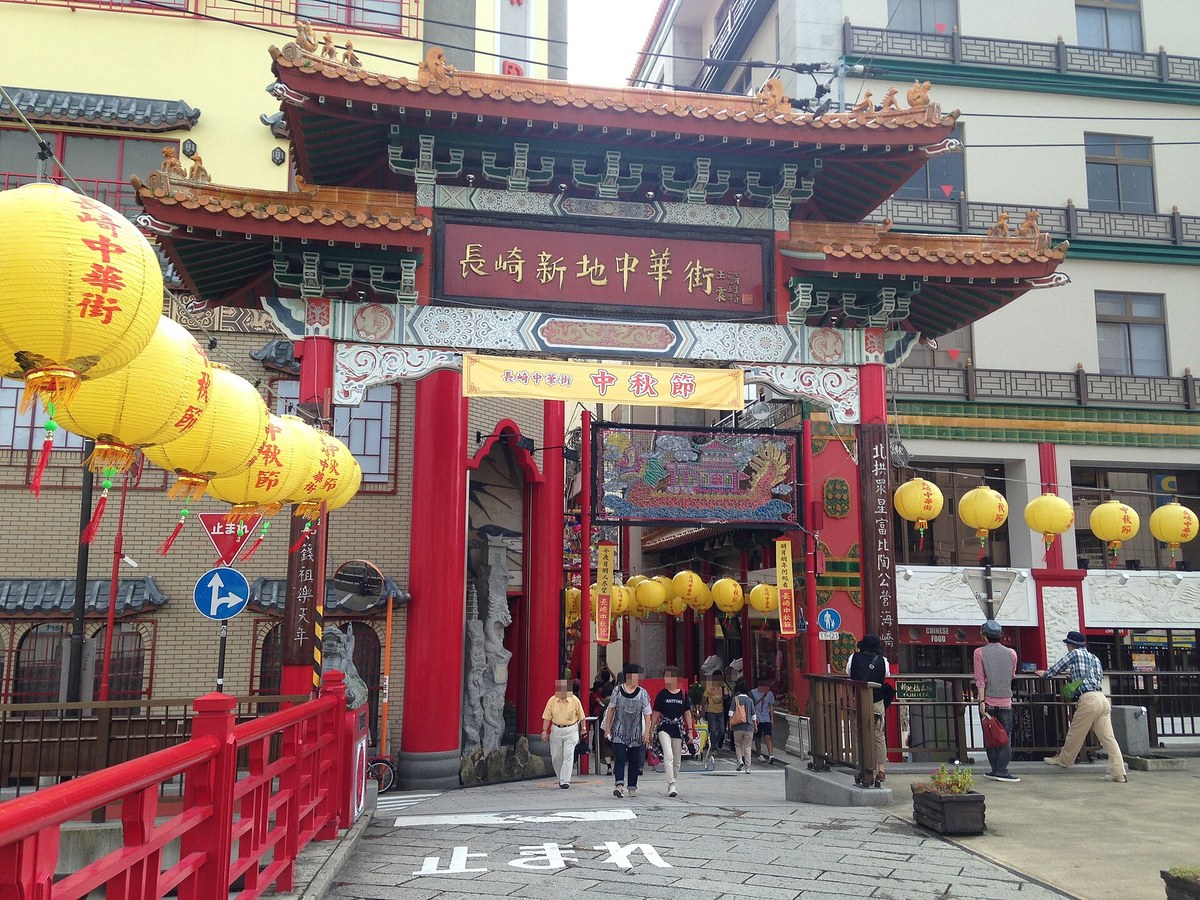
Both dishes were born in Nagasaki's Chinese community in the years around 1900. The champon story is the famous one: in 1899, at Shikairou (Shikairo), the Fujian-born founder Chen Ping Shun — Heijun Ching — created champon as an affordable, nourishing single bowl for Chinese students in the port city. Sara udon grew up beside it in the same restaurant culture of Shinchi Chinatown, and Shikairo's official site, on the October 2026 menu check, states that its founder created sara udon too.
The century since has spread the plate across Japan — Ringer Hut, founded in Nagasaki in 1974, built a national chain on the two dishes — but Nagasaki keeps the originals in concentration: the Chinatown houses, Shikairo's dining rooms near Oura Church, and neighbourhood counters all over the city serve both noodles and let you order the pair and compare them at one table.
How the plate is eaten
Sara udon is a dish of changing texture, and the technique is patience measured in bites. Eat the crisp edges first, while they still crackle; then drag noodles up through the sauce so they soften to order — some diners stir the plate together at once, others keep a crisp reserve to the end. A dash of the table vinegar or sauce is the local adjustment; the sauce itself is already seasoned, sweet-edged and thick enough to cling.
The toppings are the champon census — a dozen-ingredient mix at the grand houses — and they are the point of the splurge versions: bigger prawns, scallops and squid push a plate toward the top of the range, while the everyday plate stays one of Japan's great inexpensive lunches. Order the thick-noodle version once, for history: it is the older form, and its chew under the sauce is closer to what the Chinatown kitchens first served.
Eating it in Nagasaki
Begin at the birthplace. At Shikairo, the October 2026 menu check reads sara udon at ¥1,430, tax included, in either thick or thin noodles — the same price as its champon, so the comparison costs nothing extra. In Shinchi Chinatown, Kozanro charges ¥1,760 for either dish, while Kyokaen, Kairakuen and Fukuju serve sara udon in either noodle at ¥1,200, and Sosyuurin reads ¥1,350, its thick-noodle version ¥1,580. At the budget end, Ringer Hut — Nagasaki's own chain — serves sara udon at ¥700–900 on the guide's reading, with gyoza sets around ¥900–1,100.
Choose the noodle when you order: hosomen for the crisp nest, thick for the original chew, and a half-size where it is offered if champon is also on the table. Nothing here is a packaged souvenir in its true form — the sauce must meet the noodles at the table, in the minute before the crunch goes — and that minute is best spent in Nagasaki.
Sources — checked 12 November 2026
- KONOMACHI-note — Champon and Sara Udon in Nagasaki: 8 restaurants compared (checked against official pages and in-store menus, 19 October 2026)
- Japan Trove — Sara Udon: Nagasaki's crispy fried noodle dish and where to try it (checked 12 November 2026)
- JOC Japan Travel — Nagasaki Noodles: Champon and Sara Udon (checked 12 November 2026)
Original prose and official links only; no source text or maker media reproduced. Photos are credited Creative Commons works, not product photographs.
Editorial review 2026-11-12