Japan's udon map has two famous poles — thick Sanuki in Kagawa, silk-thin Inaniwa in Akita — and a third that most mainlanders never reach: the Goto Islands, a hundred kilometres west of Nagasaki in the East China Sea. There, on Nakadori Island, noodle makers still stretch udon by hand, painting the dough with camellia oil pressed from the islands' native trees, and dry it into round strands about two millimetres thick. Goto udon is counted one of Japan's three great udons, and it is the only one that begins on an island and is mostly eaten somewhere else: eighty percent of production leaves Shinkamigoto Town.
Two millimetres, by hand
The Kyushu Tourism Organization's factory record gives the noodle's measure: about 2 mm in diameter — closer to a thick spaghetti than to Sanuki's square slabs — with a smooth, slippery passage down the throat that the record calls its salient feature. The fineness is not a machine setting. Goto udon is tenobe, hand-stretched: dough is kneaded, rested, twisted and pulled in stages, and between stages the maker's hands keep it from drying and sticking.
The coating is the signature. Camellia oil — a Goto specialty, pressed from the islands' camellia trees — is applied to the surface of the stretched dough. The tourism record notes the practical effect: coated noodles absorb less water when boiled and hold their shape in the pot, so a dried noodle only two millimetres across still cooks up with a firm, gentle chew rather than dissolving into softness.
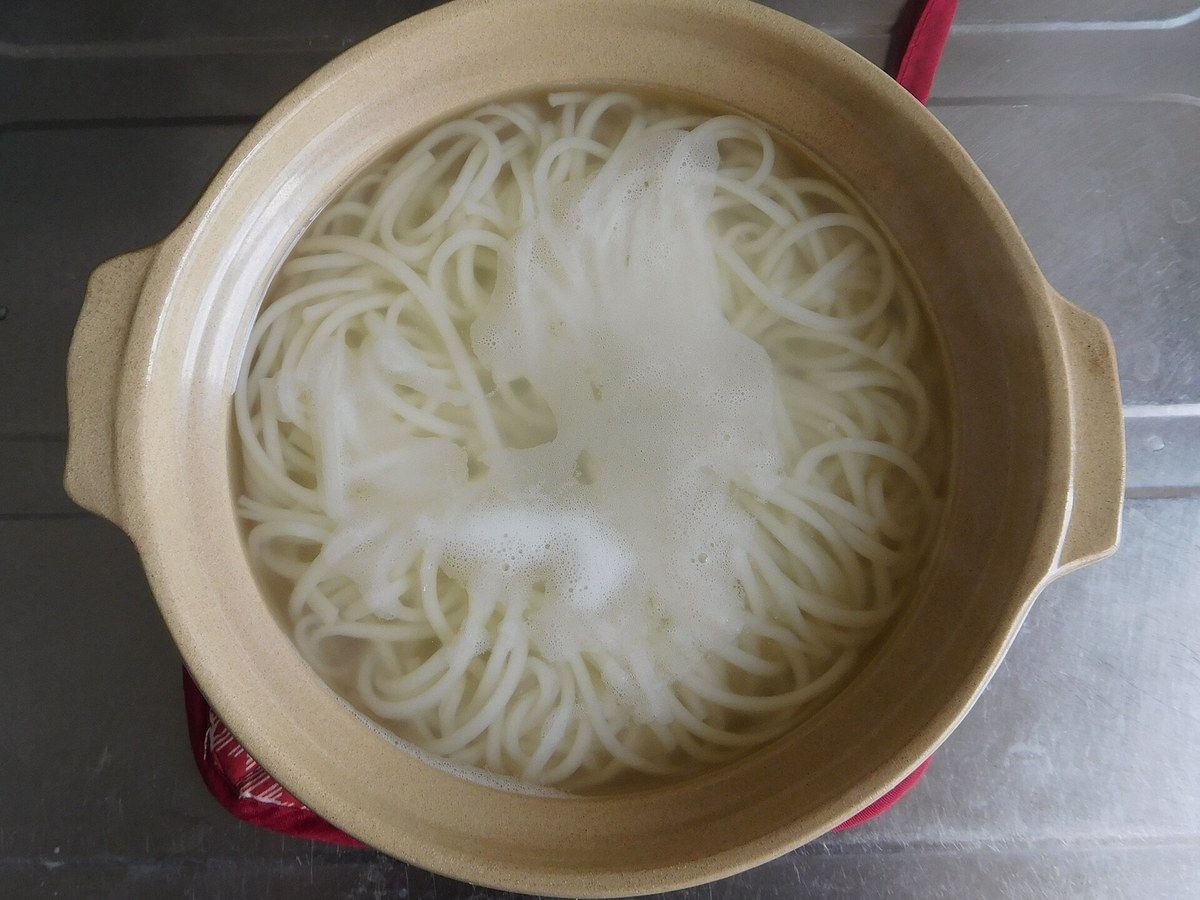
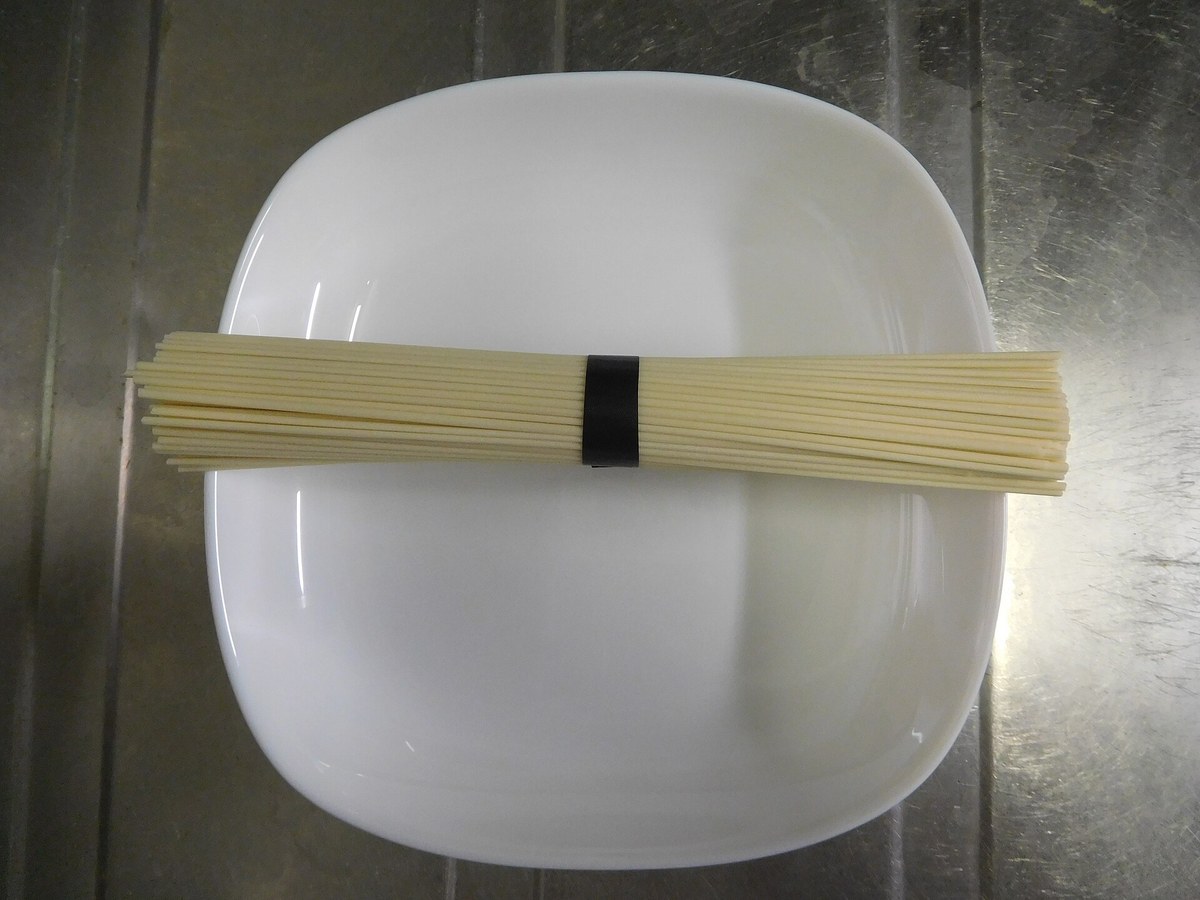
Thirty factories on one island
Goto udon was originally made only in Shinkamigoto Town on Nakadori Island, and the concentration still holds: about thirty noodle factories work in the town, each with its own individuality, and ten of them have joined into the Goto Hand-Stretched Udon Cooperative. The cooperative mills to a common standard — the same flour, sea salt and camellia oil — and sells the joint brand Nami no Ito, 'threads of the waves'.
The scale is artisanal but the market is national: the same record states that 80 percent of the town's noodles are shipped off the island. One maker the record visited, the Ota Udon Factory, marked its hundredth anniversary in 2019 — a century of stretching on an island whose whole population would fill a city ward. Island exclusivity here is not scarcity theatre; it is simply where the makers are.
The third of the three great udons
Japanese food writing groups Goto with Sanuki udon from Kagawa and Inaniwa udon from Akita as the country's three great regional udons — the Kyushu Tourism Organization uses the same grouping — while being candid that no ministry certifies the trio. The comparison is instructive anyway: Sanuki is thick and square-cut by knife, Inaniwa is flat and machine-age smooth, and Goto is round, hand-pulled and oil-finished, the only dried noodle of the three whose method carries an island ingredient inside it.
The islands' position explains the technique's arrival. The Goto chain was the last Japanese port of call for the kentoshi embassies to Tang China, and island tradition ties its noodle-making to that traffic — continental technique landed on the islands, met an abundance of camellia trees, and stayed. The dried form suits an island: a noodle that keeps, travels, and boils in minutes is a store-cupboard staple where ferries, not motorways, set the supply rhythm.
Buying the cooperative's bag
The canonical purchase is the cooperative's own noodle: Yodobashi lists the Goto Hand-Stretched Udon Cooperative's Nami no Ito in its black washi-paper bag, 300 g, at ¥519 including tax — the joint brand of the island factories, at a price that underlines how everyday this prestige noodle remains at home. The traditional island serving is jigokudaki, 'hell-boiled': the noodles are eaten straight from the pot they boiled in, dipped in a hot broth of ago (flying fish) dashi with egg, ginger and spring onion.
What to check on any packet: the maker or cooperative name and the Goto origin, and camellia oil in the method — a 'Goto-style' noodle stretched with generic vegetable oil elsewhere is an imitation of the form without the island ingredient. On the islands, the noodle-making experience at Funasaki, where visitors stretch their own and receive the finished dried udon by post, is the souvenir with the method included.
Sources — checked 12 November 2026
- Kyushu Tourism Organization (Visit Kyushu) — Goto udon, Shinkamigoto-cho, Nagasaki
- Yodobashi — Goto Hand-Stretched Udon Cooperative, Goto Udon 'Nami no Ito' black washi bag 300 g (checked 12 November 2026)
Original prose and official links only; no source text or maker media reproduced. Photos are credited Creative Commons works, not product photographs.
Editorial review 2026-11-12