Cut a bar of Ogi yokan and the knife tells you it is not modern yokan. The outside has crystallised — a crisp sugar crust the makers call shari — while the inside stays soft and barely set, because this is yokan made by an Edo-period recipe that modern factories abandoned: no sealed pouch, no year-long shelf life, just agar, beans and sugar, eaten within the month. A whole town in Saga has made it this way since the 1870s, and the name is a cooperative’s trademark.
The crust is the signature
Every other yokan in Japan is engineered not to change. Ogi yokan is engineered to change beautifully. Made by the traditional method — the paste poured into a boat-shaped mould, set, cut, and wrapped in bamboo skin — the bar’s exposed surface slowly crystallises as the days pass, so the outside turns crisp with sugar, the shari texture, while the middle stays soft and full of bean flavour. The flagship house, Muraoka Sohonpo, states the trade plainly: the traditional bars keep only eighteen to twenty-five days, by season, and that short life is the method’s signature.
The method is genuinely old. Muraoka’s account matches its recipe to the Edo-period Funabashiya Orie house as written in the confectionery record Kashiwabune, down to the kaku-kanten — stick agar, now rare in yokan — that sets the paste. The standing flavours at the flagship are ogura (whole-bean), beni-neri (pink white-bean), hon-neri (smooth red-bean) and matcha, with limited runs of kibi-zato and ao-endo — the green-pea bar the maker’s own page prices at 1,100 yen.
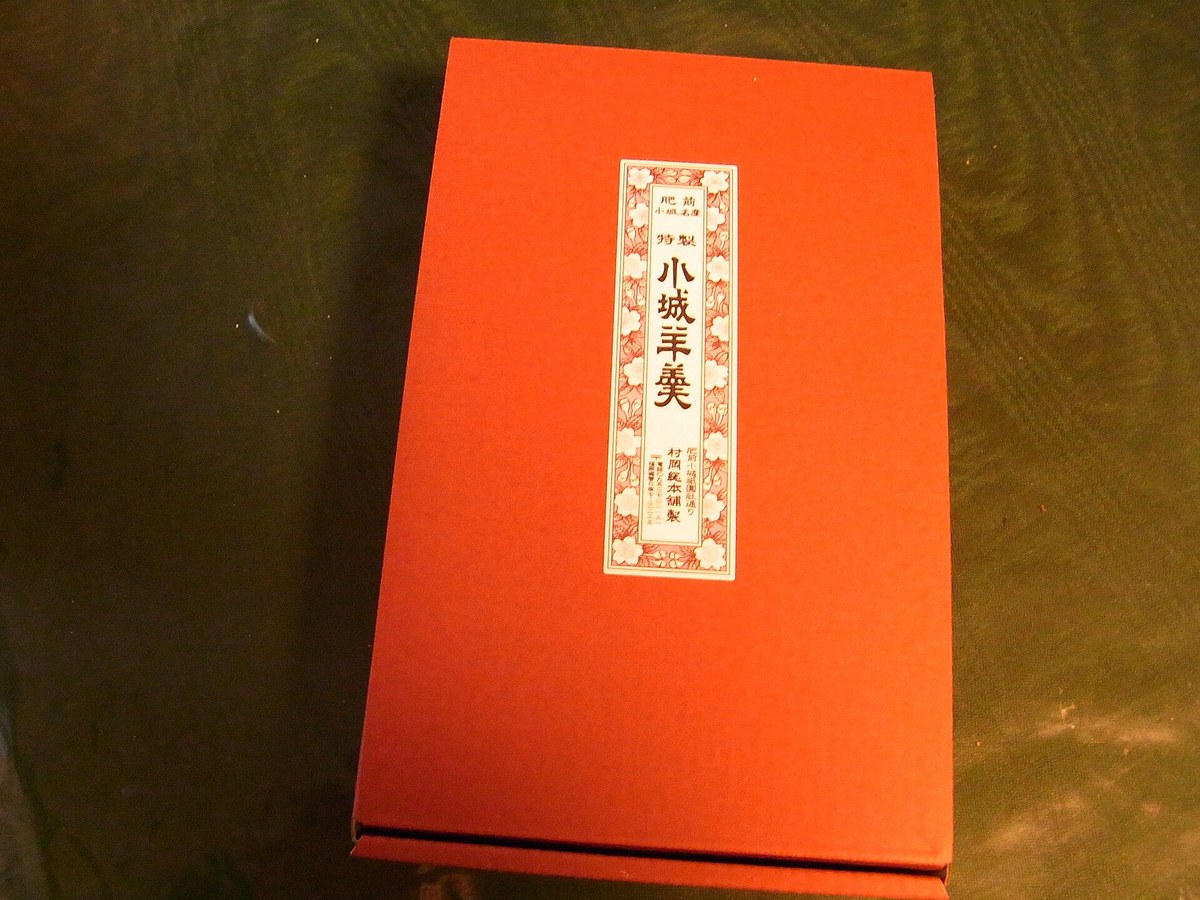
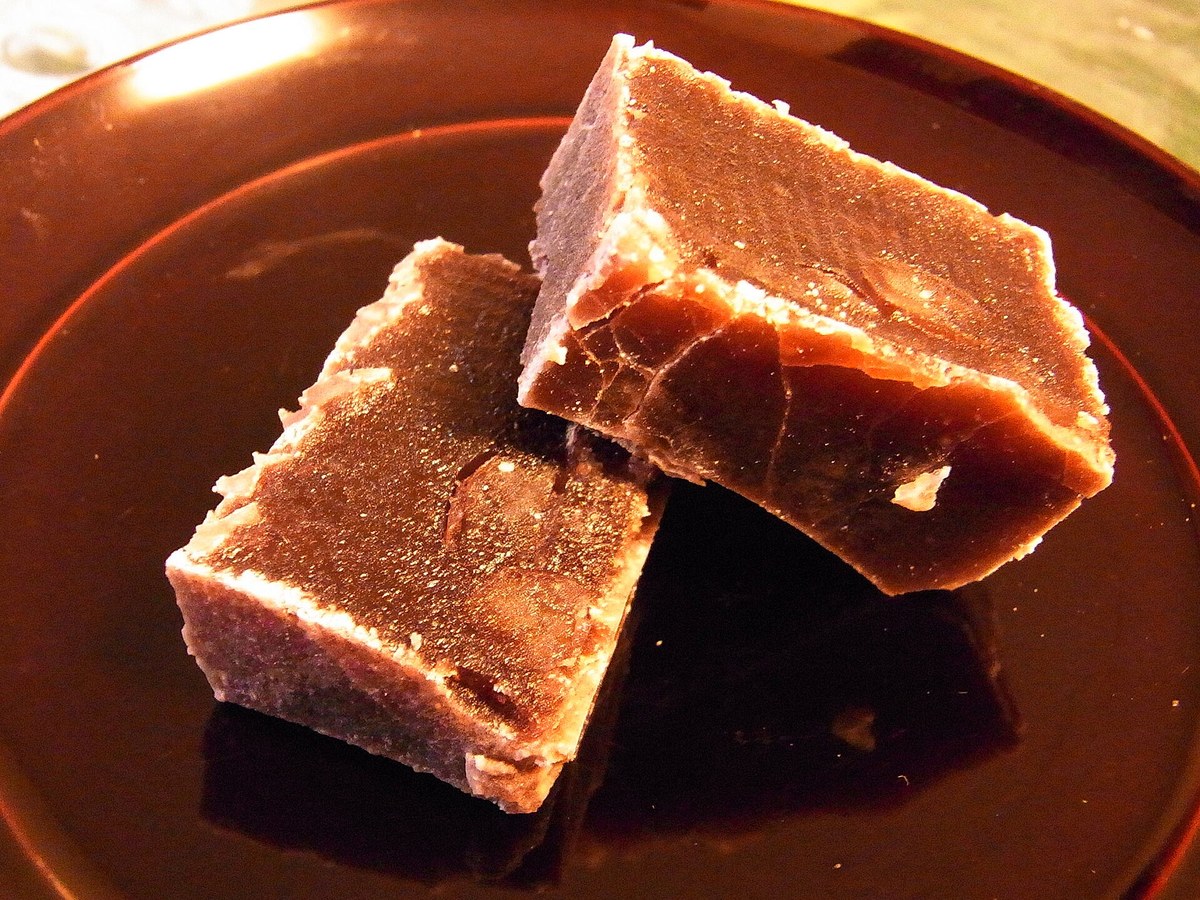
A sugar-road town of twenty-nine makers
Ogi stands on the Nagasaki Kaido, the old road that carried sugar inland from the trading port — the Sugar Road, now a Japan Heritage route, with Ogi yokan certified among its component cultural properties in 2020. The town’s yokan begins, on the account Ogi City and the Yokan Museum present, with Morinaga Sokichi around 1872: a caterer who took a hint on bean-cooking from an Osaka Toraya craftsman and worked out a yokan that kept its flavour in storage — a soldier’s and traveller’s sweet. His red Sakura Yokan was joined by white (1898) and tea (1899) bars.
By 1914 the little castle town counted twenty-nine yokan makers and some 162 tonnes a year, and the makers formed their association that year. Muraoka Yasuyoshi, who founded Muraoka Sohonpo in 1899 and is honoured as the industry’s reviver, gave the town its flagship; his son, the second president, is said to have first used the very name "Ogi Yokan". The flagship’s yokan museum — a registered tangible cultural property — still stands beside the head shop in Ogi, which is where both of this article’s photographs were taken.
Twenty-five firms, one name
"Ogi Yokan" today is a regional collective trademark, held not by one house but by the Ogi Yokan Cooperative — twenty-five member firms, nineteen of them inside Ogi City. It is a town’s name run as a town’s brand: any member may sell under it, and the method is the membership card.
The prices are a working sweet’s prices. The flagship’s official page prices its limited ao-endo bar at 1,100 yen; a fellow cooperative maker in Ogi City, Yamada Roho, sells its bars through Rakuten — a soft 400-gram bar at 1,296 yen including tax among them — and five-bar cut-yokan sets beside them. This is not a luxury confection. It is a town industry that has outlived the domain, the railway age and the sealed pouch.
Why Ogi yokan belongs to Ogi
Yokan is made across Japan, and three towns contest its honours. The article documented here is defined by a chain that exists in one town only: the Sugar Road’s sugar, an 1870s storage-proof recipe, an Edo method whose sugar crust is prized rather than prevented, twenty-nine makers at the industry’s height, and a cooperative trademark that still binds twenty-five firms to the town’s name. A bar that keeps for a year in a pouch is, by Ogi’s standard, a different sweet.
It is also a rare survival: a food whose short life is the luxury. Ogi did not modernise its yokan’s keeping qualities away, and a century and a half later the crystallising crust is the whole argument.
Sources — checked 13 November 2026
- Wikipedia — Ogi Yokan (cooperative trademark, origins and industry history)
- Muraoka Sohonpo official site — Traditional-method yokan (Tokusei Kiri Yokan)
- Rakuten — Yamada Roho (Ogi City) Ogi yokan bars and sets
Checked 13 November 2026 (stored links re-fetched and judged per product): reserved where the page says so, with an editorial review note kept per product. Press, PR and travel use stays outside the grant.
Editorial review 2026-11-13