It looks like satsuma-age and eats like nothing else in Kyushu. Obiten is the fried fish cake of Obi, the castle town of Nichinan: the day’s common fish ground whole, kneaded with tofu, miso and brown sugar, and fried without a crumb of batter. The tofu makes it soft where satsuma-age is firm; the brown sugar makes it gently sweet. It was townspeople’s food in the Edo period, and the name is now a trademark.
Fish, tofu, miso, brown sugar
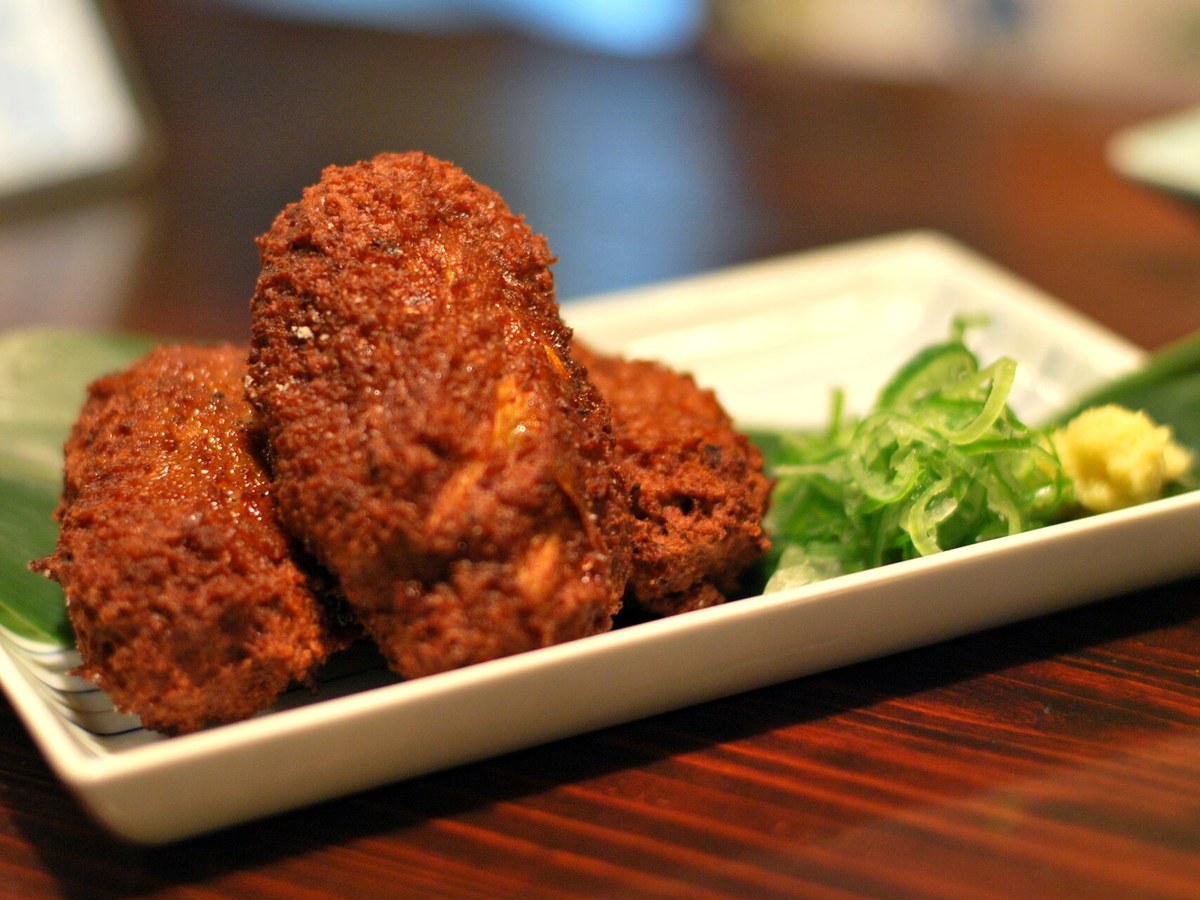
The agriculture ministry’s record for Miyazaki — its photograph provided by the maker, Ganso Obiten Honpo — lays out the paste. The fish are the common catch of the Hyuga-nada: sardine, horse mackerel, mahi-mahi, mackerel, flying fish and Spanish mackerel, ground whole into surimi. Into the surimi goes tofu, and the seasoning is miso, soy sauce and brown sugar. The paste is shaped and fried with no batter at all.
Obiten classifies as an age-kamaboko, a fried fish cake, and at a glance it is satsuma-age’s twin. The difference is in the bite: the tofu keeps it soft and fluffy where satsuma-age is dense, and the brown sugar gives it a gentle sweetness. The ministry record is firm on the serving: obiten is eaten as it comes from the oil, with no second cooking — though it is also, in Obi, a year-round side dish and a fixture of planting, harvest and sports-day tables.
A castle town invents its cake
The dish was devised by the townspeople of the Obi domain in the Edo period. Obi cooking already leaned on miso; then, in the middle of the nineteenth century, settlers from the Nansei Islands to the south began growing sugar cane around the town, and brown sugar entered the local kitchen. Obiten — fish paste sweetened and deepened with the two seasonings the town had to hand — is the taste of that meeting.
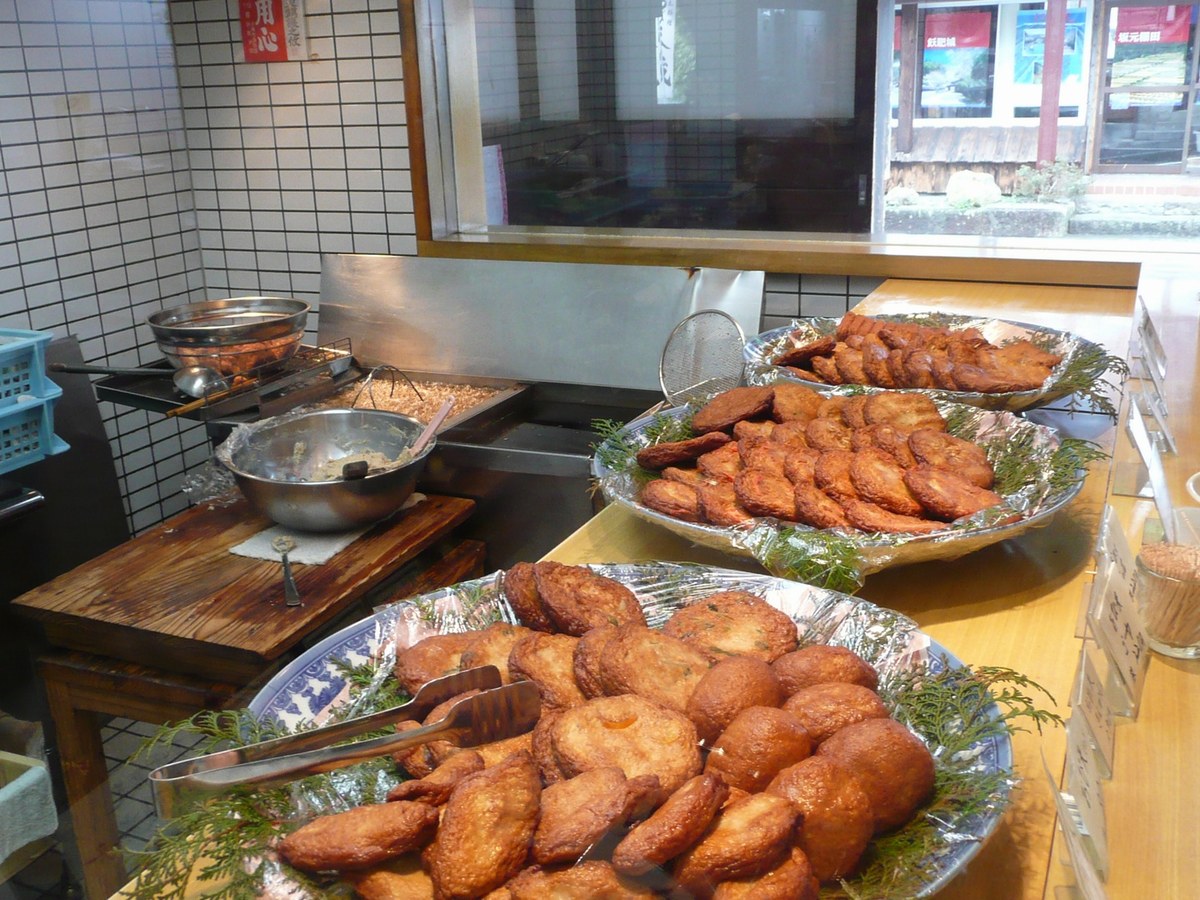
Obi is one of Kyushu’s best-kept castle towns, a grid of samurai streets under Obi Castle in today’s Nichinan City, and its restaurants still serve obiten fresh from the fryer in set meals. The second photograph in this article is the maker’s Nichinan shop, the cakes heaped on their trays; the first is a plate of them at a Miyazaki regional restaurant, crisp and dark from the oil.
One trademark, nine kinds
"Obiten" is not a generic word anyone may fry under. It is the registered trademark (No. 837659) of Ganso Obiten Honpo, the Obi maker whose own tofu — made from 100 percent domestic soy — goes into the paste with the nearshore fish and a secret dashi. The maker’s assortment runs to nine kinds: the plain cake plus shiso, burdock, red ginger, chilli, takana, shrimp, squid and cheese.
The dated record is the maker’s hometown-tax assortment on the Daimaru Matsuzakaya store: nine kinds, thirteen pieces in all — five plain obiten and one each of the eight flavoured kinds — offered as Nichinan City’s return gift at a 12,000 yen donation. In Obi itself the cakes are bought piece by piece at the maker’s shops, warm if you time it right.
Why obiten belongs to Obi
Fried fish cakes are made all over Kyushu — satsuma-age most famously, one prefecture away. The article documented here is defined by a chain that exists in one town only: the Obi domain’s townspeople’s recipe, Hyuga-nada fish ground whole, tofu in the paste, miso and Nansei-Islands brown sugar as the seasoning, no batter, and a registered trademark held by the Obi maker. A cake that leaves out the tofu and the brown sugar is a different cake.
It is, in the end, a sweet made of fish — a castle town’s pantry logic, fried. That is why it survived as Obi’s name on the map long after the domain itself was abolished.
Sources — checked 13 November 2026
- MAFF, Our Regional Cuisines — Obiten, Miyazaki (image provided by Ganso Obiten Honpo)
- Daimaru Matsuzakaya hometown-tax store — Ganso Obiten Honpo nine-kind set, Nichinan City
Checked 13 November 2026 (stored links re-fetched and judged per product): reserved where the page says so, with an editorial review note kept per product. Press, PR and travel use stays outside the grant.
Editorial review 2026-11-13