Namerou is what Boso fishermen did with the fish before the fish was even landed: fillet it on a rolling deck, lay miso and aromatics on the flesh, and chop the whole thing with the knife until it turns sticky — a mince of raw fish seasoned as it is cut. It is eaten the moment it is made, it does not keep, and its name is a boast: so good you will lick the plate.
Devised for an unsteady boat
The agriculture ministry’s Chiba record sets the scene precisely. The Boso Peninsula faces the Pacific where the Kuroshio runs; its Kazusa and Awa fishermen — the south of what is now Chiba — needed a way to cook the just-caught fish on a boat that would not hold still. The answer was to bring the seasoning into the cutting: fillet the fish, lay miso and minced aromatics over the flesh on the board, and chop everything together with the knife until the mince turns sticky and holds together.
And the seasoning itself is the sea story. It is miso, not soy sauce, for a practical reason the record gives plainly: on a rough sea soy sauce spills, while miso stays where it is put and is chopped into the fish. What began as boat logic became the dish’s flavour — the mince tastes of miso, not of the soy that seasons almost every other raw-fish dish in Japan.
So good you lick the plate — and two more stories
The name carries its own testimonial. On the ministry’s telling, it is “sara wo nameru hodo umai” — so delicious you lick the plate — worn down to namerou; and the same record keeps a second, earthier sense in the same word: the mince is so sticky it clings to the plate, so that you cannot finish it without licking it off. The encyclopedia account adds the texture itself to the etymology — the nameri, the stickiness, is in the name as well — and gives the dish its other old title, oki-namasu, the namasu of the open sea.
The fish is whatever the boat has, within a family: aji first of all, which southern Boso lands all year, and by season iwashi, sanma, tobiuo — and in home and restaurant kitchens since, katsuo and even squid. The aromatics settled as the dish came ashore: negi, ginger, shiso, sometimes myoga and sake.
Chopped until it barely keeps its shape
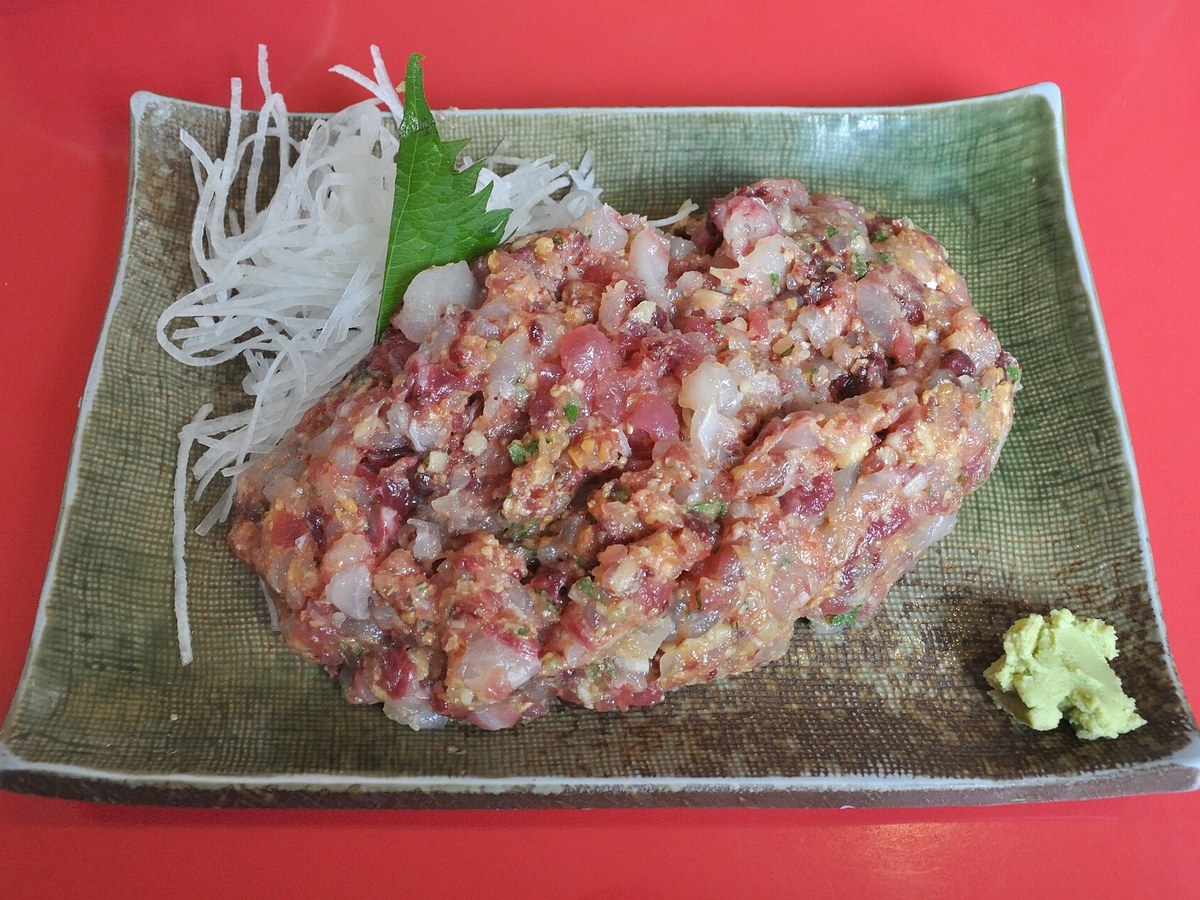
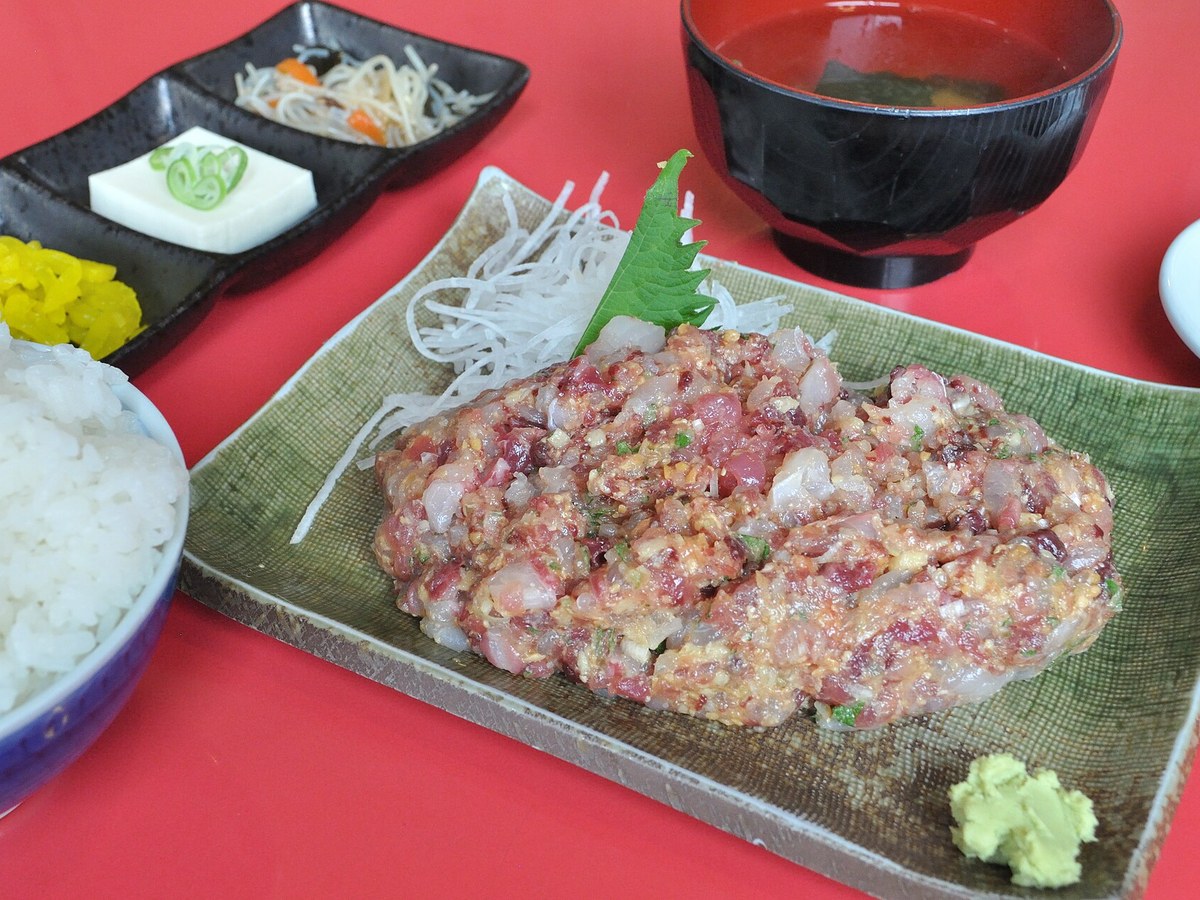
The ministry’s recipe, provided by the Chiba dietary improvement council’s “Chiba no Okazu”, portions four aji for four servings, with three to four tablespoons of grated ginger, half a long negi, four shiso leaves and two tablespoons of miso. The method is two cuts: the fish is taken to three slices, the skin pulled, and the flesh cut in one-centimetre widths; then the aromatics and miso are laid on top and the knife works until the fish almost loses its shape and the mince lifts, fluffy and sticky. That finish — neither sashimi slices nor paste, but a coarse, holding mince — is the whole technique, and the photographs show it exactly: a rough-textured mound, flecked with its aromatics.
One rule governs the eating, and the ministry states it without decoration: namerou does not keep. It is eaten fresh, immediately. There is no aged, stored or travelled form of the dish, which is why its map is still the map of the Boso fishing ports.
Raw here, grilled as sanga — and where to eat it
Grill the same mince and it changes its name: packed onto a hot plate, or into shells or leaves, namerou becomes sanga-yaki — the “mountain-house grill”, on the ministry’s adopted account, from fishermen grilling their carried-up mince in the mountain huts. The pair travel together now: the Minamiboso Namerou Research Society, founded in 2009 under Kurihara Kazuyuki of Daitokuya in Chikura — a sushi house established in 1869, now in its fifth generation — counts more than thirty restaurants and inns promoting the two dishes and developing new plates from them.
Eat it in the south of the peninsula, in Tateyama, Minamiboso and Kamogawa, where the ports land the aji. Served over rice it becomes the port cafeteria bowl: at Gyoko Shokudo Daibo, the cafeteria at Ito fishing port in Tateyama, the namerou-don is listed at ¥2,530 on the restaurant’s menu as published in October 2025. Order the plain mound first, with rice and soup beside it as the second photograph shows; the donburi is the second lesson.
Sources — checked 14 November 2026
- Namerou, Chiba — MAFF “Our Local Cuisine” record (the boat origin, the recipe, the research society)
- Namerou — encyclopedia record (the method, the oki-namasu name, sanga-yaki)
- Gyoko Shokudo Daibo (Tateyama) — the menu record with the namerou-don price
Checked 14 November 2026 (stored links re-fetched and judged per product): reserved where the page says so, with an editorial review note kept per product. Press, PR and travel use stays outside the grant.
Editorial review 2026-11-14