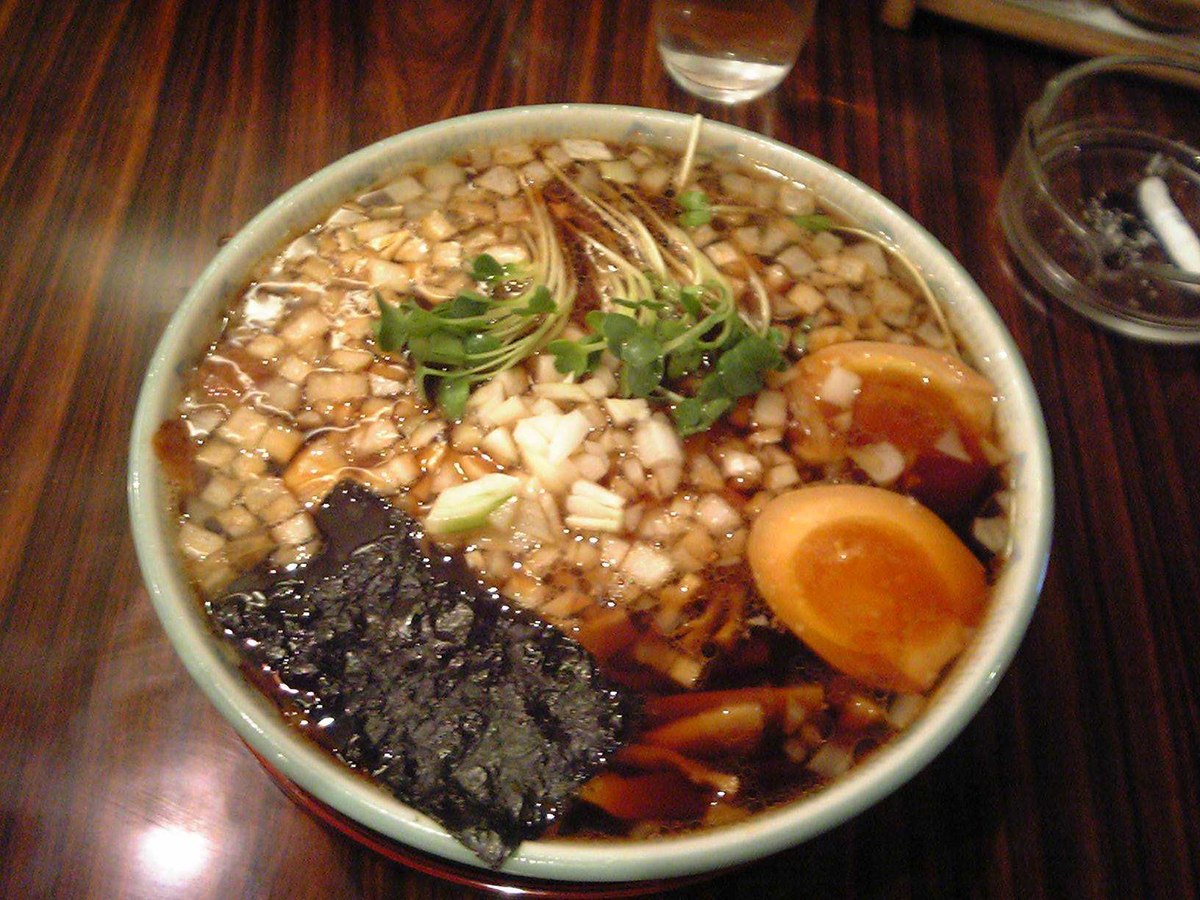
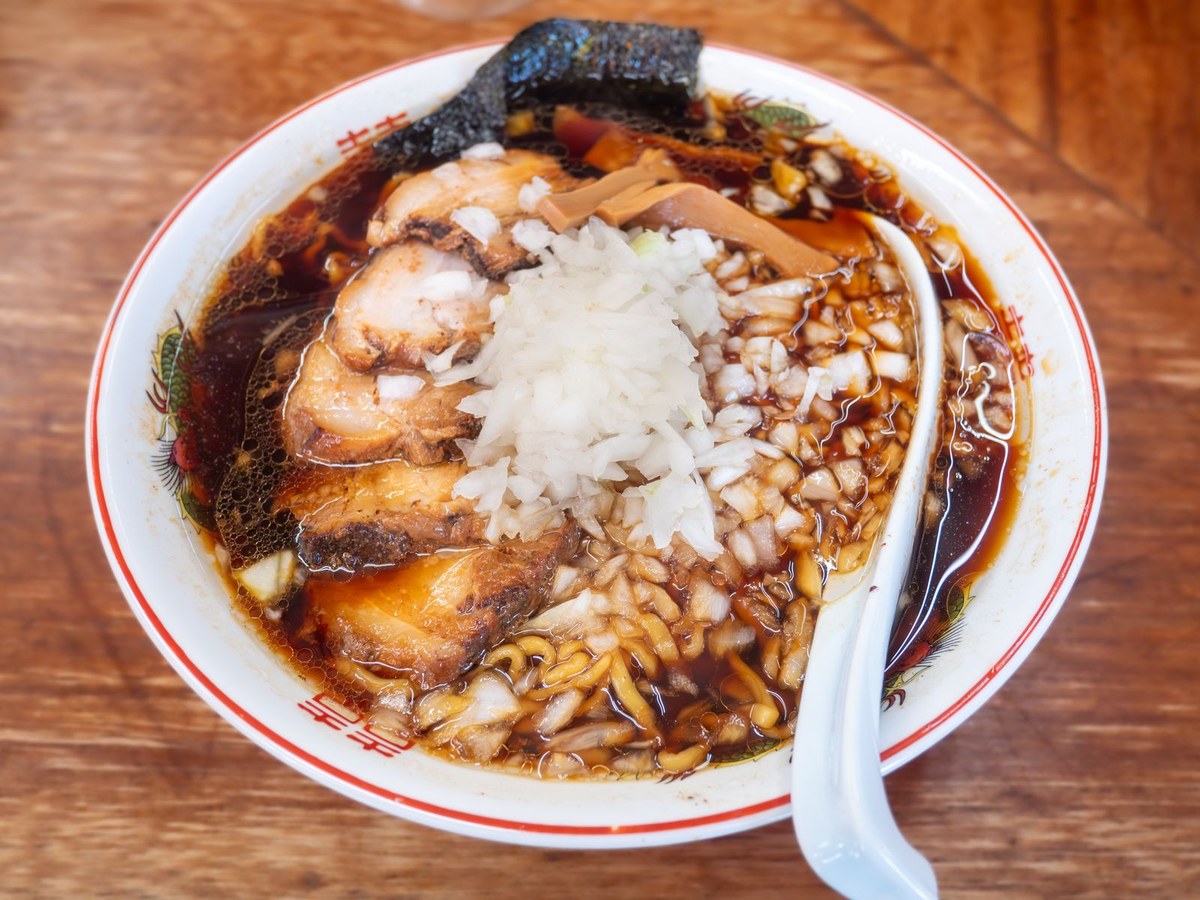
Takeoka ramen breaks ramen’s first rule: there is no stock. The soup is the soy tare the chashu was cooked in, cut with the hot water the noodles were boiled in — nothing else. It looks jet-black and drinks mellow, over dried noodles boiled in a small pot on a charcoal brazier, under a drift of diced raw onion, in a fishing town on Chiba’s Uchibo coast.
A soup with no stock in it
Every other ramen begins with a stock pot. Takeoka ramen begins with a chashu pot. The soup is made by taking the soy tare in which the pork was cooked — dark with meat juices — and cutting it with the hot water the noodles were just boiled in, or with plain hot water. That is the whole recipe, and the record states it without apology.
The result inverts its appearance: the soup pours nearly black, the colour of straight soy, but drinks mellow, because what carries it is the pork’s umami dissolved in the tare. The standard yakumi cuts across it — raw onion, diced, sharp against the fat — with a big chashu, menma and nori completing a bowl built entirely from a fishing town’s economy: nothing bought twice, nothing thrown away.
Two houses in a fishing town
The style’s origin is credited to two shops in Takeoka, a fishing town in Futtsu on the Uchibo coast: Suzuya, the older founding, and Umenoya — founded in 1954 — the house from which the style actually spread, and whose traits define what “Takeoka-style” means wherever the name is used across Chiba.
With Katsuura tantanmen and Ariran ramen, it stands as one of Chiba’s three local ramens — and it is the strangest of the three, the only one whose fame rests on an omission. The shops elsewhere in the prefecture that carry the name are imitators of these two houses or breakaways from their imitators; the encyclopedia record is careful that neither origin house stands behind them.
Dried noodles, a small pot, a charcoal fire
Umenoya’s noodle is dried — Miyakoichi’s dried noodles, chosen because any cook can boil them to the same finish every time, so the bowl’s quality never depends on who is on shift. The boiling is done in a small pot over a shichirin, a charcoal brazier, because the heat under a small pot is easy to judge and the dried noodle’s flavour comes out best that way.
The toppings follow the same practical logic: a chashu cut large because it is the soup’s source, its cooking liquid too valuable to waste; menma and nori; and the chopped onion without which the bowl is not finished. Many of the style’s imitators quietly improve on the formula — fresh noodles, a kombu dashi under the tare — and the record notes the difference plainly: those are their own inventions, not the origin houses’ bowl.
Eating it on the Uchibo coast
Eat it at the source if you can: Umenoya stands in Takeoka itself, and on the published menu record read for this story its ramen stands at ¥950 — the regular bowl already carrying several thick slices of the chashu whose tare is the soup. Order the yakumi; the onion is ordered as an extra at the origin house and regulars treat it as non-negotiable.
Go early and expect a queue, and cash. The bowl is a working port’s lunch scaled up by fame, not a restaurant production — when the day’s chashu and its tare are gone, the soup is gone with them, in the most literal sense in ramen.
Sources — checked 14 November 2026
- Takeoka ramen — encyclopedia record (tare-and-water soup, Umenoya and Suzuya, dried noodles)
- Futtsu City shop listings — menus compiled (Umenoya)
Checked 14 November 2026 (stored links re-fetched and judged per product): reserved where the page says so, with an editorial review note kept per product. Press, PR and travel use stays outside the grant.
Editorial review 2026-11-14