Mizu Shingen Mochi is a sweet made of almost nothing: the subsoil water of Mount Kai-Komagatake and the least agar that will hold it, set into a clear dome that weeps and collapses in thirty minutes. Kinseiken of Hokuto sells it only at its own shops, only in summer, only on weekends — and the world knows it as the raindrop cake.
A dome of water that holds for thirty minutes
The ingredient list is the whole recipe: water, and agar in the smallest quantity that will set it. The water is the subsoil water of Kai-Komagatake, the great peak above Hokuto, and the set is so light that the dome cannot keep itself — moisture seeps out, the shape slumps, and the sweet’s own maker sets its life at thirty minutes. It is eaten at once, where it was bought, with kuromitsu black syrup and kinako, as our two photographs show: two servings, two sauces — black syrup on one, green-tea syrup on the other, kinako beside both.
That fragility is the product. The record classes Mizu Shingen Mochi among the "shunkan gourmet" — instant gourmet — foods whose eating window is measured in minutes, and the thirty-minute limit is not a warning but the definition: a sweet engineered to be exactly as solid as water can be persuaded to be, and no more.
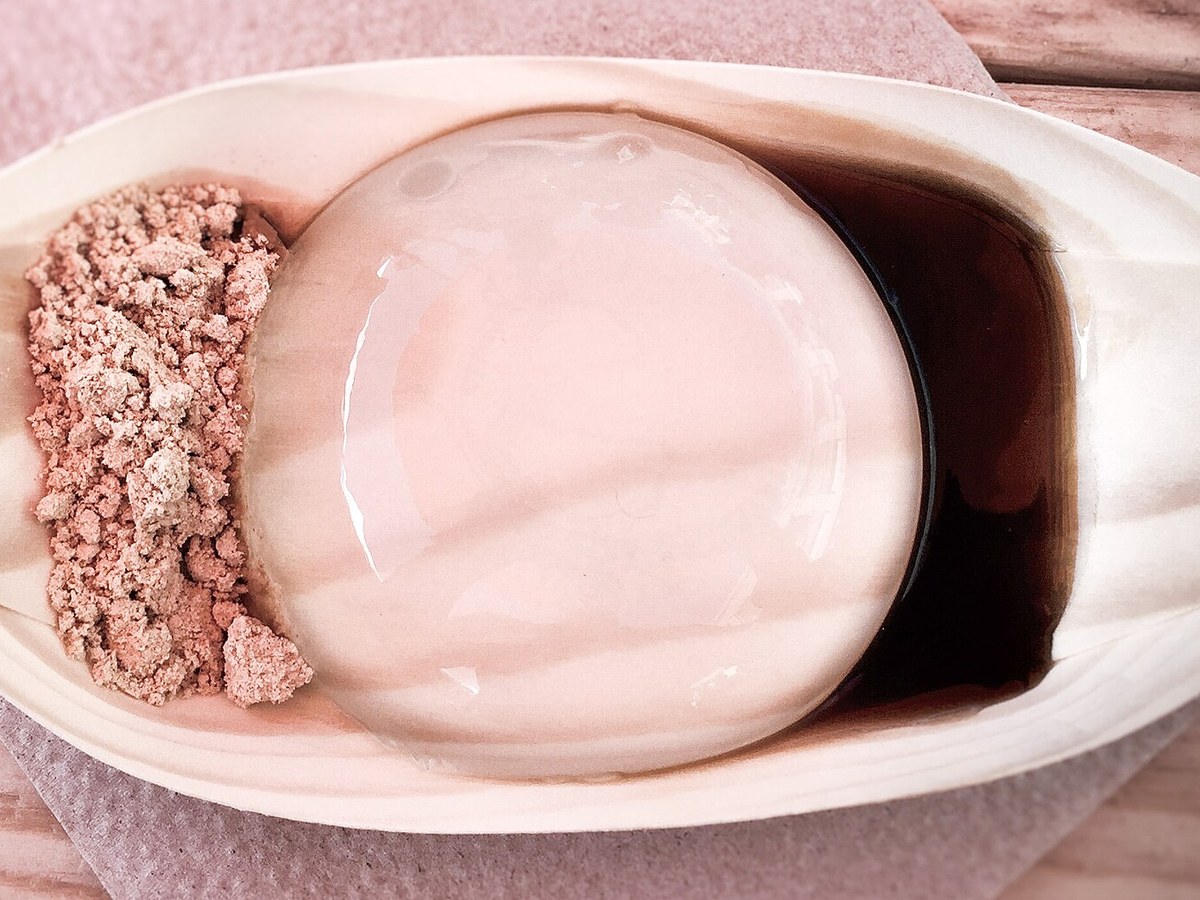
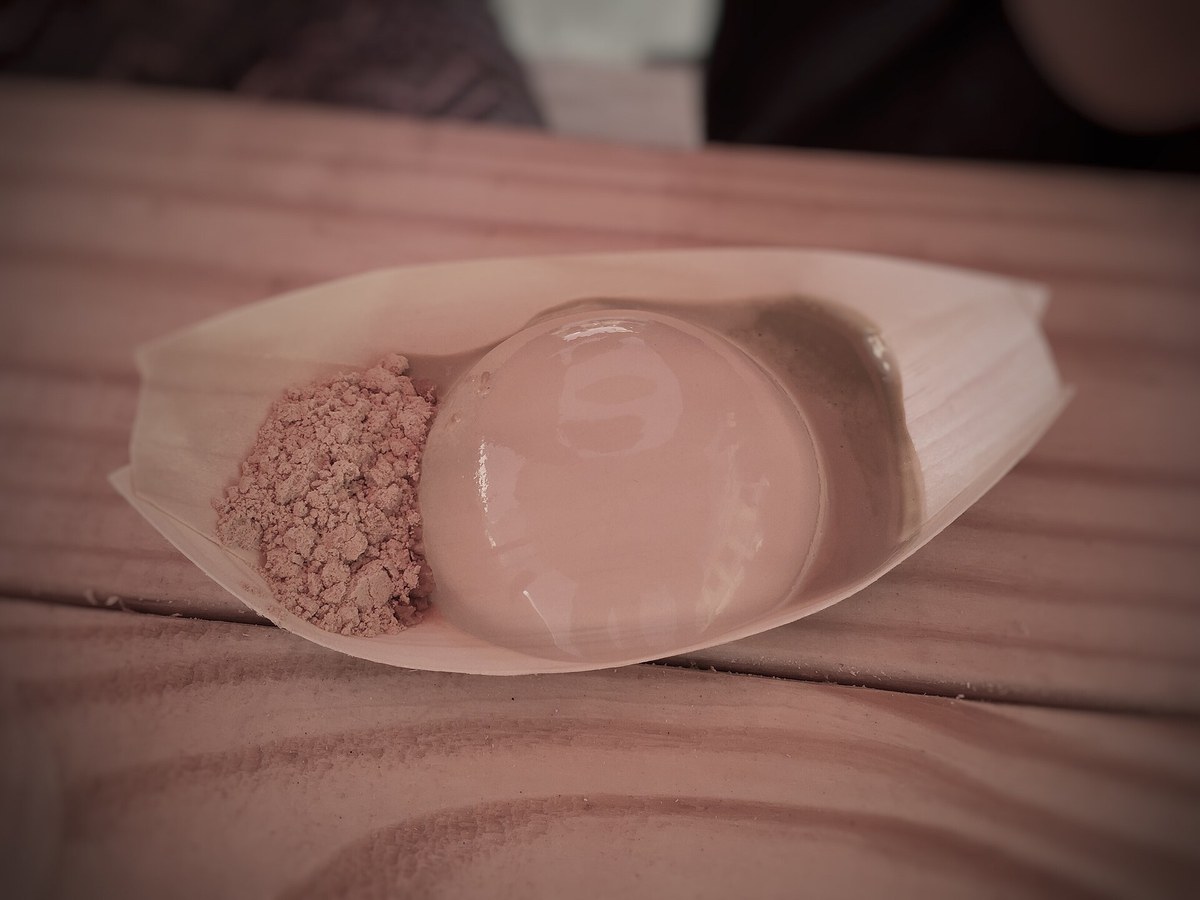
2012: a craftswoman and a glass of water
The sweet is young and its inventor is named by role: in 2012 a craftswoman at Kinseiken, the Hokuto wagashi house, set out to make the sweet that would let a person taste the district’s beautiful water in the simplest possible way. Sales began in 2013, and the dome’s photograph did the travelling — it spread on Instagram, in the first years of food photography as a social force, and a shop sweet from a mountain town became an international image.
The name is protected as firmly as the texture is not: Mizu Shingen Mochi is Kinseiken Seika’s registered trademark, registration No. 5889870 — the water branch of the Shingen mochi family this same house is known for, and a legally one-maker sweet.
The raindrop that crossed the Pacific
In New York, chef Darren Wong took the idea and rebuilt it from similar materials under a new name: Raindrop Cake, presented at the Smorgasburg food fair in April 2016 and carried by American national media. London’s Yamagoya spent four months developing its own version, and kits for making the dome at home went on sale — the imitation is documented in the encyclopedia record itself, which treats the original and the copies as separate entries in one story.
None of the copies changes where the original can be eaten. The copies travel because they must; the original does not travel at all, and that refusal is precisely what the copies were copying.
Buying thirty minutes
The rules are the shop’s own: Mizu Shingen Mochi is a summer item — in 2026 the season ran from 30 May into September — sold in principle on weekends and holidays only, and only at Kinseiken’s own counters, the Daigahara main store in Hakushu, Hokuto, and the Nirasaki store. There are no advance reservations; on busy mornings the store hands out numbered tickets, and the day’s domes can be gone by late morning.
The measured price this run is ¥660 tax included at the Daigahara main store, on the dated visit record read this run. Pay it, sit down, and eat inside the half hour: the dome you photograph at minute five is already on its way back to being water.
Sources — checked 15 November 2026
- Mizu Shingen Mochi — encyclopedia record (the Kinseiken trademark, the 2012 development, the 30-minute life, the Raindrop Cake copies)
- Daigahara Kinseiken main store — dated visit record, 2 November 2026 (the ¥660 tax-included price)
Checked 15 November 2026 (stored links re-fetched and judged per product): reserved where the page says so, with an editorial review note kept per product. Press, PR and travel use stays outside the grant.
Editorial review 2026-11-15