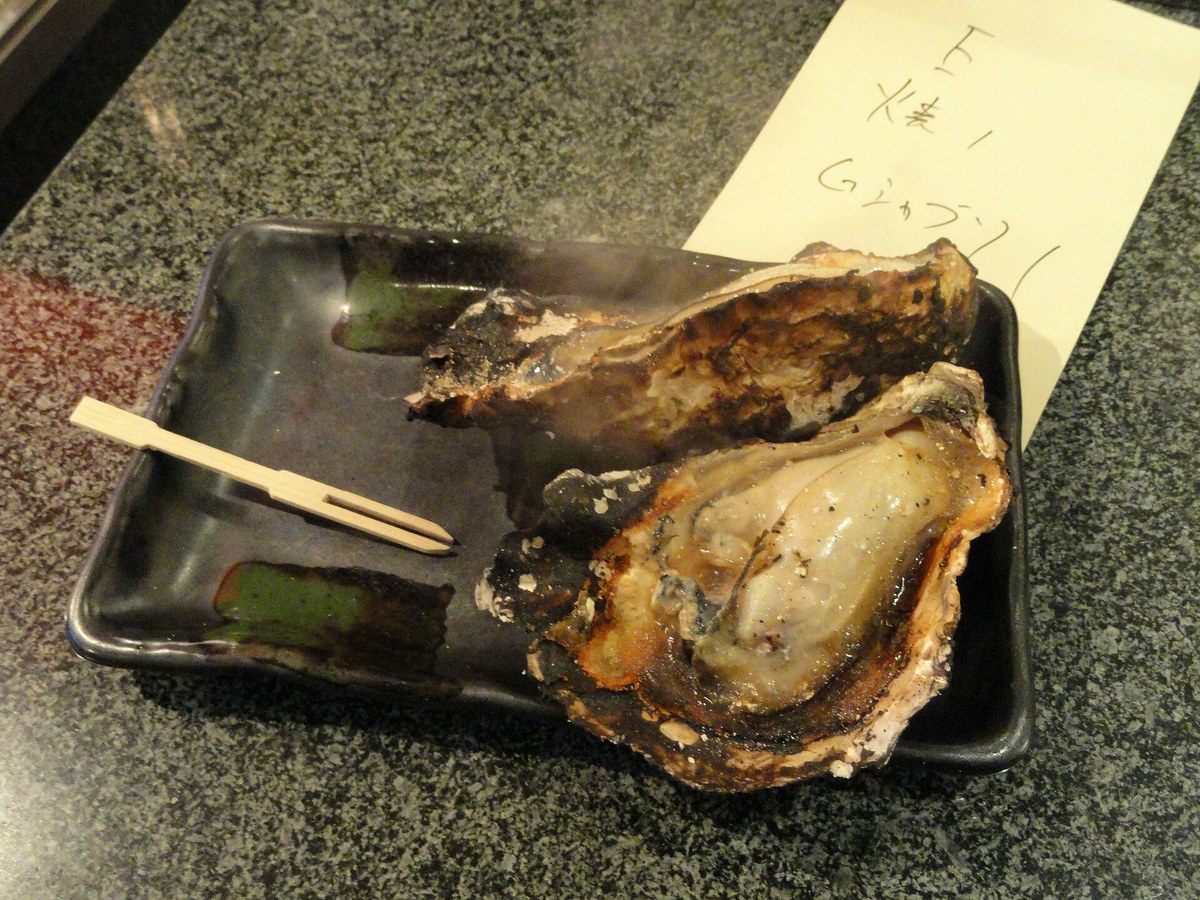
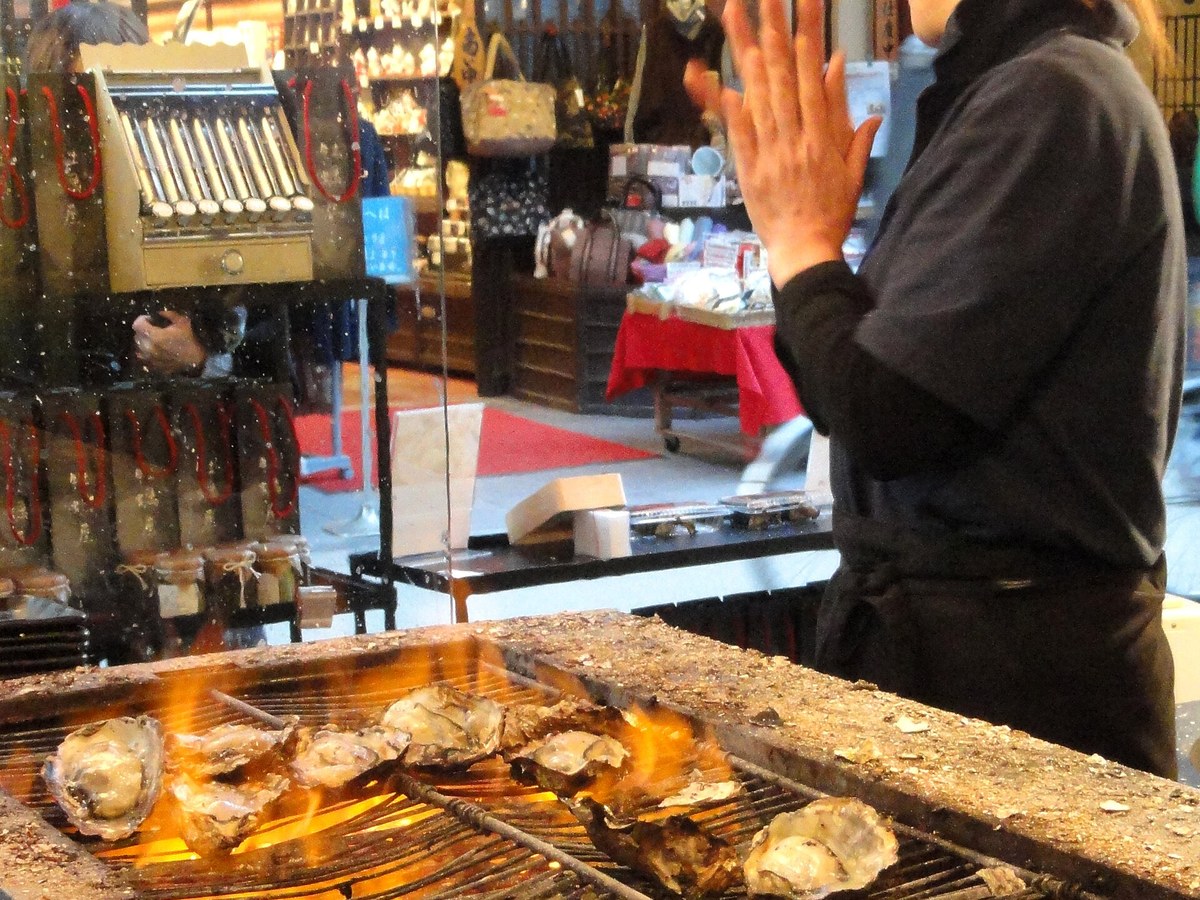
Hiroshima kaki is the most-produced oyster in Japan: a farmed magaki whose meat is large for its small shell, raised on rafts in the enclosed bays of the prefecture that lends it its name. Farming here is said to run back some 400 years, the oyster boats carried it to Osaka in the Edo period, and in winter the prefecture still eats it the way the second photograph shows it — grilled in the shell at a Miyajima stall, straight off the fire.
A bay built for oysters
The record gives Hiroshima Bay a list of gifts, and they read like a specification for oyster farming. The bay is largely closed off by islands and headlands — Etajima, Kurahashi, Itsukushima — so the water is calm and the oyster rafts rarely break. Many rivers run into it, the Ota system at their head, carrying out the silt that built the tidal flats where wild magaki always lived, and the plankton and nutrient salts the oysters feed on. In the spawning season the river water freshens the bay’s surface into the low-salt layer the oysters favour, and because the bay is closed, the larvae and the feed stay inside it instead of drifting away.
The human half of the record matches: farming began early, the castle town was close, the domain protected the fishery rights, and the prefectural fisheries station kept improving the method. The result is visible from any shore in the west of the prefecture — a sea patterned with rafts.
Four hundred years, and the oyster boats
Farming is said to have begun around the end of the Muromachi period — the oldest dated account puts an oyster-farming method in Aki in the Tenbun years, 1532–55 — and by the Edo period Hiroshima had already built the sixth industry to go with it: the kaki-bune, the oyster boats. Producer-run boats carried shell-on oysters to Osaka, shucked them in front of the customer, and cooked on board; the Kusatsu and Niho boat guilds held the Osaka trade between them for most of the period, and dishes from kaki dotenabe to kaki-meshi were devised on those boats.
The modern leap came from the raft. Hanging culture was trialled by the prefectural station in 1926 in the Ono strait by Miyajima, and after the station developed a typhoon-strong bamboo raft in 1953 the raft method spread fast — the grounds could move offshore and stack the sea in three dimensions, and production rose to the level that has kept Hiroshima first in Japan ever since. Kure City, on the record, is the single top-producing municipality in the country.
Small shell, large meat — and Kaki Komachi
The eating reputation is precise: for a small shell, the meat is large, plump and rich. More than ninety percent of domestic oysters are eaten shucked, so the shucking — kaki-uchi, done in Hiroshima with a small pick-like tool rather than a knife — is part of the product: a practised shucker opens an average of some 3,200 oysters in an eight-hour day on the record, and the prefecture has regulated the hygiene of the trade since 1932, with designated sea areas for raw eating and weekly testing.
The season used to close in the months without an R. The prefecture’s own answer is Kaki Komachi, a triploid oyster developed at the prefectural marine technology centre: it does not spawn, so the meat does not thin in summer, it grows to about one and a half times ordinary size, and it lets Hiroshima ship all year. Around it stand the named brands — Jigozen kaki from the shore opposite Miyajima, Miyajima kaki from the island’s own ground, and the single-seed lines such as Aki no Hitotsubu.
Grilled on Miyajima, or in a winter hut
Eat them where the photographs were taken: on Miyajima, where the grill stalls on the shrine approach serve yaki-gaki in the shell all year. At Yakigaki no Hayashi — founded in 1948 and the self-described first grilled-oyster shop — two grilled oysters, three-year-old stock from Jigozen steamed and grilled with the shells shut, cost ¥1,500, and only forty to fifty servings a day are grilled, so the queue forms before opening. The island’s kaki also go into kaki-meshi, kaki fry and the miso-edged dotenabe the oyster boats devised.
In the city, the winter form is the kaki-goya, the oyster hut: you buy shell oysters by the plate and grill them yourself over charcoal. At Kaki-goya Ujina by Hiroshima Port, open from 10 October to early May for the 2026–27 season, shell oysters are ¥1,320 a plate with a ¥600 charcoal fee per table — and the first kilogram is roughly ten to twelve oysters in the shell.
Sources — checked 14 November 2026
- Hiroshima kaki — encyclopedia record (the bay, the boats, the rafts, Kaki Komachi)
- Hiroshima oyster-hut comparison 2026–27 — Ujina and Miyajima prices, checked against the shops’ official pages (6 October 2026)
Checked 14 November 2026 (stored links re-fetched and judged per product): reserved where the page says so, with an editorial review note kept per product. Press, PR and travel use stays outside the grant.
Editorial review 2026-11-14