Every colour in a Hakone yosegi box is a tree. Not a stain, not a lacquer — the wood itself, species by species, glued into a patterned block and then planed off in a sheet thinner than a postcard. The craft has been Hakone's since the last years of the Edo period, and its home hamlet, Hatajuku, still smells of cedar shavings.
Founded in Hatajuku, designated in 1984
The maker Kiro's own history, read on its site, places the founding in the Hatajuku area at the end of the Edo period. The early work was muku — solid-wood pieces in ran-yosegi scatter patterns and unit-pattern work. Continuous patterns followed: ko-yosegi, in which small unit patterns repeat across a whole surface, became the mainstream, and in early Showa a maker developed the defining trick — zuku, planing the assembled pattern block with a great plane to shave off the pattern itself as a flexible sheet, which could then skin any object. In May 1984 the craft was designated a traditional craft by the Minister of International Trade and Industry; the association's list fixes the date as 31 May 1984, item 147.
The technique has been handed down in Odawara and its neighbourhood since the Edo period, on the checked area guide's account — Hakone's mountain inns and Odawara's castle town were the two ends of the traveller's road the boxes were sold along. The most famous child of the craft is the himitsu-bako, the secret box that opens only through a hidden sequence of sliding panels; a checked guide credits its creation to Okawa Ryujiro in the late nineteenth century, and it remains the craft's signature object.
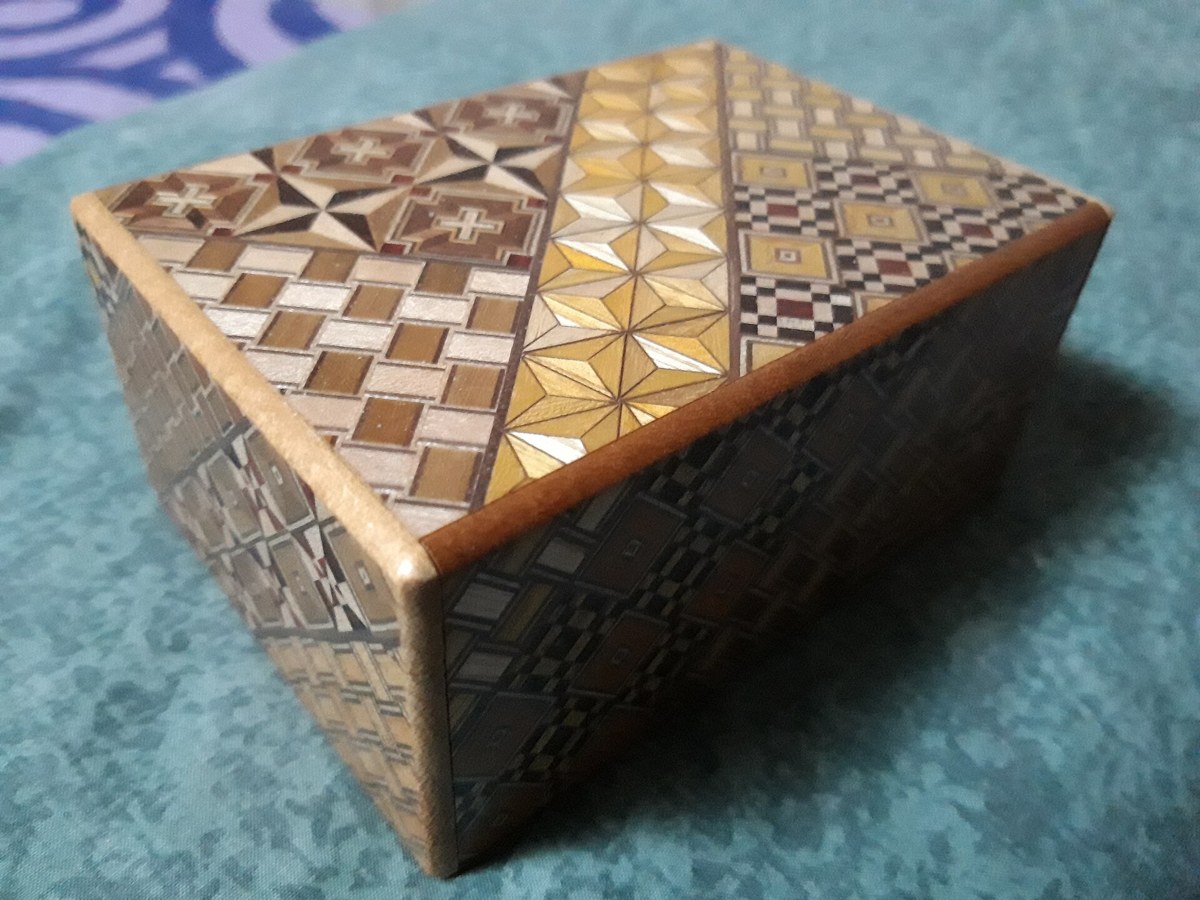
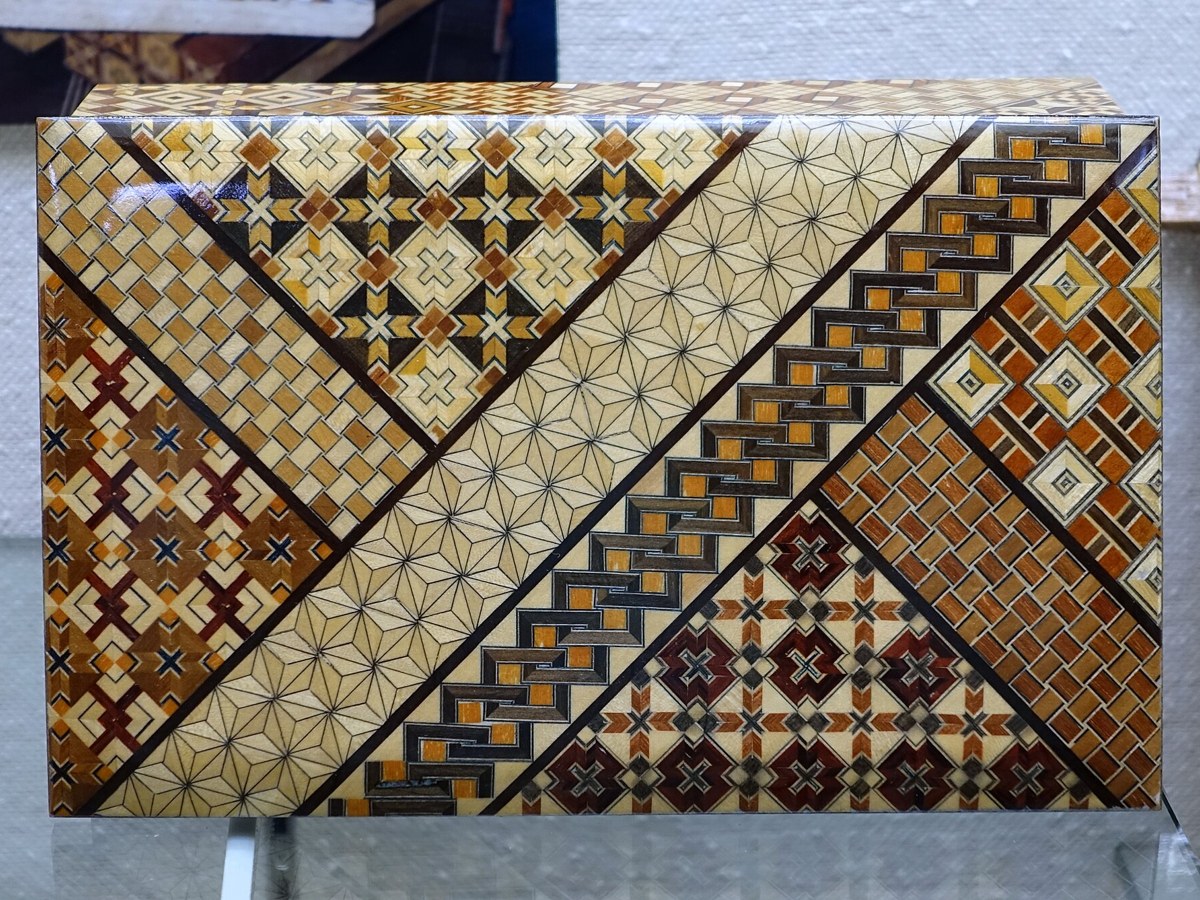
Eight steps, no dye
Kiro lists the making in eight steps, and the list is worth following because the whole craft is in it. First, natural coloured woods are glued together toward the intended pattern. The stack is sawn and planed true. Pattern parts are assembled and glued into a unit pattern — one motif, complete. The dried unit is sliced to a set thickness, and several blocks are combined into a continuous pattern. Then the great plane comes down: the continuous pattern is shaved to 0.15mm — that shaving is the zuku. The zuku is applied to the object, a small box or tray, and the surface is finished with a protective coat.
Nothing in those eight steps adds colour. The Hakone mountains, on the maker's account, carry one of the richest ranges of tree species in Japan, and the craft is a way of spending that range: pale, dark, red and grained woods set side by side until geometry appears. A yosegi surface that looks printed is, at 0.15mm, quite literally a slice of assembled forest.
What it costs to hold — and to make
The honest entry price is at the craft's own hall. The Hatajuku Yosegi Hall, at 103 Hatajuku in Hakone — the first hall of its kind on the guide's account — is free to enter, and its workshop lets you assemble your own yosegi coaster for ¥800, reservation required, between 9:00 and 16:30. The hall's shop carries the craft's working range: vessels, picture frames, toys and accessories alongside the boxes.
Finished work runs from small, simple puzzle boxes at around ¥2,000 to larger or complex pieces above ¥30,000, in the shops of Hakone-Yumoto, Gora and Miyanoshita on the checked guide's readings; specialist shops like Hatajuku's Kiro carry their own originals beside the traditional lines. Kanagawa's standing stories are a Yokohama shiumai, a cup-noodle workshop and a museum's goods — all eaten or experienced. Yosegi is the prefecture's first craft you can hold: the one that stays on the shelf.
Reading a box before you buy it
Two questions sort the shelf. Is it zuku or muku? A zuku piece wears its pattern as a skin over a plainer body — lighter, and the standard form for boxes and trays; a muku piece is patterned solid wood all the way through, heavier and priced like it. And how many woods can you count? The cheaper patterns repeat two or three tones; the fine ones keep resolving into more species the closer you look.
Then open the secret box — or try to. The shopkeepers expect it, and the mechanism is the craft's argument in miniature: nothing hidden is electronic or even metal, just wood sliding on wood, cut so exactly that the sequence feels like a combination lock. Hakone has sold that small astonishment to travellers for well over a century.
Sources — checked 10 November 2026
- Kiro (Hakone yosegi specialist shop): the craft's history and making (maker's own site, Japanese)
- Traditional Craft Association: designated items list (official association list)
- Hakone Jiyujin magazine (Hakonemag): Hatajuku Yosegi Kaikan (Hakone Town's hall, magazine account)
- JOC Japan Travel: Hakone himitsu-bako, the art of Japanese puzzle boxes (checked guide)
Original prose and official links only; no source text or maker media reproduced. Photos are credited Creative Commons works, not product photographs.
Editorial review 2026-11-10