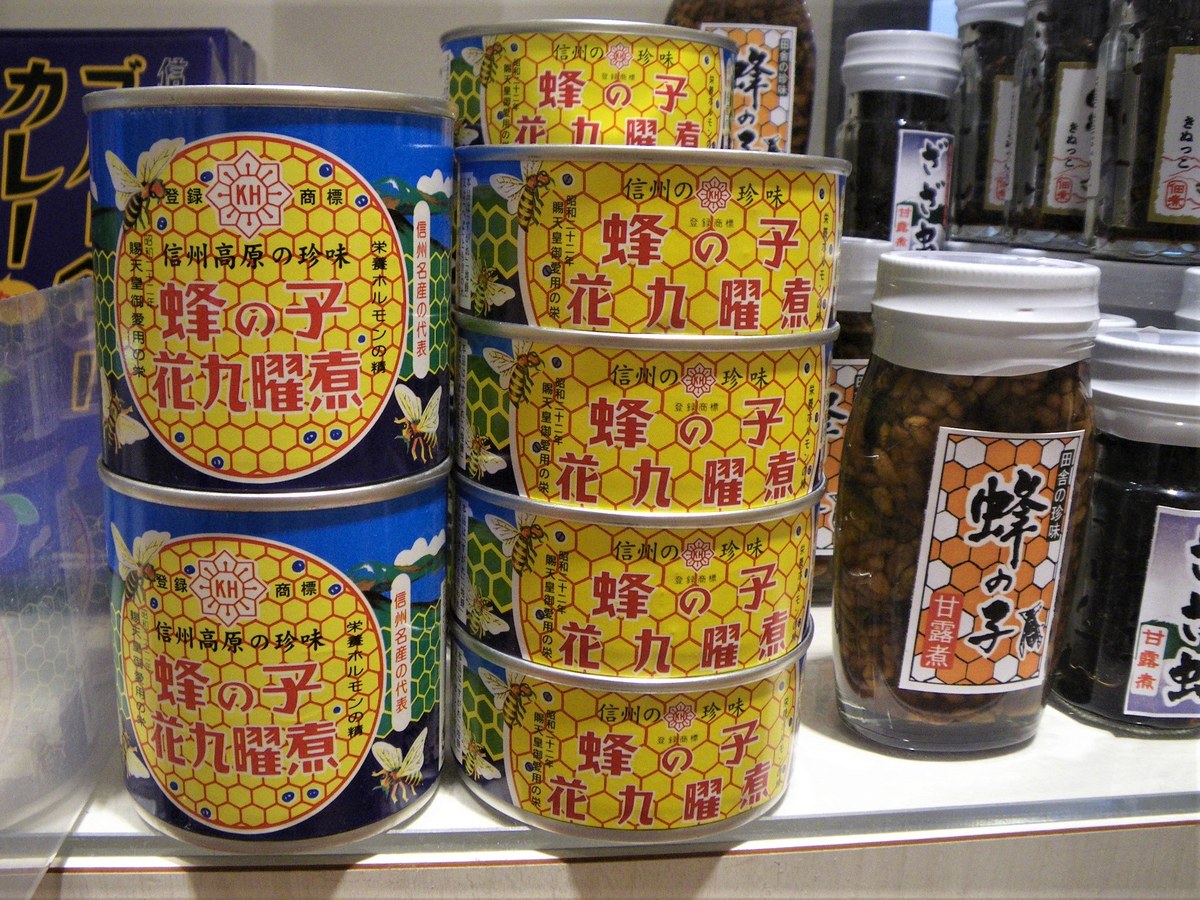
Hachinoko — wasp larvae and pupae — is the mountain delicacy Nagano hunts on foot. In the Ina valley the ground wasps are called sugare, the autumn chase after their nests is sugare-oi, and the catch comes home to be simmered sweet and canned under names like Hana-Kuyo-ni. Our photographs are the food as Nagano actually sells it: cans and bottles on an Ina grocery’s shelf.
Larvae, simmered sweet
Hachinoko is the brood of bees and wasps — larvae, and pupae with them — and in Japan it means above all the small ground wasps, kurosuzumebachi and its kin, whose nests sit in the soil of the mountain districts. The encyclopedia record lists Nagano first among the prefectures where the food holds, and Nagano’s own word for the ground wasp is sugara, sugaru, sugare — the name the Ina valley’s whole culture of the food runs under.
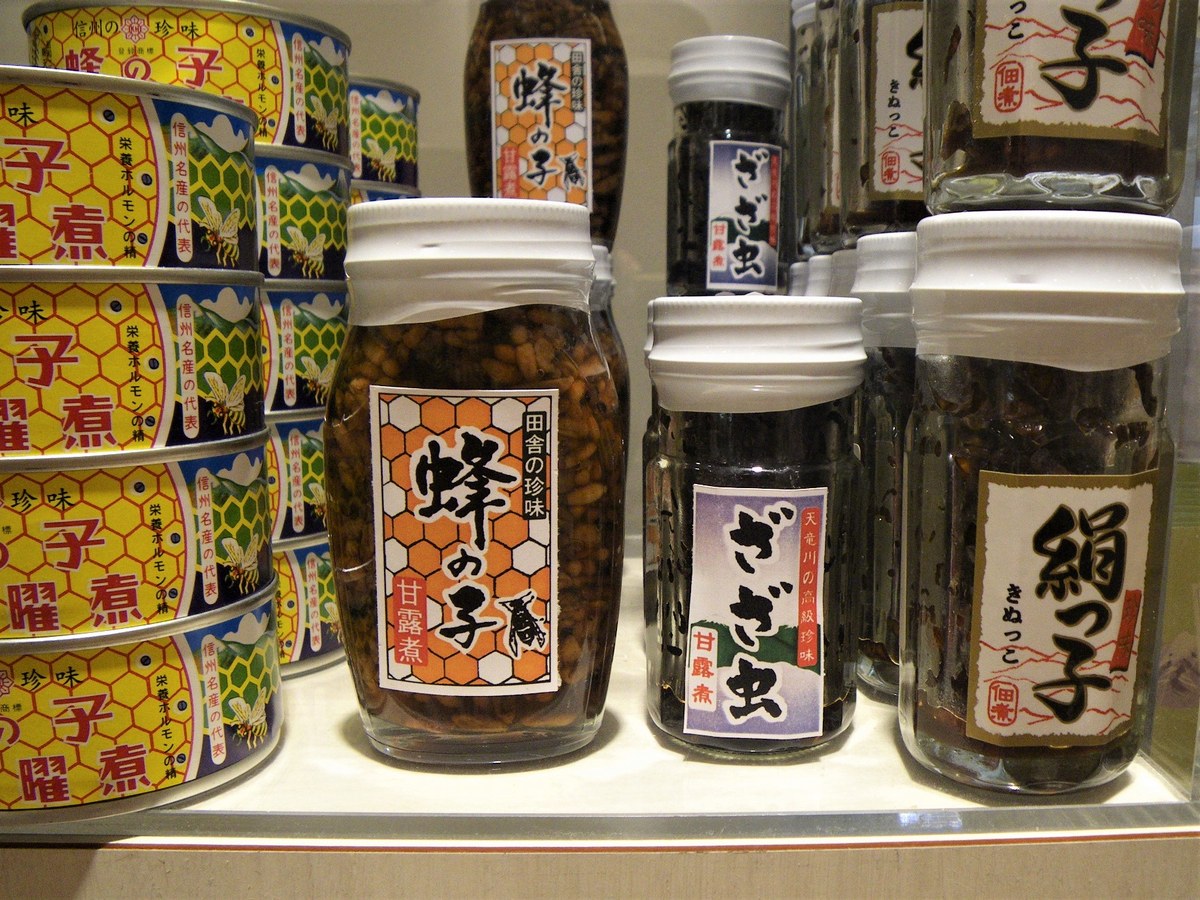
The eating form is preservation: the larvae simmered sweet as kanro-ni or tsukudani and put up in cans and bottles, exactly the goods stacked in our photographs at a grocery in Ina — Harada Shoten’s Hana-Kuyo-ni cans to the left, bottled hachinoko beside the valley’s other insect jars. It is classed a high-grade delicacy, and the price record below shows what that means at the till.
Sugare-oi: following a wasp home
The hunt is the tradition. In autumn — the season — hunters bait a worker wasp with meat; while it feeds, they fix a marker to it, today often a strip of cut plastic bag, light and easy to see. Released, the wasp carries its meat home, and the hunters follow, round after round, until the nest is found and dug. In Nagano the chase is called hachioi, and in the Ina valley, sugare-oi; it began as children’s play and is now the pursuit of adult devotees.
The dedication goes as far as equipment: Nagano sells a dedicated wasp-hunting smoke cartridge, made with extra sulphur, for the work at the nest. A second road to the same food is husbandry — a small nest found in early summer is brought home and raised in a purpose-built box until autumn.
One shelf of the mountain pantry
Our second photograph is the context the encyclopedia itself uses as its reference for the food’s sale form: an Ina grocery’s insect shelf, labelled left to right — hachinoko, zazamushi (the caddisfly larvae of the mountain rivers) and kinukko, silkworm pupae. Nagano’s mountain pantry is a shelf of neighbours, and hachinoko is its first jar.
The food is not Nagano’s alone, and this page does not pretend otherwise: Gifu’s Tono district cooks its ground wasps — hebo there — into hebo rice and bottles them sweet too, and the custom runs through Japan’s mountain country. Nagano’s claim is the density of the culture: its own name for the wasp, its own name for the chase, its own smoke cartridge, and the valley groceries where the cans are ordinary shelf stock.
Buying the cans
The practical way in is the can in our first photograph: Harada Shoten’s Hachinoko Hana-Kuyo-ni, a 65 g can of seasoned wasp brood, listed at ¥1,904 tax included on the mail-order record read for this page — delicacy pricing for 65 grams, and the listing warns that supply is irregular as wasps decline. A Shinshu shop’s 60 g kanro-ni at ¥2,200 sits in the same band.
Eat them as the valley does: straight from the can as a drinking snack, or folded through rice. The cans keep, travel, and carry the whole story — hunt, nest, simmer pot — in a form a first-timer can actually open.
Sources — checked 14 November 2026
- Hachinoko — encyclopedia record (the sugare name, the sugare-oi hunt, the Nagano cans)
- Harada Shoten Hachinoko Hana-Kuyo-ni 65 g — d Shopping price record, checked November 2026
Checked 14 November 2026 (stored links re-fetched and judged per product): reserved where the page says so, with an editorial review note kept per product. Press, PR and travel use stays outside the grant.
Editorial review 2026-11-14