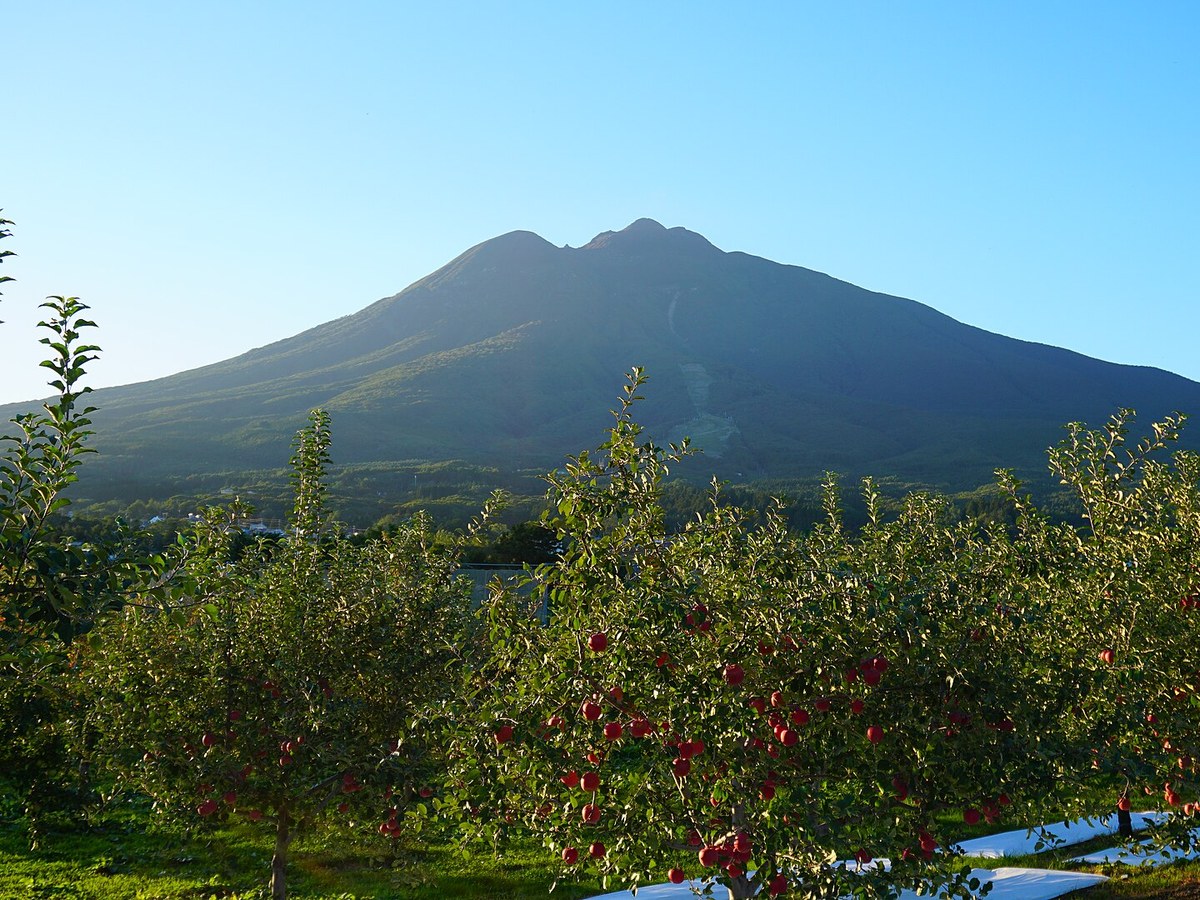
Stand in Hirosaki in October and the arithmetic of Japanese apples is visible from the road: orchard rows running to the foot of Mount Iwaki, and more than half of every apple eaten in Japan behind them. The government's Highlighting Japan feature records Aomori as the country's largest apple producer at nearly sixty percent of domestic output, and the prefecture's own guide puts its orchard land — 21,400 hectares in 2012 — as the largest in Japan. This is the story of how a job-creation scheme for disbanded samurai became a one-prefecture industry, and of the cultivar Aomori bred for the world: Fuji, developed in the prefecture's Fujisaki town and now about half of everything the orchards pick.
Work for the samurai, trees for the north
Apple cultivation in Aomori was promoted after the Meiji Restoration of 1868 as employment for former samurai, who turned to work considered suitable to their station; the climate did the rest. The trees are sensitive to heat, so Aomori's cool summers fit them, and the prefecture's large day–night temperature swings are credited with fostering remarkably sweet fruit.
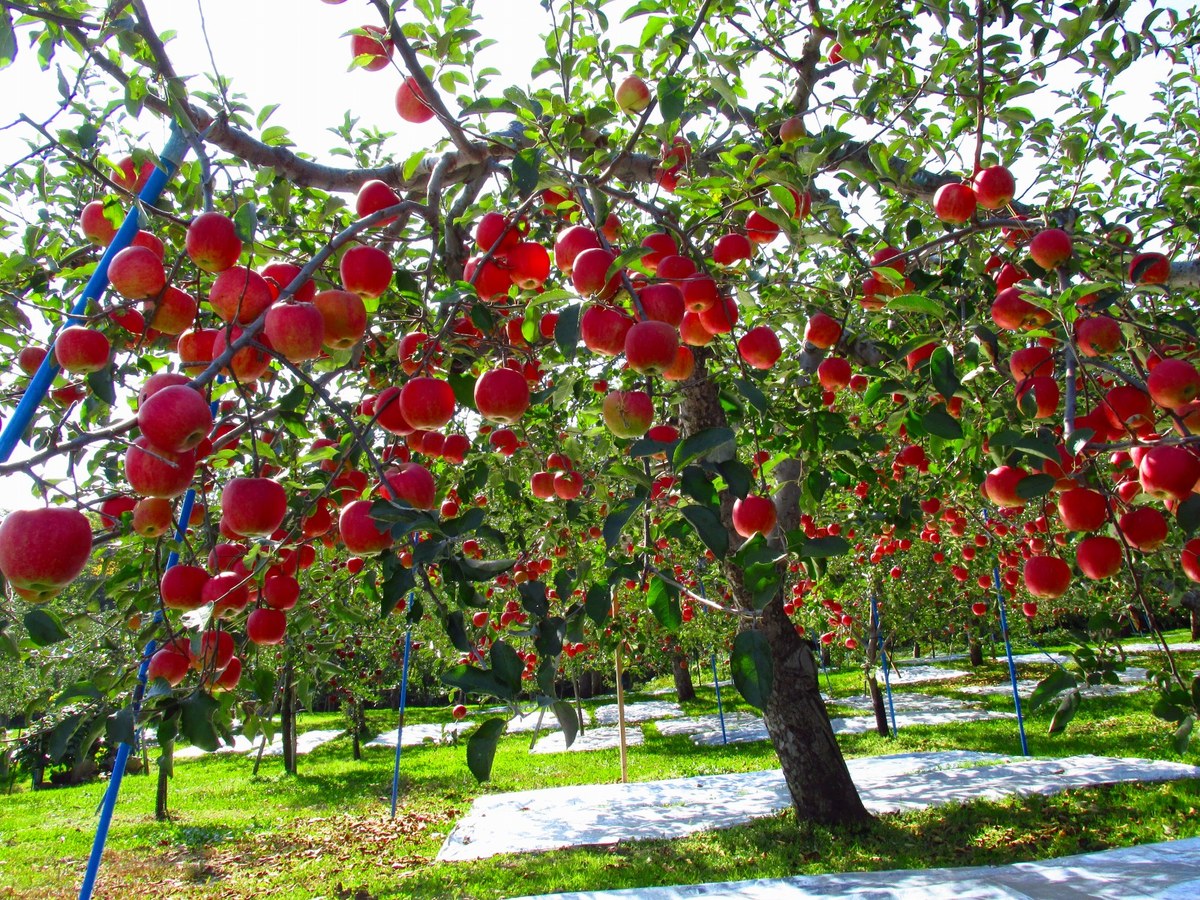
The geography concentrated into a genuine heartland. The prefecture's official travel guide lists the production areas — Hirosaki, Aomori City, Hirakawa, Kuroishi and Fujisaki Town among them — and records 446,000 tons in 2012, about 56 percent of the domestic market, from Japan's largest apple farmland at 21,400 hectares. The government's feature, four harvests later, puts production at 470,000 tons and the share at nearly sixty percent: the exact figure moves, the position at the top does not.
Sixty percent of a nation's apples
The scale shows most clearly at the border. Highlighting Japan records that apple exports from Japan began as early as 1899, and that in 2015 they reached a record 36,304 tons — of which Aomori supplied more than 90 percent; the prefecture's guide gives the same 90 percent for 2012. Taiwan is the largest market, where, the government feature notes, vivid red Aomori apples are treated as auspicious and given as New Year gifts, a use that rewards exactly the colour and shine careful orcharding produces.
About fifty varieties are grown across the prefecture, a bench deep enough that Hirosaki Apple Park — the city's orchard park — keeps over 1,300 trees of 65 varieties for visitors to compare. The breadth matters commercially as well as horticulturally: a prefecture that grows half a nation's apples needs early, mid and late fruit, keepers and eaters, reds and greens (the yellow-green Ourin is Aomori's other famous name), rather than a single bet on one variety.
Fuji, the hometown cultivar
The flagship, though, is one variety. Fuji was developed at the Tohoku Research Station in Fujisaki — a town inside Aomori's own apple country — in the late 1930s, a cross of Red Delicious and Virginia Ralls Genet, and brought to market in 1962. The cultivar record is held by Yale University's Nature Walk; the government feature adds the orchard-level facts: Fuji is juicy, sweet and fragrant, it stores for a long time, and it now accounts for about half of the prefecture's production.
That last trait — storage — is what turned a regional apple into a national default. A variety that keeps well can be picked in Aomori in autumn and sold across Japan for months, which is why the boxes in the practical panel below are not a seasonal curiosity but a standing offer: sugar-selected Fuji, graded and shipped by the postal shop like everything else Aomori sends south.
Sorted by sweetness, sold by the box
The grading is industrial. The prefecture's guide describes the sorting facilities visitors can tour, where 200 apples a minute are sorted by sugar and acid content — sweetness measured fruit by fruit rather than judged by eye. That machinery is what the retail grades rest on: the Japan Post online shop's apple page offers Aomori Fuji selected at 13 degrees of sugar content or more, and, above it, a Hirosaki 'ultimate' ripe Sun Fuji gift set — two readings of the same orchard, one for the table and one for the gift season.
Buying from abroad, the practical routes are the postal shop's apple category (Japanese-language, domestic delivery), the gift sets that department-store and hometown-tax (furusato nozei) catalogues carry each autumn, and the orchard shops around Hirosaki itself in season. What to check on any listing: the prefecture of origin, the variety, and the selection grade — 'Aomori Fuji, sugar-selected' is the complete form of the name, and each of its three parts is doing work.
Sources — checked 11 November 2026
- Highlighting Japan (Government of Japan) — “Open Orchards”, November 2016
- Amazing AOMORI — official Aomori travel guide, apples page
- Yale Nature Walk — Fuji Apple (cultivar record)
- Japan Post Shop — apple category (checked 11 November 2026)
Original prose and official links only; no source text or maker media reproduced. Photos are credited Creative Commons works, not product photographs.
Editorial review 2026-11-11