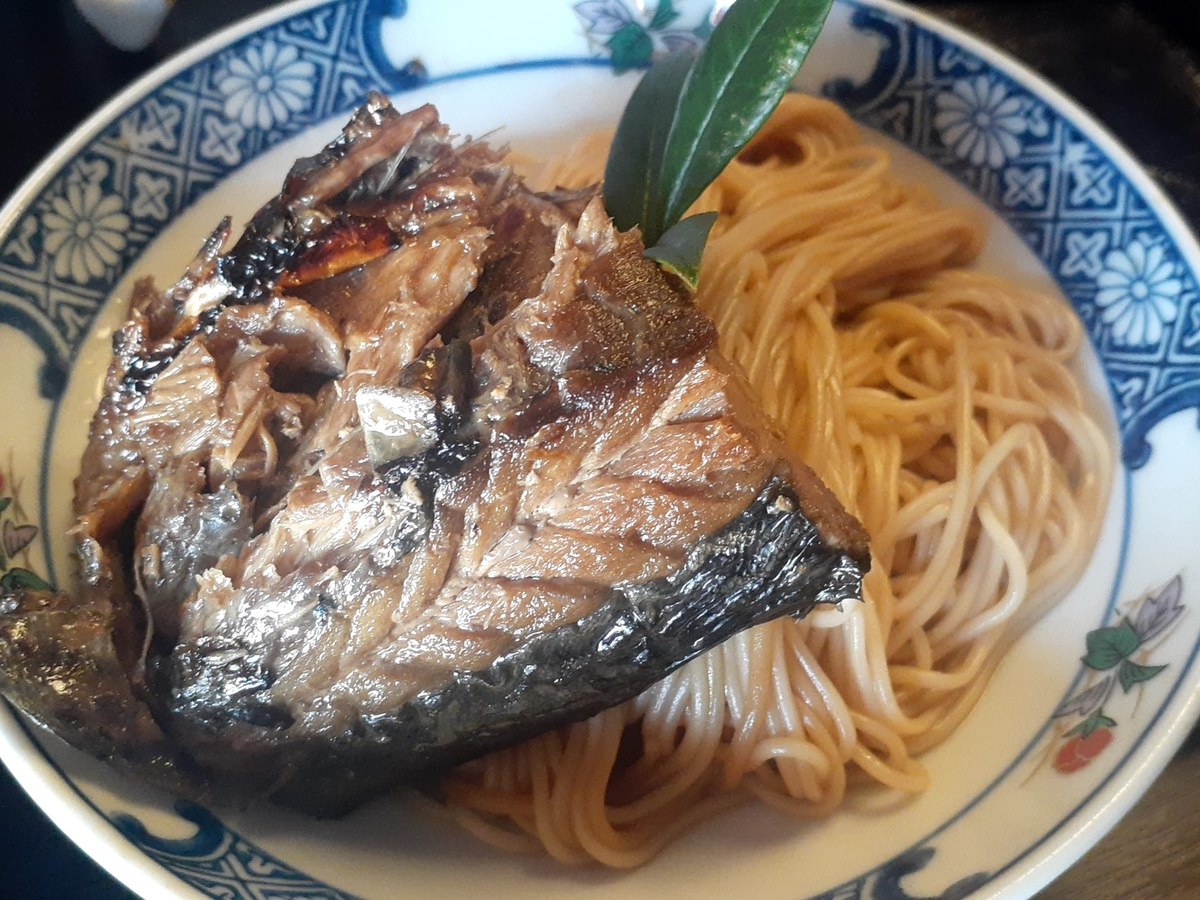
Yakisaba somen is the farmhouse dish of Kohoku, the Lake Biwa north shore around Nagahama: a whole grilled mackerel simmered sweet-savoury until it falls from the bone, then laid over somen noodles cooked in the fish’s own liquor. It began as a gift — the “May visit” of grilled mackerel that parents carried to a daughter married into a farm family, at the busiest planting season of the year — and it is eaten, richly seasoned, less as a noodle dish than as an accompaniment to rice.
The May gift that became a dish
The custom behind the dish has a name: satsuki-mimai, the May visit. In the Kohoku farm villages, May is the frantic heart of the agricultural year, and parents whose daughter had married into a farm family would carry grilled mackerel to her new house — rich food for a busy bride, and one less meal to cook. Kohoku is inland, but it lies close to Wakasa Bay, the great mackerel coast, and the Saba Kaido — the mackerel road — ran through it; grilled saba, funazushi and heshiko were familiar things here long before they were delicacies.
The pairing itself is younger than the gift. Grilled mackerel and somen were both eaten for generations, but cooking them together — the fish simmered down in a sweet-savoury dashi, the noodles boiled in that same liquor and the fish laid over them — dates, on the record, only to the years around 1965–75. It was a home dish first: food for festival days, for guests, for weddings and funerals.
Cooked in its own liquor
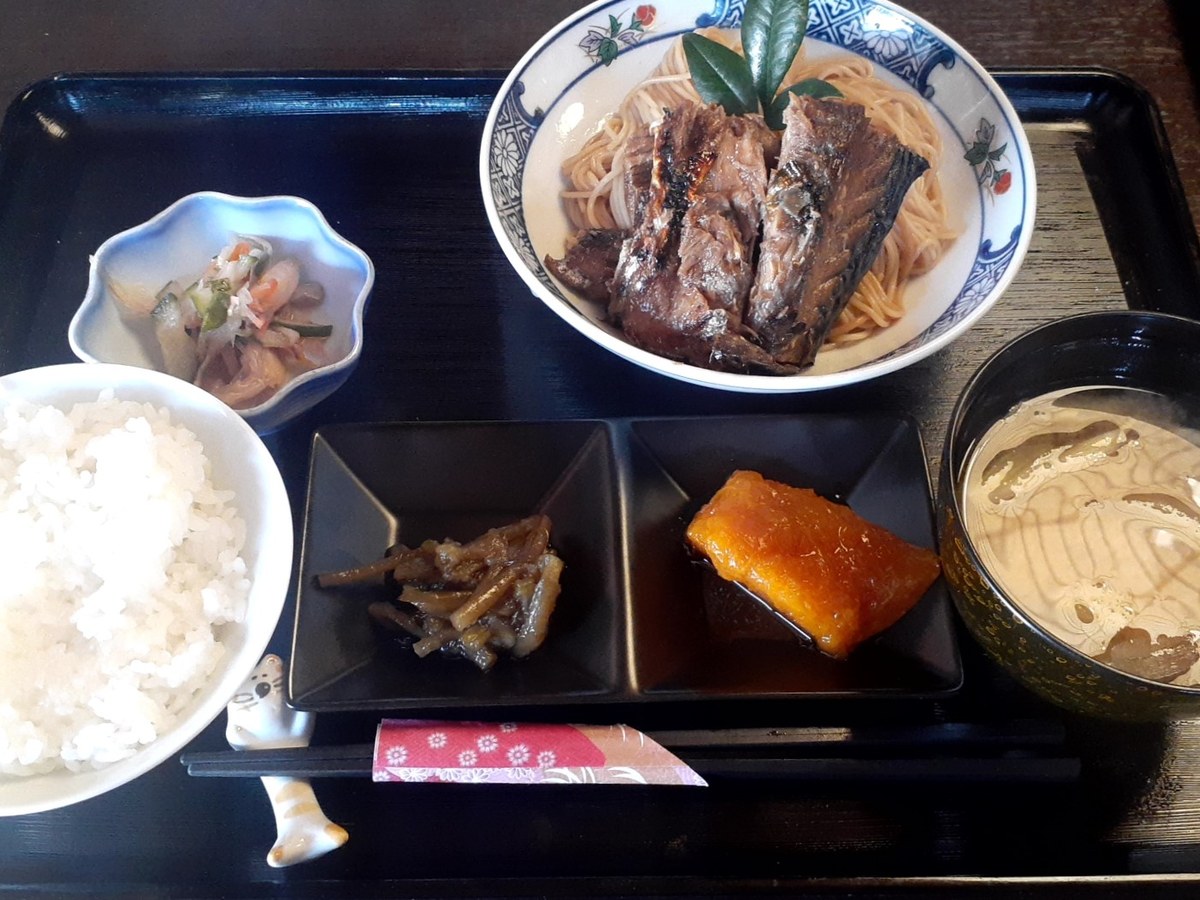
The method has three moves and no shortcuts. Grill the mackerel. Simmer it in a sweet-savoury dashi until it is soft enough to come apart. Then cook the somen in the simmering liquor, so the noodles take the fish’s flavour into themselves, and serve the fish over the noodles. Both photographs show the result: the first, the whole dark-glazed mackerel resting on its bed of pale somen; the second, the same bowl as the centre of a full Nagahama set, with rice and soup beside it.
The seasoning is deliberately strong — this is a dish built to be eaten as an okazu, a companion to plain rice or a drink, not as a light noodle course. Households vary the balance in small ways, and the record is honest that the fine differences are family property.
From farmhouse to Nagahama’s nine shops
The dish stepped out of the farmhouse around 1990, when Nagahama began serving it to visitors. Yokaro, in a 200-year-old merchant house on the Kurokabe Square street, was among the first to build its menu on the bowl, and by about 2005 the local tourism association had taken the dish up as a resource in its own right. By 2020 nine shops in central Nagahama served it, and the local supermarket sold it from its deli counter.
In 2020 it jumped form entirely: a classroom project by Nagahama schoolchildren led to an instant cup version of yakisaba somen, developed with a maker and covered in the national press — the farmhouse gift dish, reissued as a cup noodle by the town’s own children. It is also eaten up the Saba Kaido in Takashima’s Kutsuki district, where no festival table is complete without it.
Eating it in Nagahama
Go to Yokaro first: the two-century-old chirimen wholesaler’s house in Kurokabe Square, open from 10:30 and done when the fish sells out, closed Mondays. The dated menu record gives the yakisaba somen on its own at ¥900, the Saba Kaido set — the bowl with yuba tofu, Omi rice, soup and pickles — at ¥1,340, and the set with a stick of grilled-mackerel sushi at ¥1,770; takeout is the same price. Expect a queue on weekends; it is the shop that taught the town to sell the dish.
Whichever shop you choose, order rice. The bowl’s seasoning assumes it — and that, in one instruction, is the whole history of the dish: a gift of fish, carried across the fields in May, meant to be eaten with the rice of the house it arrived at.
Sources — checked 14 November 2026
- Yakisaba somen — encyclopedia record (the May-visit custom, the method, the Nagahama shops)
- Yokaro, Nagahama — menu record (Gourmet Note, updated 20 August 2026)
Checked 14 November 2026 (stored links re-fetched and judged per product): reserved where the page says so, with an editorial review note kept per product. Press, PR and travel use stays outside the grant.
Editorial review 2026-11-14