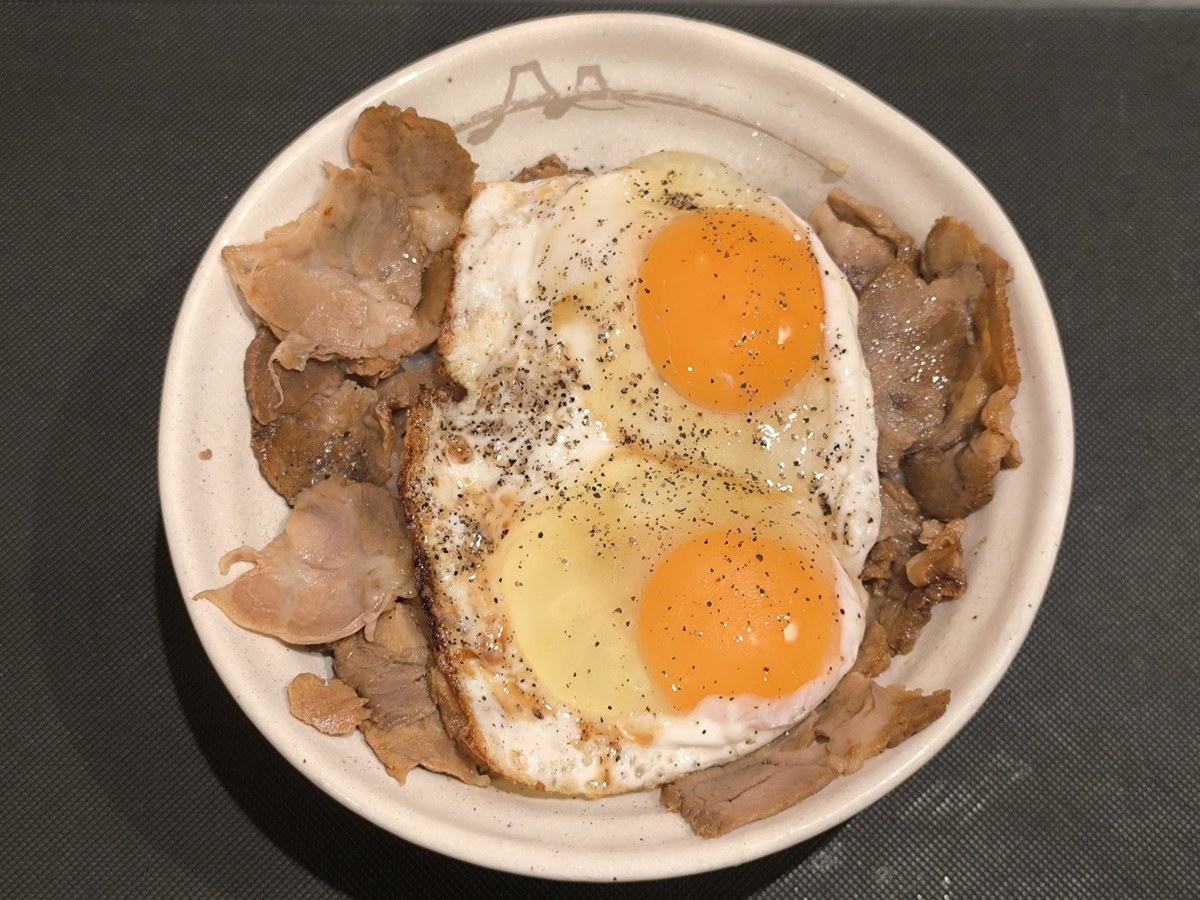
Yakibuta tamago meshi is Imabari’s rice bowl of beautiful economy: a bed of white rice covered edge to edge with thin slices of simmered roast pork, crowned with two soft fried eggs, and finished with the pork’s own sweet soy tare and a shake of pepper. It began as a staff meal in a Chinese kitchen, was carried out the door by a trainee who made it a menu, and went on to take prizes at the B-1 Grand Prix — the bowl a towel-and-shipbuilding city now calls its own.
Three ingredients, no gaps
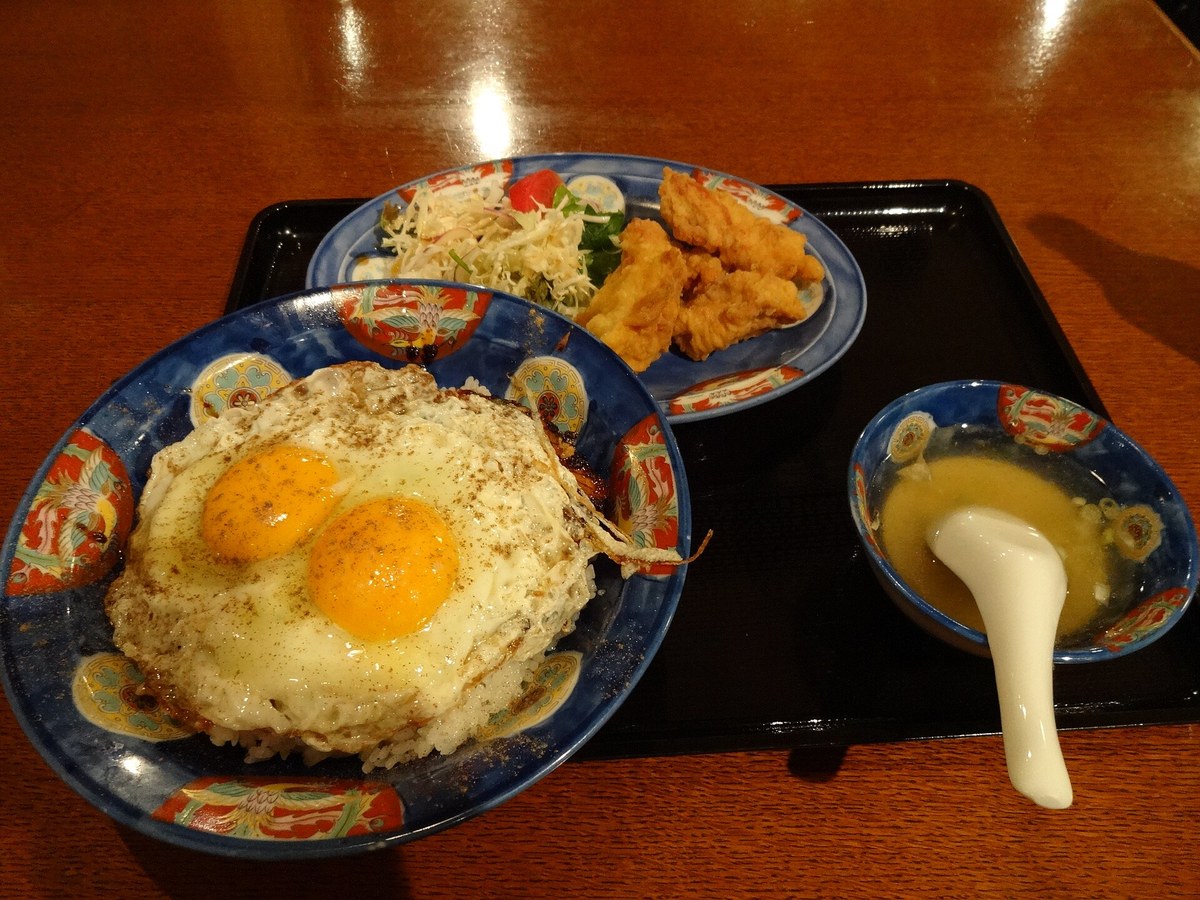
The construction is fixed and visible in both photographs. First the rice; then thin slices of yakibuta — pork simmered until tender in its tare — laid over the whole surface with no rice showing; then two fried eggs, cooked soft so the yolks run; then more of the pork’s sweet-savoury cooking liquor over everything, and pepper. The first photograph shows the bowl as Hakurakuten in Imabari serves it, on a tray with its soup and sides; the second shows the anatomy from directly above — two orange yolks on a pavement of pork.
The record compares it, fairly, to a chashu-egg from a Tokyo canteen set on rice — but the Imabari form is a donburi with its own rules, and the eating ritual is part of it: break both yolks with the spoon and fold them through the pork and rice before the first mouthful.
A staff meal that left the kitchen
The dish was born as the makanai — the staff meal — of Gobankaku, a Chinese restaurant in Imabari. One of its cooks, Seki Masatsugu, left to found his own restaurant, Hakurakuten, and put the staff meal on the menu under the name yakibuta tamago meshi (叉焼蛋飯). Several other Gobankaku trainees later opened shops of their own in the city and added the same bowl, which is why Imabari today has a small constellation of houses serving it rather than a single inventor’s counter.
The bowl’s second life began in 2006, when local volunteers formed a committee to promote it. Renamed the Imabari Yakibuta Tamago Meshi World Promotion Committee, it won the Onomichi teppan Grand Prix in 2010, took third at the 2011 regional B-1 and fifth at the national B-1 in Himeji the same year — the best result among seventeen first-time entrants, in a contest where rice dishes were said to be handicapped — then gold at the 2012 regional B-1 in Tottori, bronze at the national finals in Kitakyushu and again at Koriyama in 2014, and gold again at the 2017 West Japan B-1 in Akashi.
From Imabari to the national chains
Success travelled. In 2012 FamilyMart sold an Imabari yakibuta tamago meshi across some 650 stores in Chugoku and Shikoku; in 2025 the Matsuya chain put the bowl on menus nationwide; in 2026 the Hotto Motto bento chain followed with its own version. Bottled versions of the dedicated tare are sold by several makers for home cooking — the surest sign that the dish has become a genre, not just a menu item.
Through all of it the reference bowl stays in Imabari. Hakurakuten — founded in 1970 on the record of its own chroniclers — serves the dish it named: at a first-hand visit reported in May 2026 the bowl was ¥950, out of the kitchen in about five minutes, the pork in two cuts, the eggs softer than soft, the tare sweet with a pepper kick, and a house spicy sauce on the table for the second half of the bowl.
Eating it in Imabari
Hakurakuten’s main shop stands in Tokiwa-cho, about six minutes on foot from Imabari Station, and serves lunch and dinner with Tuesdays closed. Order the yakibuta tamago meshi (¥950 at the May 2026 visit), or the A set that adds the house’s Imabari-style karaage, salad and soup for roughly ¥1,300 on recent menu reports. Break the yolks first, mix as you go, and use the spicy sauce at the table for the back half — the shop’s own recommended second act.
The other Gobankaku-lineage shops in the city serve their own readings of the bowl, and eating two in a day is the local sport. What you cannot do is eat the original anywhere else: the chains’ versions are licensed echoes of a staff meal that belongs to one city’s Chinese kitchens.
Sources — checked 14 November 2026
- Yakibuta tamago meshi — encyclopedia record (the Gobankaku staff meal, Hakurakuten, the B-1 record)
- Hakurakuten Imabari Honten — first-hand visit report (Yahoo News Expert, 4 May 2026)
Checked 14 November 2026 (stored links re-fetched and judged per product): reserved where the page says so, with an editorial review note kept per product. Press, PR and travel use stays outside the grant.
Editorial review 2026-11-14