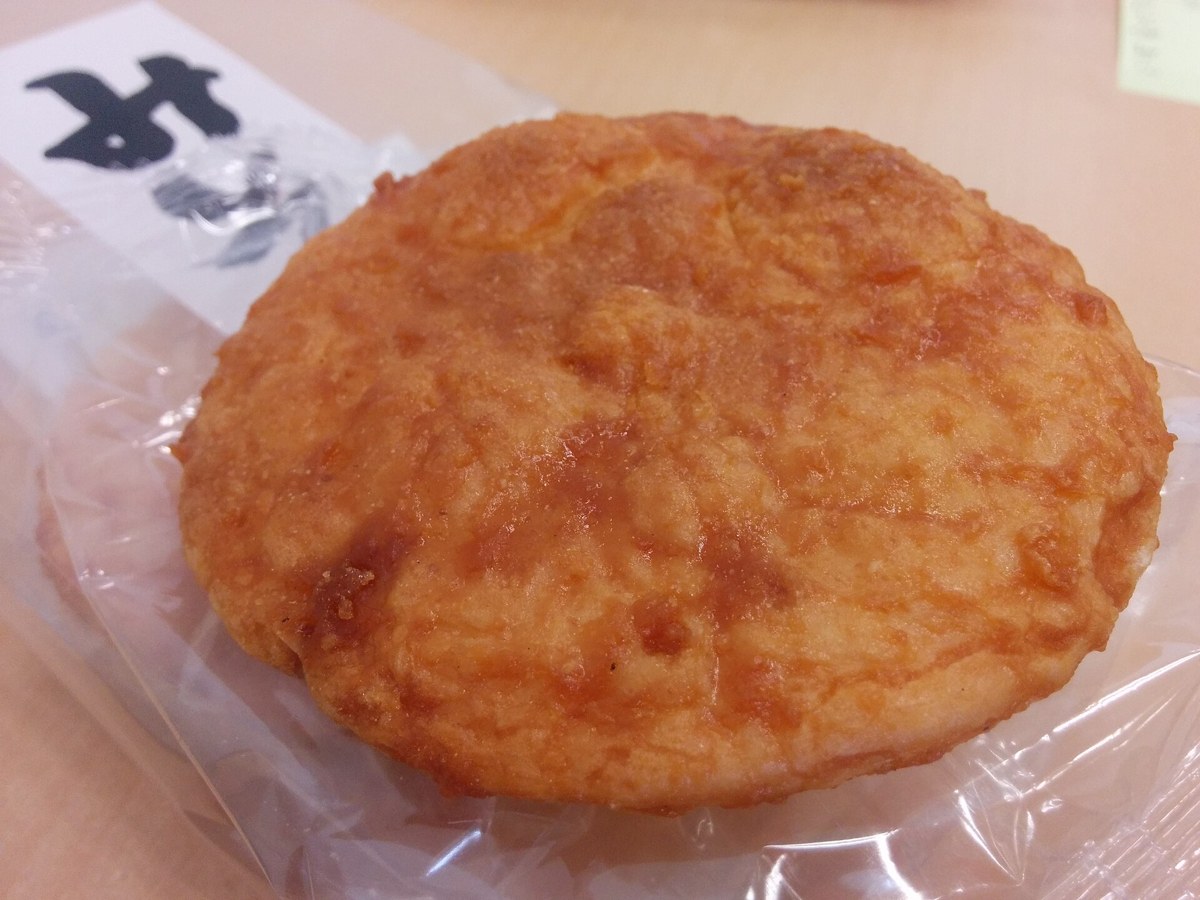
Some snacks are named after their town. Soka senbei went further: it named a whole style of cracker. This is the katayaki of Soka, a former post town on the Nikko Kaido in Saitama — rice crackers baked deliberately extra hard, pressed flat with a ceramic weight as they grill, and brushed with soy sauce at the moment they come off the flame. The crunch is the point, and the town has been perfecting it since the Edo period.
Katayaki: the extra-hard cracker
The checked feature defines the form by its rice and its press. Soka senbei belongs to a regional style called katayaki, notable for being extra hard and crunchy, and it is made with uruchimai — the standard white rice people eat at meals — instead of the more glutinous mochigome other crackers use. Cooked rice is pounded into a sticky dough, cooled and kneaded further, then pressed into a sheet; round moulds cut the discs, which are dried, then grilled over a gas or charcoal flame until slightly brown, turned regularly so they cook evenly.
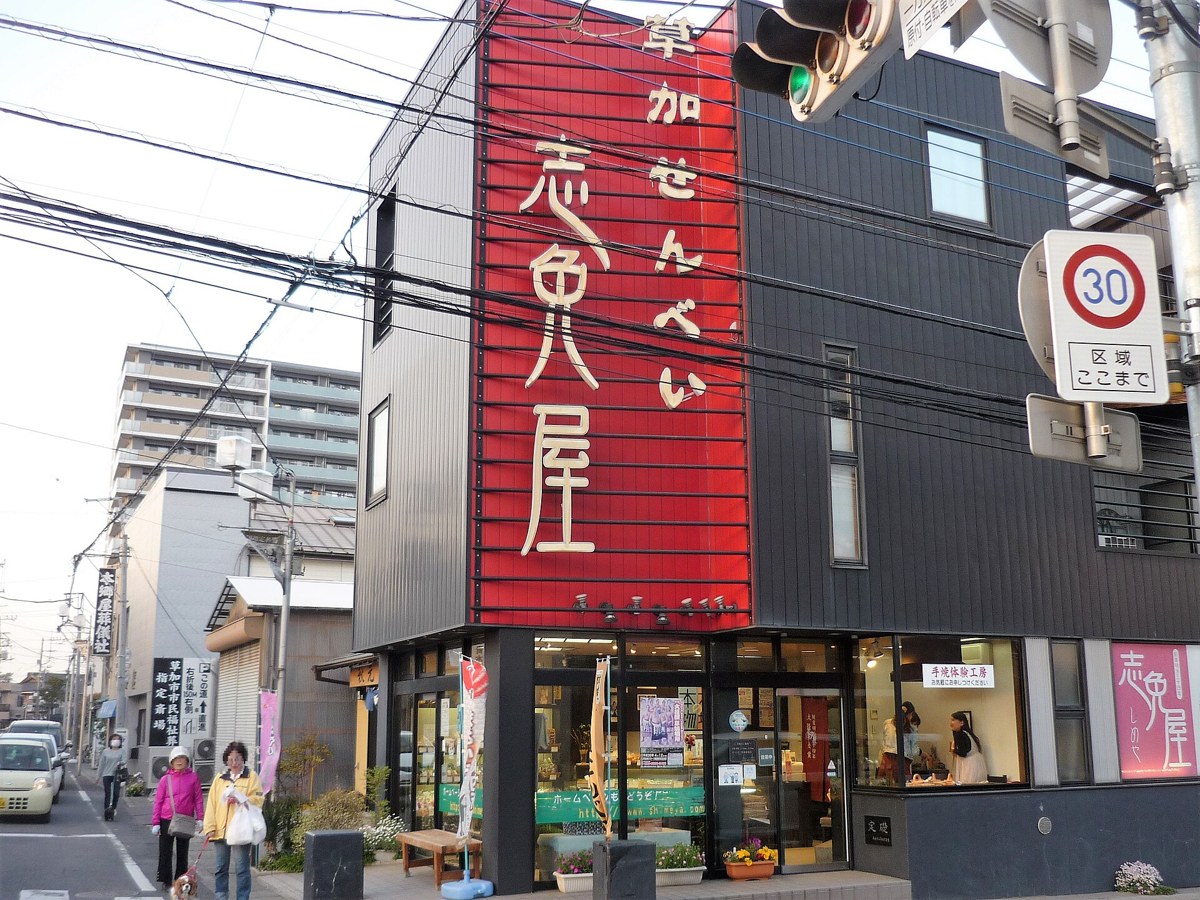
Two acts finish the cracker and both happen hot. A ceramic press called an oshigawara is applied while the senbei grills, keeping it from curling — Web Japan's account credits the same press with the cracker's characteristic crunch — and a soy sauce-based tare is brushed on while the cracker is still piping hot. At Shimeya, a maker of 1901 standing on the old highway, the tare is enriched with konbu and bonito stock, and its soy sauce comes from just up the road in Noda, in Chiba. Sesame, nori and chilli can be pressed into the sheet before grilling, but the grammar never changes: rice, flame, press, sauce.
Osen's legend and the farmers' truth
The town tells its origin as a legend, and the checked feature is careful to call it one. Osen ran a tea shop along the old highway, famous for its rice dumplings but vexed by their short shelf life, until a passing samurai suggested she pound the leftovers flat, dry them in the sun and sell them as grilled rice cakes. A monument at Osen Park marks the birthplace of Soka senbei, and her statue stands outside Soka Station. It makes a good tale — and the feature says the truth is probably plainer and better.
Soka's many rivers made it a rich rice-growing area, and its farmers had long pounded leftover cooked rice into dumplings, dried and stored for later use. When the Nikko Kaido made Soka a post town, locals began turning those flattened rice cakes into senbei to sell as refreshments to travellers on the road — a cottage industry born where the rice surplus met the highway. At first the crackers were salted; as soy sauce consumption grew from around the middle of the Edo period, it became the main flavouring, and it has stayed that way since.
The brand that had to be rescued
The big break came in the Taisho era, from 1912 to 1926, when the crackers were presented to the emperor as a gift and the brand was established in the public's mind; postwar growth made them nationally known. Then success attracted low-quality knockoffs that damaged the reputation of Soka rice crackers — and the makers banded together to bolster the brand and restore it to its previous lustre. The certification that stands today is the result, and it is admirably specific.
Three requirements, as the feature records them: the crackers must be made entirely from high quality, locally grown uruchi rice; an artisan with over 10 years of senbei-making experience must oversee the manufacturing process; and the crackers must be pressed during grilling. Certified crackers carry the 'Honba no honmono' mark. The scale behind the rules is a town still perfumed by its trade — Web Japan counts more than 100 varieties, from sesame and seaweed to sugar and hot pepper, and over 50 rice cracker shops in Soka.
Grill your own for seventy yen
Soka is one of the few food towns where the making is the souvenir. At Shimeya, in the historic part of the city near the old highway and the Ayase River, ambitious visitors can grill their own senbei for ¥70 per cracker — learning that timing is everything, because a cracker turned too slowly cooks unevenly and one pressed too sparingly with the oshigawara will buckle. At the Soka Senbei Garden, run by maker Yamako, visitors make two rice crackers for ¥650, then eat them with the cafe's senbei-tare noodles and soft-serve sprinkled with crushed cracker.
Saitama's standing stories are a tea, a doll and a sweet bean bun — Sayama's leaves, Iwatsuki's ningyo and Gyoda's Jumangoku manju. Soka senbei is the prefecture's fourth, and its first cracker: the savoury, portable, emperor-gifted proof that a post town's packed lunch can outlive the highway that created it. Basho passed through Soka on the Narrow Road and wrote the town into literature; the senbei shops wrote it into Japan's snack cupboard.
Sources — checked 11 November 2026
- Nippon.com: Matsuo Basho and 'Senbei' Rice Crackers — exploring the old post town of Soka (checked feature)
- Web Japan (Kids Web Japan): Saitama — Soka Rice Crackers (checked account)
Original prose and official links only; no source text or maker media reproduced. Photos are credited Creative Commons works, not product photographs.
Editorial review 2026-11-11