The salad pan contains no salad. Inside Tsuruya Pan’s soft koppe roll is a filling of finely shredded takuan — yellow pickled daikon — folded through mayonnaise: crunchy, salty, faintly sweet, and the signature bun of Kinomoto, Nagahama, since 1962. It began in 1957 as a cabbage roll that kept going soggy; the pickle fixed the water problem, the printed bags were already ordered, and the name simply never changed.
The salad with no salad in it
Open the yellow bag and the joke explains itself: a plump koppe roll, and inside it not lettuce or potato salad but takuan — daikon pickled to a deep yellow — cut into fine shreds and dressed with mayonnaise. The texture is the whole idea. Takuan crunches like fresh cabbage, tastes of pickle and salt, and gives up almost no water, so the roll stays soft and the filling stays crisp for the length of a school day or a train ride.
The takuan itself is now a specified ingredient: Tsuruya’s third-generation president told an interviewer the bakery buys from contracted farms in chosen districts and ages the pickles for about a year and a half before they are shredded. What reads as a novelty bun is, on the inside, a small supply chain built around one pickle.
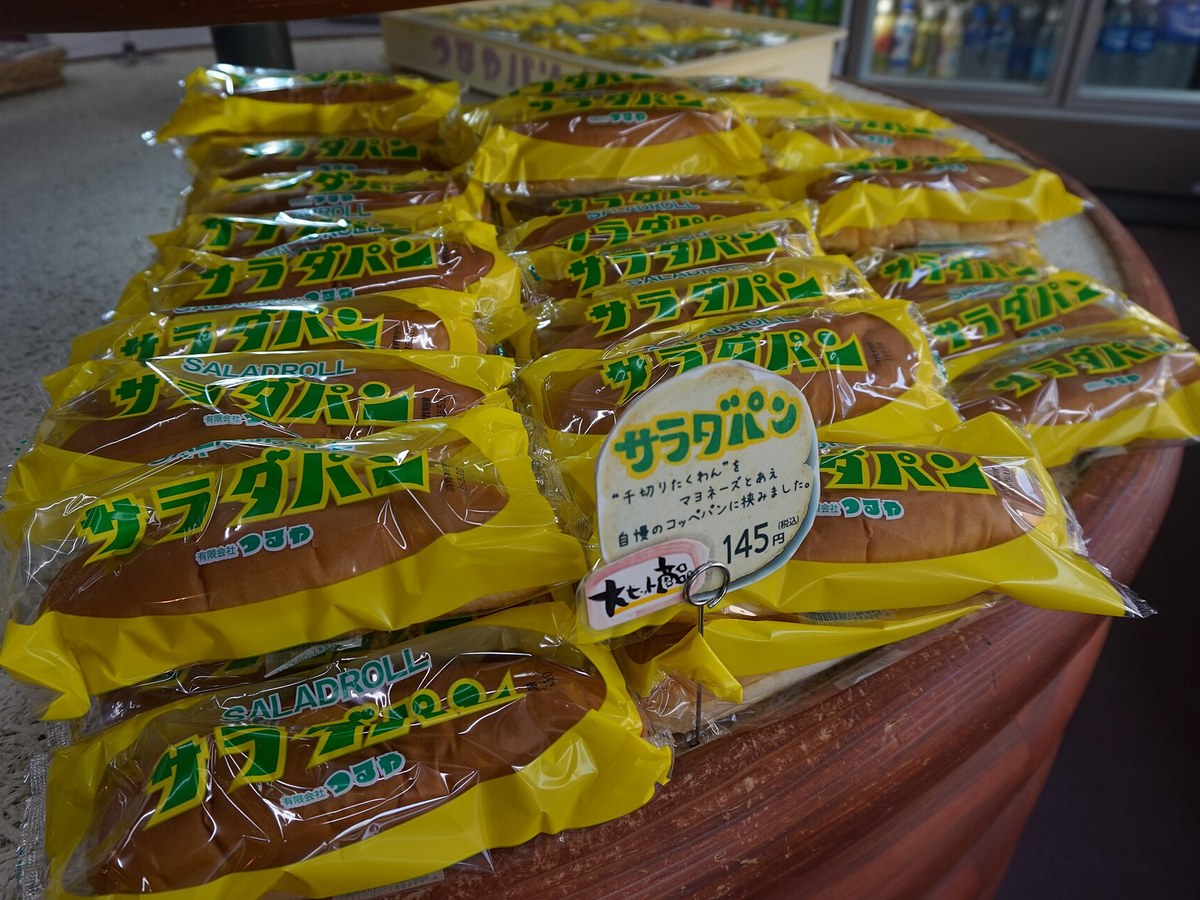
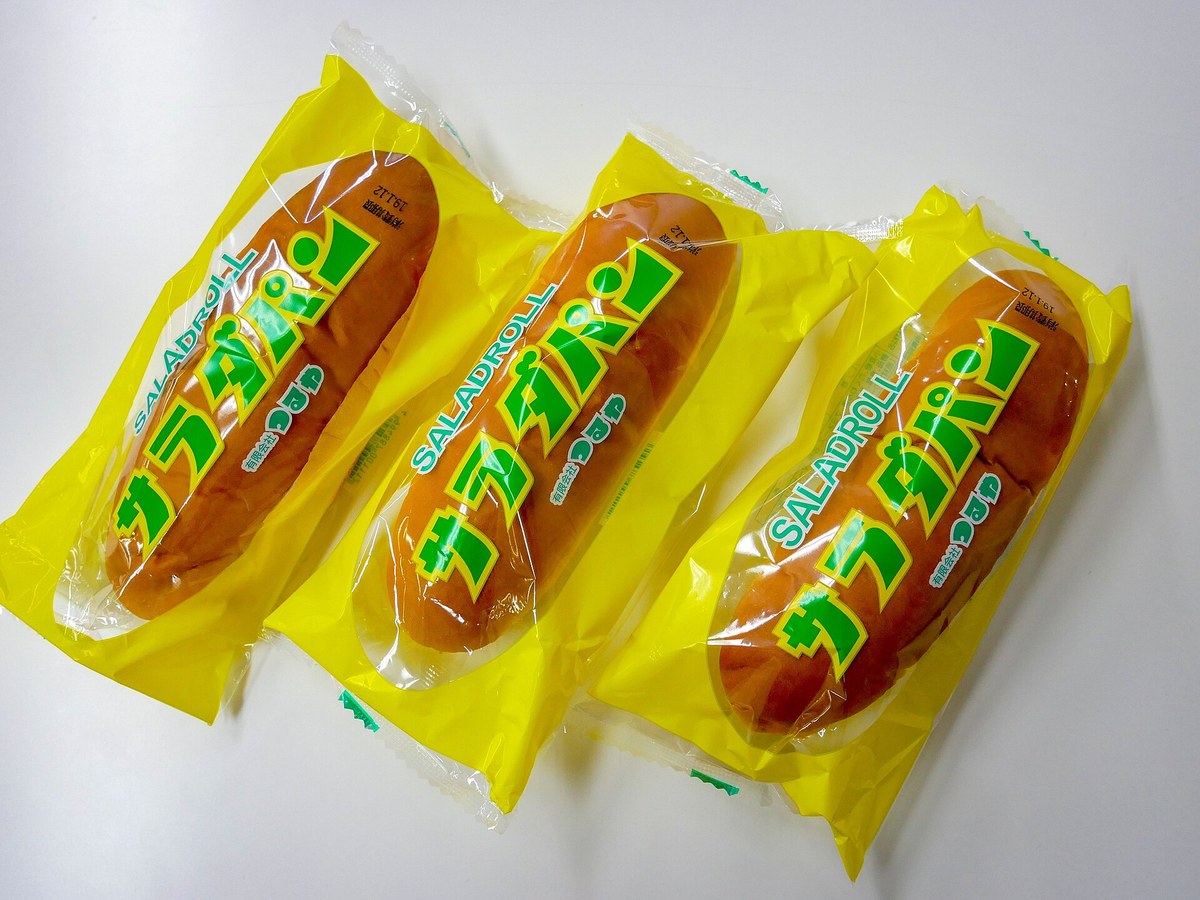
1957 cabbage, 1962 takuan
Tsuruya Pan was founded in Kinomoto in 1951. In 1957 the founder’s wife, looking for a savoury roll in a sweet-bun era, devised the first salad pan: salted cabbage shredded and dressed with mayonnaise — an actual salad, named for the salad oil in the dressing, which was then a fashionable new ingredient. It sold, and then it failed the way cabbage always fails: by summer its water soaked the bread, returns mounted, and production stopped.
The fix was the household pickle jar. Takuan had the cabbage crunch, kept without spoiling, and shed no water. Sales resumed in 1962 with the filling swapped and everything else — the roll, the mayonnaise, and above all the name — unchanged. The bakery had thousands of printed “salad pan” bags in stock, and the family’s reasoning has been quoted ever since: takuan is a vegetable too, so it is still a salad.
A package that kept the secret
The bag is a fossil of the cabbage years, and Tsuruya still prints it: yellow for the mayonnaise, green lettering for the cabbage — the encyclopedia record is explicit that the yellow is not the takuan’s colour, because the pickle is coloured by its curing, not by dye. Generations of Shiga schoolchildren have read that bag without ever learning what the colours meant.
The roll’s afterlife keeps extending the joke. Since 2009 the Inazuma Rock Fes, Shiga’s big outdoor festival, has sold an official Inazuma salad pan every year — one edition, the Rainbow, filled with seven different pickles — and a Calbee potato-chip flavour carried the bun’s name across Kansai in 2019. None of it changed the original: same roll, same pickle, same bag.
From 300 a day to 4,000
When the third-generation president came home to take over the bakery, the salad pan was a 300-a-day local habit. It is now the firm’s flagship at 3,000 to 4,000 a day. Buy it where the locals do: the Tsuruya main shop on the old Hokkoku Kaido in Kinomoto, Heiwado supermarkets across Shiga, the Shizugatake service area on the Hokuriku Expressway, or — on Fridays and weekends — Coco Shiga, the prefecture’s antenna shop in Nihonbashi, Tokyo. The maker’s own online shop ships assortment sets the day they are baked.
One discipline governs every route: the bun lives for two to three days including the day it is made. That short life is why it stayed a Shiga secret for four decades, and it is the honest limit of the edition — outside the prefecture you are always eating it against the clock.
Sources — checked 14 November 2026
- Salad pan — encyclopedia record (the 1957 cabbage original, the 1962 takuan restart, the bag)
- Tsuruya Pan’s president, interviewed at the Kinomoto main shop — Yahoo News Expert visit report
Checked 14 November 2026 (stored links re-fetched and judged per product): reserved where the page says so, with an editorial review note kept per product. Press, PR and travel use stays outside the grant.
Editorial review 2026-11-14