The black of this silk is not a dye colour but a chemical event: tannin from a rose-family shrub meeting iron in island mud, scores of dippings deep. Kagoshima's fifth story is Honba Oshima Tsumugi — the kasuri silk of Amami and Kagoshima City, a year in the making for a single bolt, and light enough to forget you are wearing it.
A masterpiece with two homes
Kagoshima Prefecture introduces the cloth without modesty: Honba Oshima Tsumugi is one of the prefecture's three nationally designated Traditional Crafts — beside Kawanabe's Buddhist altars and Satsuma ware — designated in 1975, with a history the prefecture counts at some 1,300 years, and it is called a masterpiece of silk weaving. Its features are the ones kimono wearers repeat: an exact kasuri pattern, and a cloth that is light, warm, supple and keeps its shape instead of sagging.
The name holds two homes at once. The Tokyo Metropolitan Government's craft account places the origins in the seventh century on the Amami islands, with the industry forming from the early eighteenth century and the techniques later handed on to Kagoshima; the process record distinguishes the two productions by the globe label — authentic Amami Oshima weaving against Kagoshima weaving on the mainland. This page files the cloth to Kagoshima, the prefecture that designates and administers it, and states the Amami half of its home in full.
Pattern first, cloth second
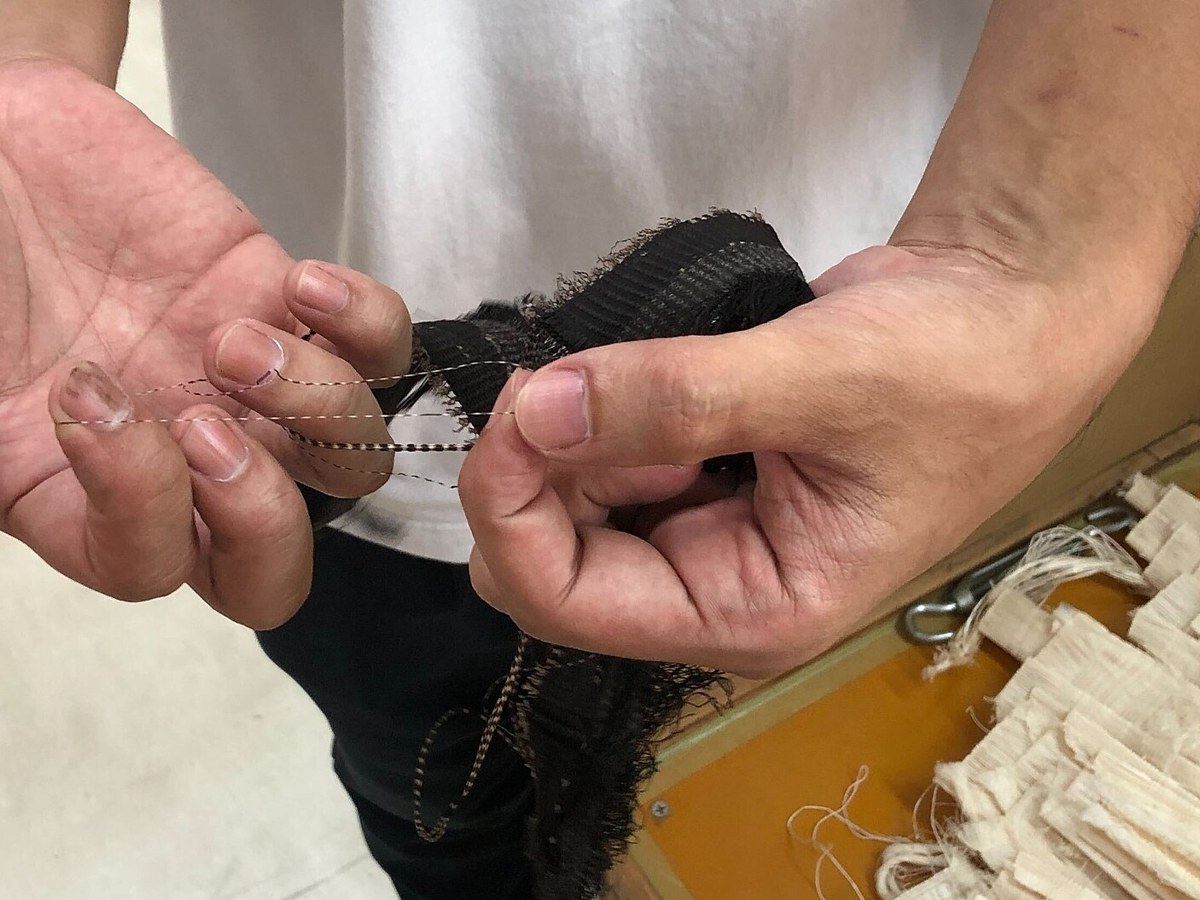
Oshima tsumugi inverts ordinary weaving: the picture is made before the cloth is. The kasuri pattern is bound into the silk yarn itself on the shimebata binding loom — thread wrapped and tied at exactly the points that must resist the dye — so that when the woven cloth finally opens, the motif assembles itself from thousands of pre-dyed segments. The prefecture counts more than thirty meticulous hand processes in all, and from design to finished weaving a single bolt can take over a year.
The weaving is the slow part measured in centimetres. On the process record, a weaver advances about thirty centimetres a day, and a thirteen-metre bolt — one kimono's length — takes forty to fifty days at the loom. Everything before that is preparation: binding, dyeing, unbinding, aligning. It is a division of labour in which a mistake made in the first month surfaces in the twelfth, which is one reason the finished cloth has always been priced like jewellery rather than yardage.
Eighty dips in a shrub, one in the mud
The colour is built like a sediment. The bound yarn is dyed again and again in a decoction of sharinbai — Rhaphiolepis umbellata, a rose-family shrub of the islands — and then immersed once in iron-rich mud. One dye set, the process record says, runs from twenty to eighty sharinbai dyeings plus that single mud bath, and sets can repeat. The tannin of the plant and the iron of the mud react to give the cloth its traditional black, a black with depth because it is a reaction product, not a pigment laid on top.
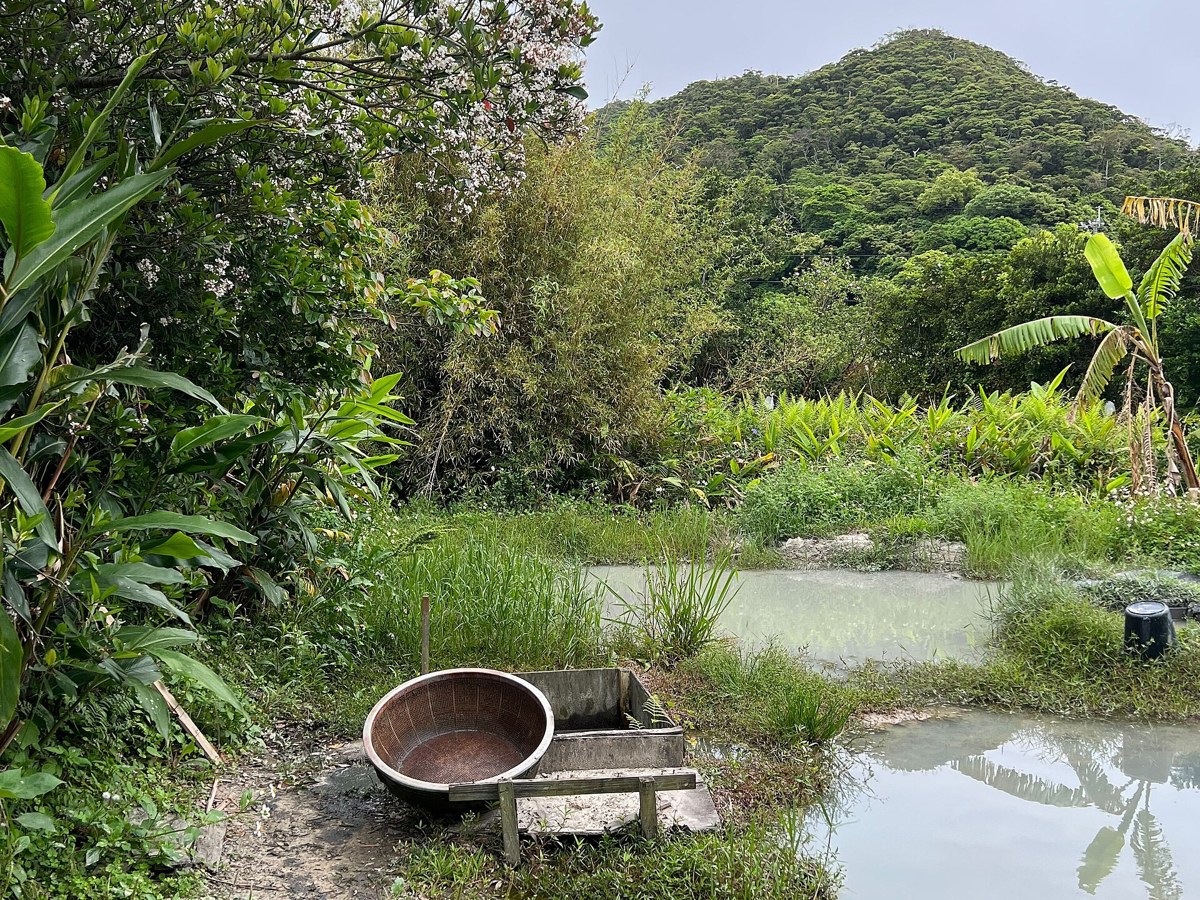
Kagoshima Prefecture names the method Techi-ki mud dyeing and traces the dyeing itself to an ancient technique practised since the mid-seventh century — older than the weaving industry that adopted it. The mud fields are still part of the Amami landscape: shallow ponds of fine silt where the dyed yarn is worked by hand, the step that gives dorozome its name and the cloth its faintly earthy undertone beneath the black.
From a bolt to a wallet
A full bolt remains the summit — a kimono length of certified cloth — but the process record notes the cloth is also worked into small goods: wallets, card cases and coasters, the forms in which most buyers will ever own it. The maker behind this page's price is Kasuri Amami, selling goods under the Honba Amami Oshima Tsumugi name; its money-clip bifold wallet pairs the tsumugi with leather at about nine by eleven centimetres folded.
The wallet is made to order in effect if not in name: delivery runs about a month, the buyer chooses among six leather colours and three thread colours, and a fully order-made version — leather, thread and the tsumugi pattern itself selected — is offered from the same page. It is the cloth's whole argument in miniature: a year's process, carried in a pocket. And the buyer is not asked to take the cloth on faith: the globe label is the mark the process record ties to genuine production, the two homes — Amami and Kagoshima — distinguished on the cloth's own passport.
Sources — checked 11 November 2026
- Kagoshima Prefecture: designated traditional crafts — Honba Oshima Tsumugi
- Tokyo Metropolitan Government (Bureau of Industrial and Labor Affairs): Honba Oshima Tsumugi
- MLIT multilingual record: Honba Oshima Tsumugi
- Kasuri Amami (maker's shop): Oshima tsumugi money-clip wallet
Original prose and official links only; no source text or maker media reproduced. Photos are credited Creative Commons works, not product photographs.
Editorial review 2026-11-11