Kagoshima already has its cut glass in this collection; its second story is the sweet the city is actually famous for. Karukan is a steamed cake of rice flour, sugar and grated wild yam — white, spongy and barely sweet, a yokan with the weight taken out. It was written on a Satsuma lord's menu three centuries ago, a box of it once cost as much as eighteen litres of sake, and the shop that an older story credits with inventing it is still open in Kagoshima City.
A yokan with the weight taken out
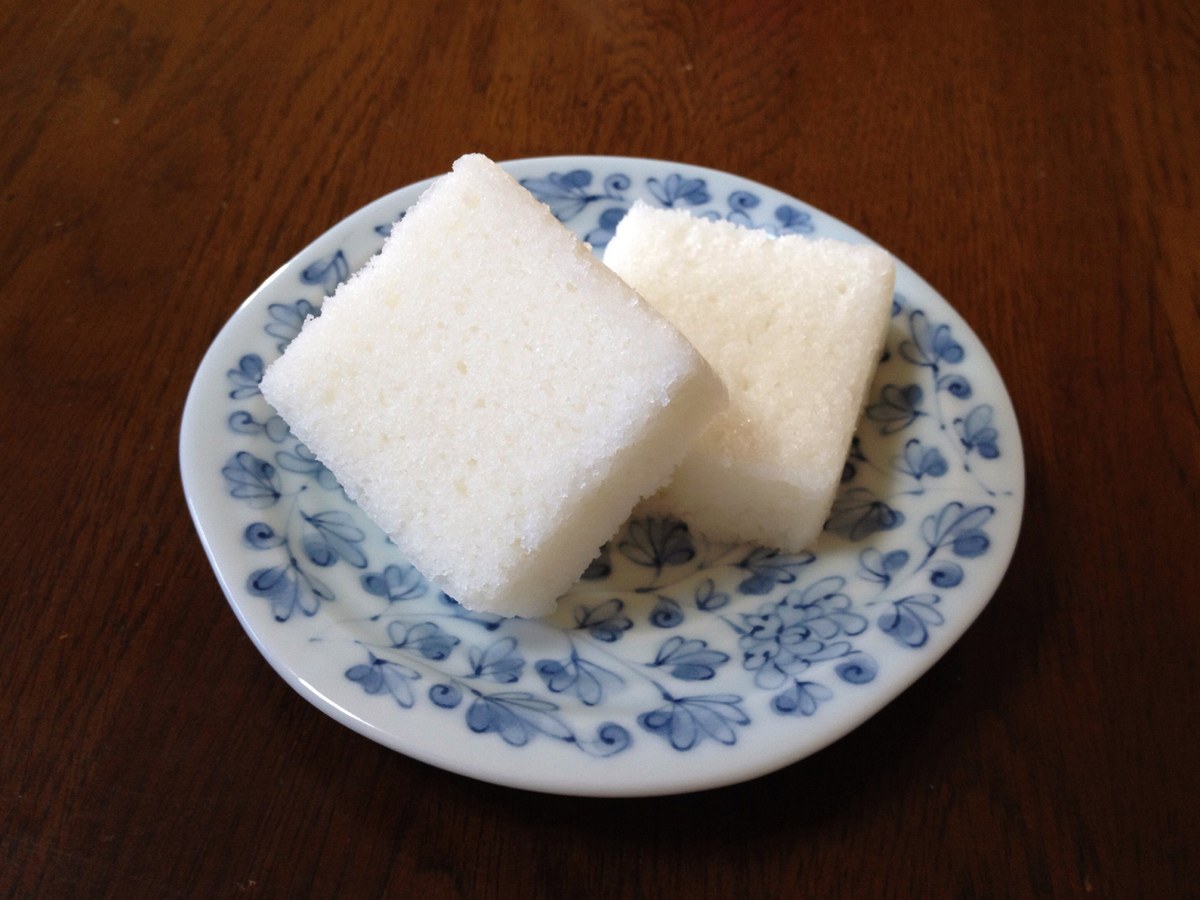
The name is usually read as 'light kan' — kan being the thick soup, and then the jelly, that yokan is named for — and the lightness is real engineering. Karukan flour is a coarse rice flour milled from cracked, dried grains; folded with sugar and a generous quantity of grated jinenjo, the wild yam whose mucilage whips the batter full of air, then steamed for twenty minutes or more. Research measurements of the commercial product put it at roughly 40 percent moisture and 40 percent sugar — a half-sponge, half-jelly that keeps the shape of the bar it is cut from.
Two forms share the name. The original is the plain bar (a sao confection, cut before eating); the form you will meet more often today is karukan manju, a round of the same dough wrapped around sweet red-bean paste and steamed — the version most Kagoshima houses lead with.
1715, and the inventor who may only have improved it
For most of the twentieth century the standard story was tidy: in 1854 the lord Shimazu Nariakira summoned the Akashi confectioner Yashima Rokubei, who — struck by the quality of Satsuma's yams — created karukan. Research since has untidied it, in karukan's favour: domain records place the sweet in Satsuma between 1686 and 1715, and a menu prepared for the lord in 1715 lists karukan alongside yokan. Rokubei is now thought to have refined an existing sweet rather than invented it — but his shop, named Akashiya after his home town, never stopped trading on the story, and 'originator Akashiya' is still how the house presents itself.
The domain could afford the experiment. Jinenjo grew wild on the shirasu plateau behind the castle town, and sugar — then a luxury — came up through the Ryukyu and Amami trade Satsuma controlled. Even so, karukan stayed a lordly sweet for a long time: when sweet prices were ordered down in 1786, a box of karukan still cost about the same as a to, eighteen litres, of sake.
Practical details: Akashiya and the other houses
Start at Akashiya's main store in Kinsei-cho, Kagoshima City (9:00-18:00), or its branches by Kagoshima-Chuo Station and in Kamoike, Taniyama and Nakayama — the originator house's boxed sets pair plain karukan bars with karukan manju (a checked Kagoshima City listing gives six bars and six manju, with an eight-day best-before from manufacture, so this is a buy-it-late souvenir).
For a checked retail price, take another city maker: Satsuma Jokiya's karukan manju, ten individually wrapped pieces, is ¥2,700 tax included (¥270 a piece) on its Amazon.co.jp listing, and its smaller plain 'moze karukan' comes in two-piece packs. Every Kagoshima confectioner of any size makes a version; prices cluster in the same few-hundred-yen-a-piece band.
Why it tastes of almost nothing, pleasantly
First-time eaters often wait for a flavour that never quite arrives — and that restraint is the point the makers themselves make. Akashiya describes its karukan's dignity as a 'Satsuma heart': white, upright, unadorned. What you actually taste is the yam's faint earthiness and the rice flour's clean sweetness, which is why karukan is served with tea and why Kagoshima people give it at celebrations, when a loud sweet would be wrong.
Handle it like the fresh sweet it is. The steamed dough stales quickly by design — the eight-day window on the boxed sets is honest — so buy on your last day in Kagoshima, and eat the plain bar first, sliced, before the filled manju: the bar is the older form and the plainer window into 1715.
The honest scope of the claim
Karukan is Kagoshima's sweet, but it is not only Kagoshima's any more, and this page does not pretend otherwise: Miyazaki sells Kagoshima-made karukan widely and makes its own, and Beppu in Oita has produced it since 1952, where it counts as a Beppu speciality in its own right. What remains Kagoshima's alone is the origin — the domain records, the yam plateau, the sugar route and the unbroken line of city houses from Rokubei's Akashiya onward.
That is the level at which to enjoy it: not as a sweet you can taste nowhere else, but as a three-hundred-year-old piece of Satsuma household technology — wild yam as leavening — that a whole prefecture still eats.
Sources — checked 10 November 2026
- Food in Japan — Karukan: history, FAQs and where to buy
- Satsuma Jokiya — karukan manju listing (Amazon.co.jp)
- Kagoshima City (JRE MALL hometown tax) — Akashiya karukan set
Original prose and official links only; no source text or maker media reproduced. Photos are credited Creative Commons works, not product photographs.
Editorial review 2026-11-10