In Hakata, the first bowl is deliberately not enough. The noodles are a millimetre wide, the portion is small, and everybody at the counter knows why: before your broth cools, you call kaedama, and a fresh nest of noodles lands in the same soup for the price of a coin. It is the only ramen in Japan designed as a refill — a milky pork-bone broth so valued that the noodles, not the soup, are the replaceable part.
White broth, thin noodles
The checked guide defines the base first: tonkotsu broth is pork bones boiled hard for many hours, until the fat and gelatin break down and the liquid turns milky white. The style began in Kurume, in the south of Fukuoka Prefecture, in 1937, at a yatai stall — and the famous whiteness itself is told locally as an accident of the late 1940s, a pot left boiling too long through a rush, expected to be ruined and found creamy instead. The guide carries that story as Fukuoka tells it, and this page keeps it in that form: a told origin, not a documented one.
Hakata's refinement, as the style moved north into Fukuoka City, was to lighten and quicken it: a cleaner milky broth, and noodles at the opposite extreme from Kurume's — ultra-thin, straight, low-hydration strands of around 1.2 millimetres that cook in well under a minute. In Fukuoka, the guide notes, locals rarely use the word tonkotsu at all; they say Hakata ramen, after the old merchant district at the city's heart. The bowl that results is rich but fast — market food, built for people whose break is short.
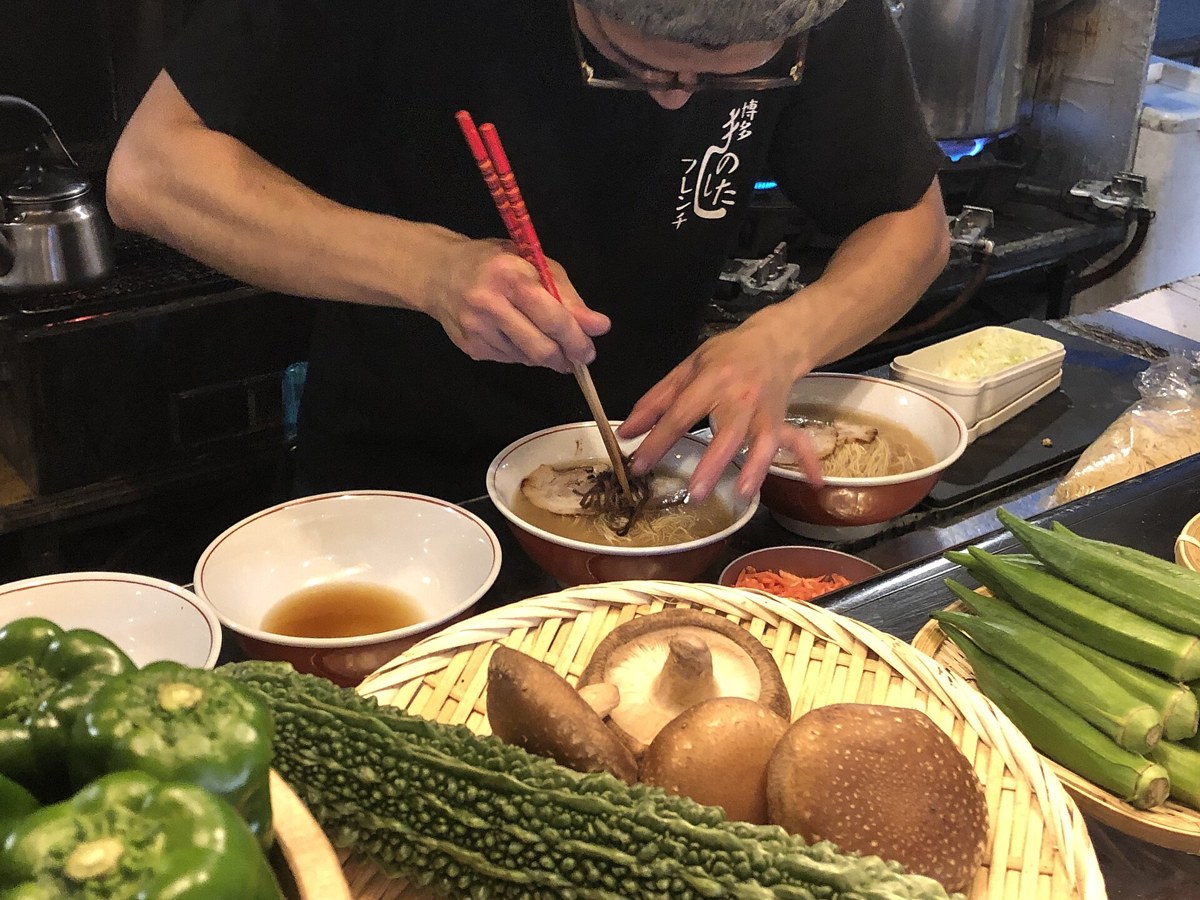
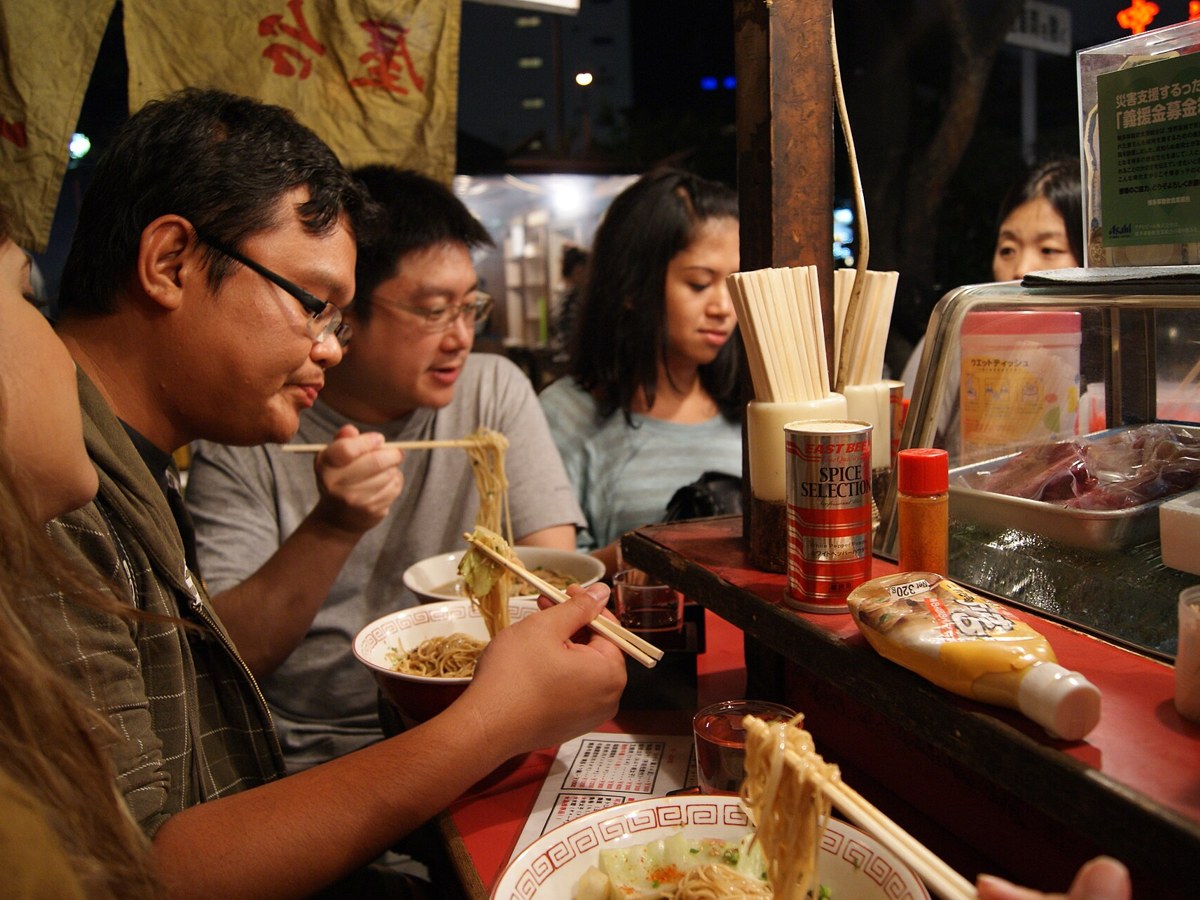
Kaedama: the refill that defines the bowl
The system is the signature, and the guide fixes its birthplace: kaedama started at the Nagahama fish market in Fukuoka, where the workers' problem was simple — thin noodles soften in minutes, shifts are short, and good broth should never be thrown away. The solution inverted ramen's economics. Serve a small first portion; keep the broth; when the noodles are two-thirds gone and the soup still hot, the diner calls for kaedama and a fresh portion of noodles — usually ¥100-200 — is dropped straight into the remaining broth.
Everything about the Hakata bowl serves this moment. The small portion is not stinginess but staging: the first noodles are meant to be finished while firm, the broth paced so enough survives, the firmness ordered by the local scale — from soft to the near-raw snap the regulars call by its own names — because a noodle with a sixty-second cooking window forgives nothing. Order kaedama early rather than proudly late; a refill into cold, depleted soup is the one true Hakata mistake.
What the home city charges
At home, the form stays priced like the market food it is. The specialist guide's typical bowl is around ¥700-1,000; the Fukuoka guide's local readings put first bowls at the named city houses around ¥650-850, with a kaedama about ¥150 — Shin-Shin's classic at ¥720 with a ¥150 refill, Ichiran's classic bowl at ¥980 with its kaedama at ¥210. Two full noodle servings inside one broth, in the style's birthplace, for less than a single fashionable bowl in the capital: the refill system is an economy as much as a ritual.
Fukuoka's standing stories are a Hakata pastry, the city's spiced cod roe, and Yame's great green tea. Hakata ramen is the prefecture's first ramen — and the missing counterweight to this collection's other Kyushu bowls, the miso-rich and soy-clear styles of the north. Kyushu's ramen map, like Japan's, starts here and in Kurume, forty kilometres south.
Eating it like the market taught you
Sit, order your firmness, and eat the first noodles fast and plain — the pickled ginger and spicy mustard greens on the counter are for the second act, not the first. At two-thirds down, call the kaedama without ceremony; it arrives in seconds because it cooks in seconds. Season the refill bowl more boldly if you like — the broth has concentrated, the fresh noodles are a new canvas — and finish the soup only if the day allows: in Hakata, leaving broth is a venial sin, wasting noodles the mortal one.
For the full civic form, take the second bowl at a yatai — the riverside stalls of Nakasu and the Naka River, where the style's postwar refinement happened under canvas. The stall, the steam, the counter of strangers eating the same white broth at the same speed: Hakata ramen was never really a recipe. It is a pace, and the city still sets it nightly.
Sources — checked 11 November 2026
- Food in Japan: Tonkotsu Ramen — Japan's Pork Bone Ramen Guide (checked specialist guide)
- Eatmono: Hakata Ramen Guide — Best Tonkotsu Ramen Shops in Fukuoka (checked city guide)
Original prose and official links only; no source text or maker media reproduced. Photos are credited Creative Commons works, not product photographs.
Editorial review 2026-11-11