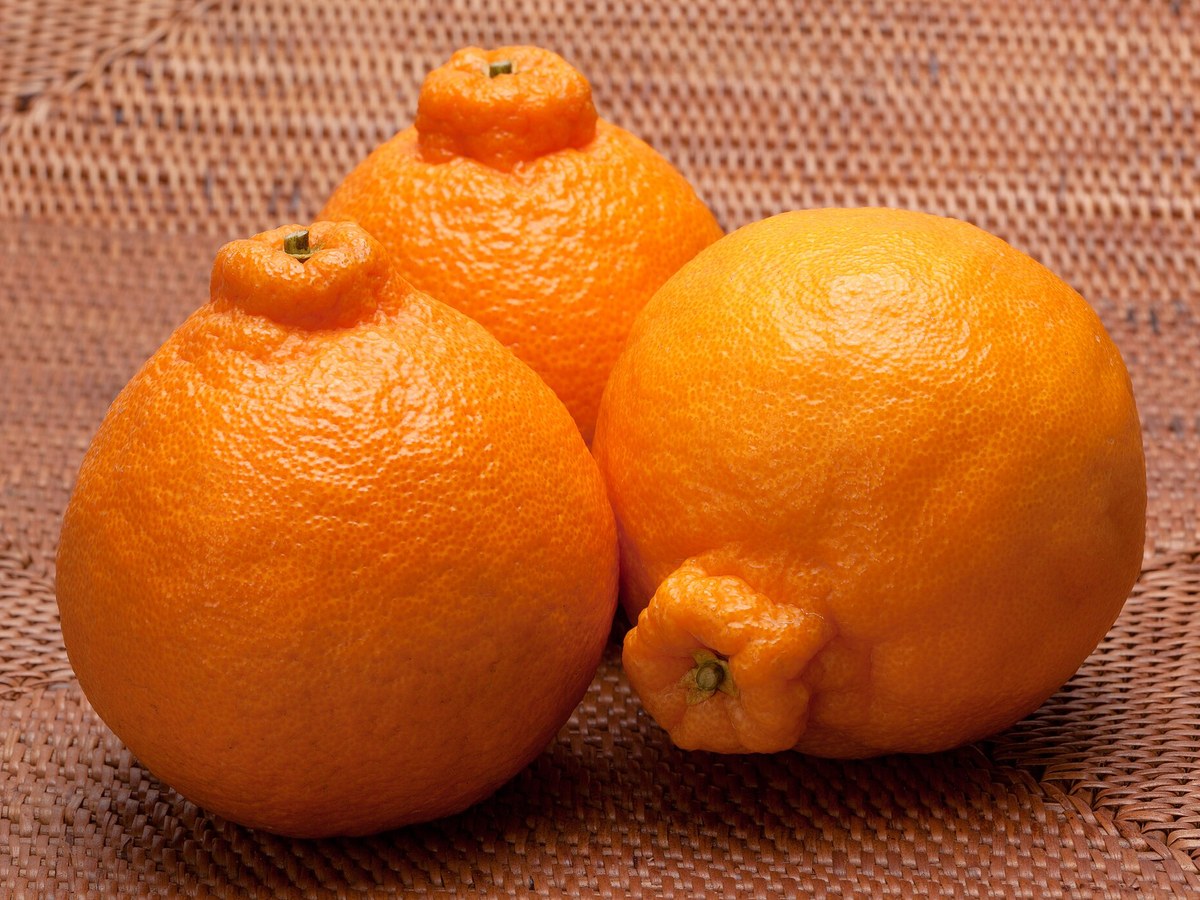
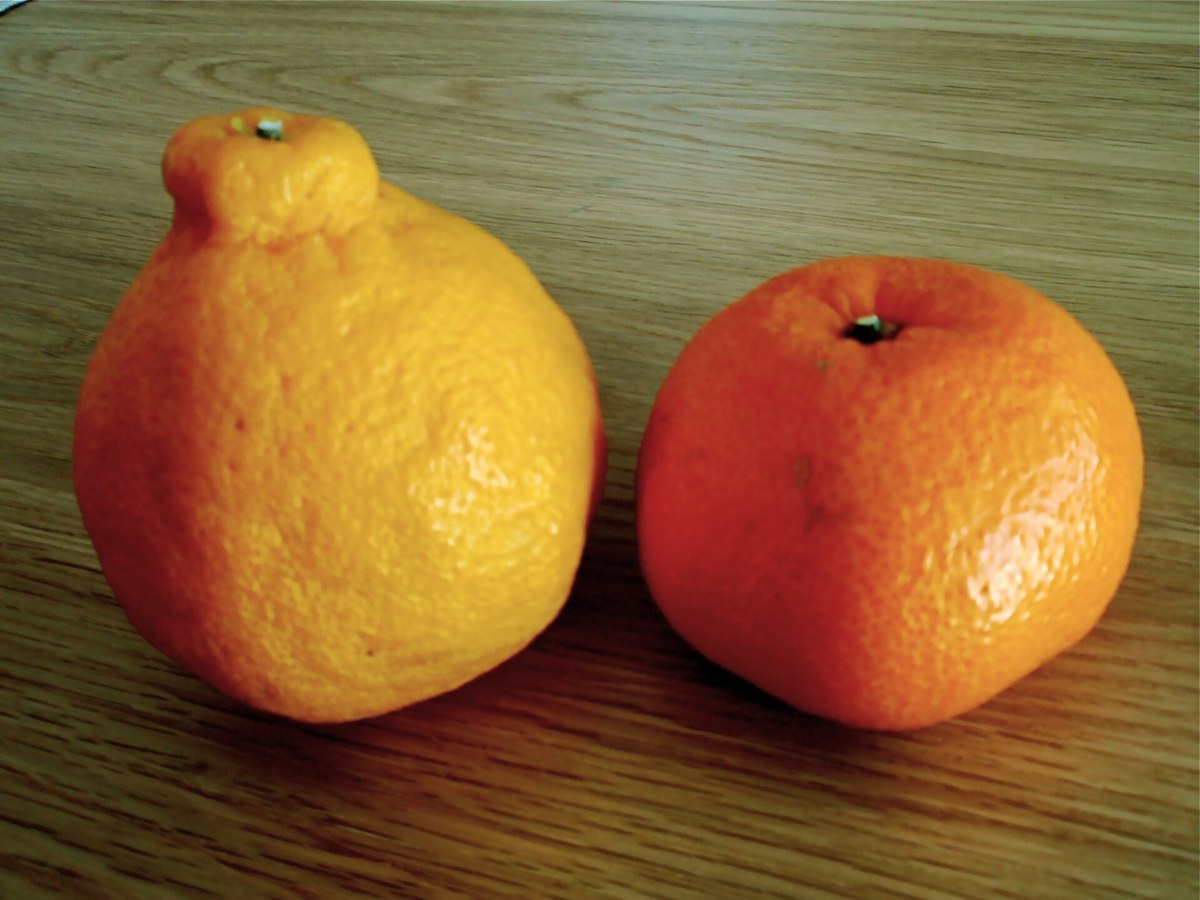
Every dekopon wears its name twice. The fruit is Shiranui — a seedless hybrid of Kiyomi and ponkan, bred in 1972, instantly recognisable by the big bump on its head. The name on the sticker, Dekopon, is something else: a registered trademark held by Kumamoto's fruit federation, usable only for Shiranui that passes a test — more than 13 degrees of sugar, no more than 1.0 percent citric acid. A shiranui that fails is still a fine citrus; it just may not call itself dekopon. The first fruit shipped under the name left Kumamoto on 1 March 1991, and 1 March is now Dekopon Day.
One fruit, two names, one owner
The trademark record draws the line precisely. Both names describe the same cross — Kiyomi × ponkan — but 'Dekopon' is a registered trademark of the Kumamoto Prefectural Fruit Federation of Agricultural Cooperative Associations (JA Kumamoto Kajitsuren), Japanese Registration No. 2495156, while 'Shiranui' is the common name anyone may use. The name itself is a joke that stuck: deko, convex, for the bump, plus pon from ponkan.
The record of the name's early years shows how Kumamoto-centred it was: while Dekopon was the trademark of the product from Kumamoto, Ehime's fruit had to be sold as himepon and Hiroshima's as hiropon. Only after a later agreement — pay the fee, meet the standard — could the name travel. The trademark stayed where it was born: in Kumamoto.
The standard is the product
What the licence buys is a measurement. The variety record states the rule in numbers: after harvest, dekopon are usually rested for 20 to 40 days so that citric acid falls while sugar rises, and only fruits with a sugar level above 13 degrees Brix and citric acid below 1.0 percent can be sold with the name dekopon. The fruit is bred seedless and large, grown largely in greenhouses for a December-to-February harvest, with garden fruit following in March and April.
The bump that defines its face nearly killed it: the variety record notes that dekopon has no agricultural variety registration number, because at the time of its development the bump was considered unsightly and the young fruit failed to reduce its acidity. The resting cure — storage until acid turns toward sweetness — is what the standard actually certifies.
Kumamoto's citrus country
Kumamoto is one of Japan's great citrus prefectures, and its southern districts — Minamata, Ashikita, Uki — grow shiranui in the winter sun above the Shiranui Sea, the inland sea whose name the fruit itself carries. The checked farm record is from Minamata: a grower there stores the fruit until acidity softens into sweetness, grows with organic fertiliser only and no herbicide, and reads its own fruit at 12 to 13 degrees of sugar — right at the dekopon threshold, which is exactly the discipline the trademark exists to reward.
The calendar closes the story: the variety record gives the greenhouse harvest from December to February and garden fruit from March to April, and the anniversary record fixes the name's birthday — the first shipment of dekopon from Kumamoto Prefecture on 1 March 1991, commemorated as Dekopon Day on 1 March.
Buying dekopon
The checked product record is the Minamata City listing on JAL's furusato portal: Onitsuka Farm's gift-grade Shiranui (Dekopon), about 5 kg, grown in Minamata, Kumamoto, at a ¥12,000 donation, shipped from late March in its season at the point the farm judges the stored fruit sweetest. In season, Kumamoto JA channels sell boxed dekopon by grade across Japan.
What to check on any box: the word dekopon itself is the guarantee — it certifies the sugar and acid test — while a box labelled only shiranui makes no such promise, however good the fruit. And check the prefecture if the Kumamoto story is what you are buying: the name is licensed beyond Kumamoto now, lawfully, and the label says where the fruit grew.
Sources — checked 12 November 2026
- Hattori & Partners — The Mystery of the Dekopon Name (trademark record)
- Dekopon — variety record (Wikipedia, after the National Institute of Fruit Tree Science and Zen-Noh)
- JAL Furusato — Minamata City, Kumamoto: Onitsuka Farm gift Shiranui (Dekopon), about 5 kg (checked 12 November 2026)
Original prose and official links only; no source text or maker media reproduced. Photos are credited Creative Commons works, not product photographs.
Editorial review 2026-11-12