Banpeiyu is the largest pomelo grown in Japan — a fruit the size of a child’s head and the weight of a small dumbbell, so heavy the tree has to be propped and netted to carry it. Almost all of it grows in one district, Yatsushiro in Kumamoto, where it is a GI-protected name, a Guinness record holder, and a bath additive.
The fruit that needs a net
Banpeiyu is a cultivar of zabon — the pomelo — and the largest of its family: a typical fruit runs about twenty centimetres across and about two kilograms, and twenty-five-centimetre fruit are not rare. The name reads its own description: ban, late-ripening; haku, the white flesh; yu, from the Chinese word for a round citrus. The flesh is crisp rather than juicy, fragrant held to the nose, and at full ripeness balances sweet against acid in a way its growers describe with pride.
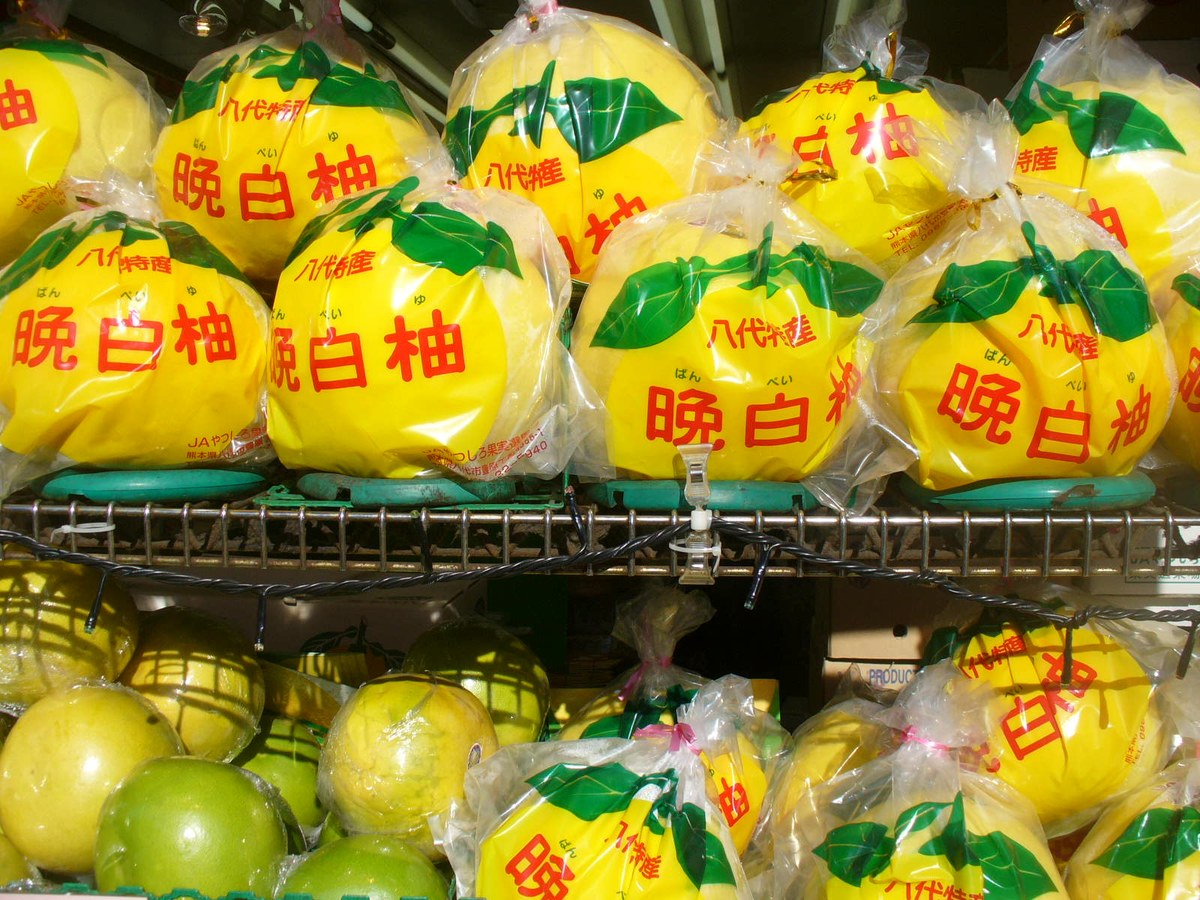
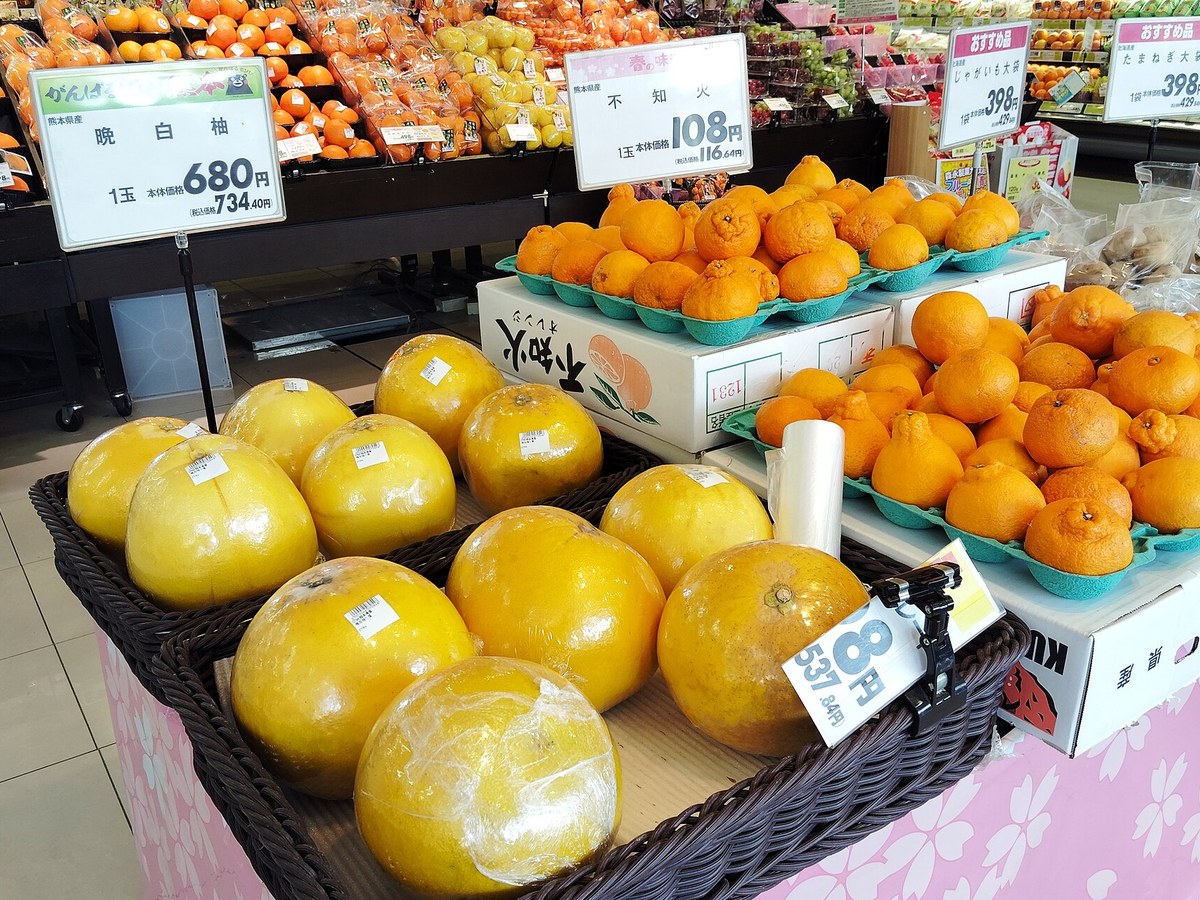
Growing it is an engineering problem. A fruit this heavy will break its own branch, and sometimes the trunk, so growers prop the boughs and sling the fruit in nets while it grows — and the care continues after picking, as our first photograph shows: harvested fruit bagged and labelled one by one. They also trim the tree’s thorns so the fruit is not wounded by its own tree. After picking, the fruit rests: it keeps for about a month, softening and ripening, and some growers sun it a week in a vinyl house until the rind turns bright yellow before it ships. Our second photograph is the fruit at market, stacked like pale moons.
A shipboard taste, a Taiwan detour, a Kumamoto home
The fruit’s road to Yatsushiro runs through two introductions. In 1920 the botanist Shimada Yaichi ate a citrus aboard a ship in French Indochina that was so good he obtained stock from the botanical garden in Saigon — but nobody knew how to grow it, and it went nowhere. In 1930 stock arrived from Taiwan at the Kagoshima fruit experiment station, and the search for its best ground ended in the Yatsushiro district of Kumamoto, where it rooted, was improved, and became the district’s speciality.
The scale of that specialisation is in the ministry’s numbers: of Japan’s 971-tonne banpeiyu harvest in 2010, 97 percent was Kumamoto fruit. The name is now protected as one: the agriculture ministry’s GI register carries “Yatsushiro Tokusan Banpeiyu”, registered on 30 March 2020 as No. 94, its production area fixed to Yatsushiro City and neighbouring Hikawa Town.
The heaviest pomelo in the world
Twice, the world record for the heaviest pomelo has been a Yatsushiro fruit: a farmer’s banpeiyu certified in 2005, and one grown by the horticulture science students of Yatsushiro Agricultural High School in 2015. The standing record the encyclopedia gives is a fruit of 29 centimetres and 4,859.7 grams — nearly five kilograms of citrus, from a school garden.
The district eats the whole fruit, rind included. The flesh goes fresh, or into jelly, jam and candy; the thick white albedo — two to three centimetres of it — is candied into zabon-zuke, and some buyers, the record notes, want the fruit for its rind more than its flesh. And at Hinagu Onsen in Yatsushiro, the inns float whole banpeiyu in the bath — banpeiyu-buro — a custom local households share, the fruit perfuming the water through the winter season.
Buying a banpeiyu
Buy by the calendar the district keeps: house-grown fruit ships from early December, in time for the year-end gift season, and open-field fruit follows from mid-January; the eating peak comes after the resting month, from late January into early March. The measured prices this run are the grower’s own: on JA Yatsushiro’s order form for the 2025 crop, house-grown top-grade (shū) 2L fruit — nineteen to twenty-one centimetres, about two kilograms each — are ¥6,000 for two, tax included; open-field yū-grade 2L fruit are ¥3,800 for two.
Judge the fruit by weight in the hand and a rind gone fully yellow; then give it its month. A banpeiyu eaten the day it arrives is a photograph, not yet a fruit.
Sources — checked 15 November 2026
- Banpeiyu — encyclopedia record (the giant zabon, the netted cultivation, the 1920/1930 introductions, the Guinness records)
- JA Yatsushiro banpeiyu order form, 2025 crop, and the agriculture ministry GI register (the ¥6,000 two-fruit price, GI No. 94)
Checked 15 November 2026 (stored links re-fetched and judged per product): reserved where the page says so, with an editorial review note kept per product. Press, PR and travel use stays outside the grant.
Editorial review 2026-11-15