Street foods rarely have inventors. Takoyaki has one, and his shop still stands. In 1933 a Fukushima-born stallholder named Endo Tomekichi opened a stall in Osaka selling rajioyaki — batter balls filled with beef and konjac, named for the radio craze. Two years later, a customer from Akashi told him that in Akashi the dumplings held octopus. Endo swapped the filling, seasoned the batter, and called the result takoyaki. Ninety years on, Aizuya serves his original the way he did: small, plain, and with no sauce whatsoever.
The swap that named a snack
The invention is unusually well documented for a street food, because the inventor's house tells it as its own history. Aizuya's official site fixes the frame: founded in 1933 by the first generation, Endo Tomekichi; two years later — 1935 — he created the takoyaki that became an Osaka speciality. The travel record, written with the shop, supplies the scene: a customer eating rajioyaki remarked, 'Osaka uses beef? In Akashi, we use octopus in our dumplings.'
What Endo did next is the whole recipe. He replaced the beef and konjac with a piece of octopus, and seasoned the batter itself — a soy-sauce broth the account traces to kozuyu, the soup of his native Aizu — so the ball would carry its flavour inside. That is why the original needs nothing on top: the seasoning is in the batter, not poured over it.
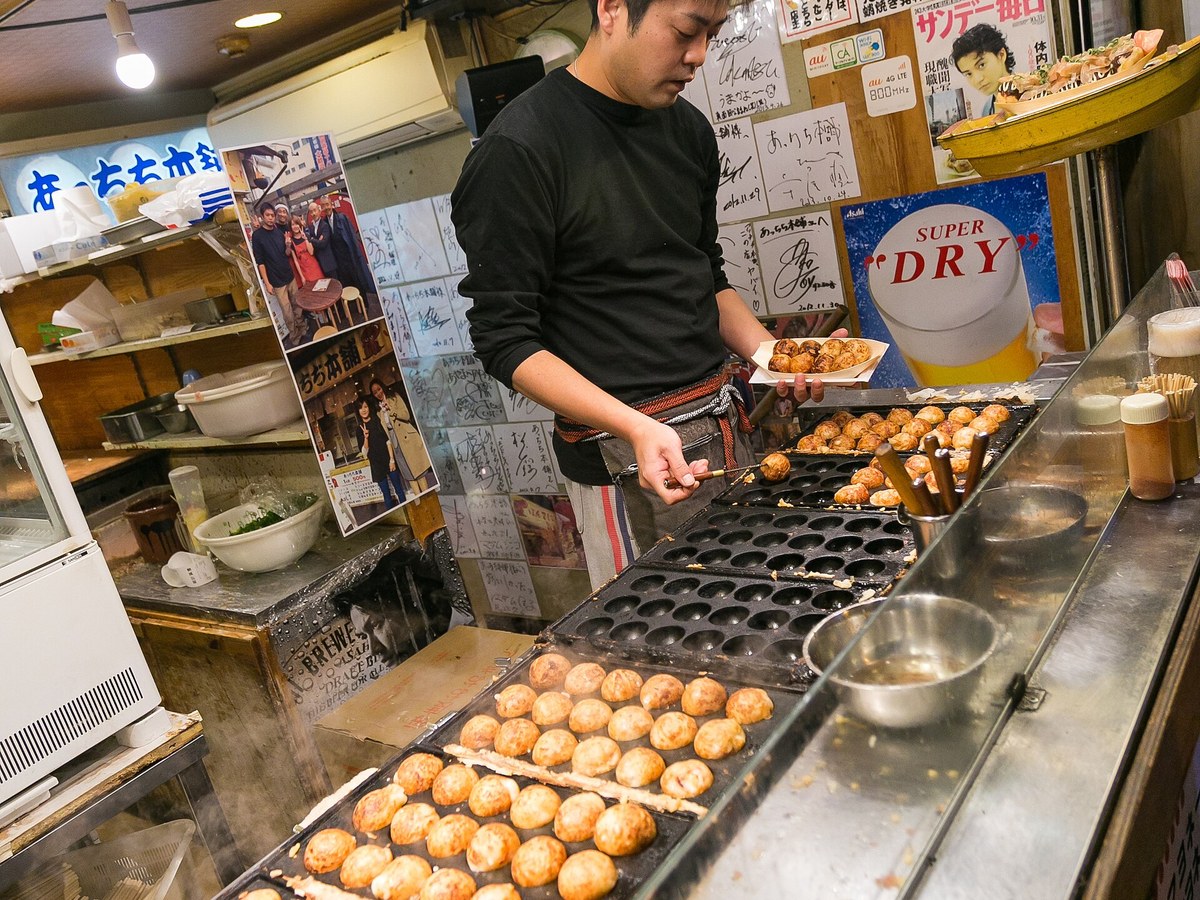
No sauce is the point
Order takoyaki almost anywhere today and it arrives dressed: sweet brown sauce, mayonnaise, aonori and a snowfall of bonito flakes that waves in the heat. Aizuya's original has none of it — no sauce, no flakes, no mayonnaise, not even pickled ginger; the 1935 ball held octopus and nothing else. The dressed form is not wrong, but on the shop's own record it is recent: the fancy versions were created about twenty years ago, while the plain ball has been sold for ninety.
The plainness is a working test of quality. With nowhere to hide, the batter's seasoning and the octopus have to do everything, and the small Aizuya ball — one bite, soft yet firm — is built to be eaten as it comes off the iron. The shop was listed as a Michelin Guide Kyoto-Osaka Bib Gourmand from 2016 to 2018 for serving exactly that.
Rajioyaki, the beefy forerunner
Takoyaki's parent snack survives beside it. Rajioyaki — thin beef cooked in soy sauce, konjac and spring onions set into batter balls — was the height of fashion-naming in 1933: 'rajio' (radio) was the era's word for the newest thing, and other Osaka stalls sold their own versions. Aizuya let it lapse, then revived it in 2005, so at the birthplace you can eat the 1933 parent and the 1935 child side by side.
The family tree reaches one step further back, to Akashi. The customer's remark pointed at akashiyaki, Hyogo's older egg-rich dumpling, eaten dipped in dashi — the dish this collection covers from Akashi itself. Takoyaki is what happened when that octopus idea crossed into Osaka's flour culture and got a name of its own.
Eating the original in Tamade
Aizuya's main store stands at 2-3-1 Tamadenishi in Nishinari, Osaka — Tamade, away from the canal-front crowds, where the stall began. MATCHA's visit prices the original takoyaki at ¥620 for 15 pieces and the revived rajioyaki at ¥600 for 12 (the guide's 2021 reading; prices change). The balls are small and go fast; regulars order both kinds and compare ninety years in two trays.
If you cannot reach Tamade, the shop grills its takoyaki at the Osaka main shop and ships them frozen nationwide through its own store, and appears at food fairs across Japan. Everywhere else, eat the dressed modern form with respect — but know that the sauce is younger than the ball by some seventy years.
Sources — checked 12 November 2026
- Aizuya (Aiduya) official site — the founding house's own history and menu (checked 12 November 2026)
- MATCHA — The origins of takoyaki at Aizuya, Osaka (in cooperation with Aizuya; published 2021)
Original prose and official links only; no source text or maker media reproduced. Photos are credited Creative Commons works, not product photographs.
Editorial review 2026-11-12