Taco rice should not exist, and Okinawa is proud that it does. In 1984, in the gate town of Camp Hansen, the proprietor of Parlor Senri looked at the young Marines crowding his counter — hungry, and short of yen in a strong-yen year — and put the filling of a taco, spiced meat and all, over a mound of Japanese rice instead of a tortilla. The tortilla lost. The rice won so completely that taco rice is now in Okinawan school lunches, and its birthplace town flies it as a flag.
1984, outside the Hansen gate
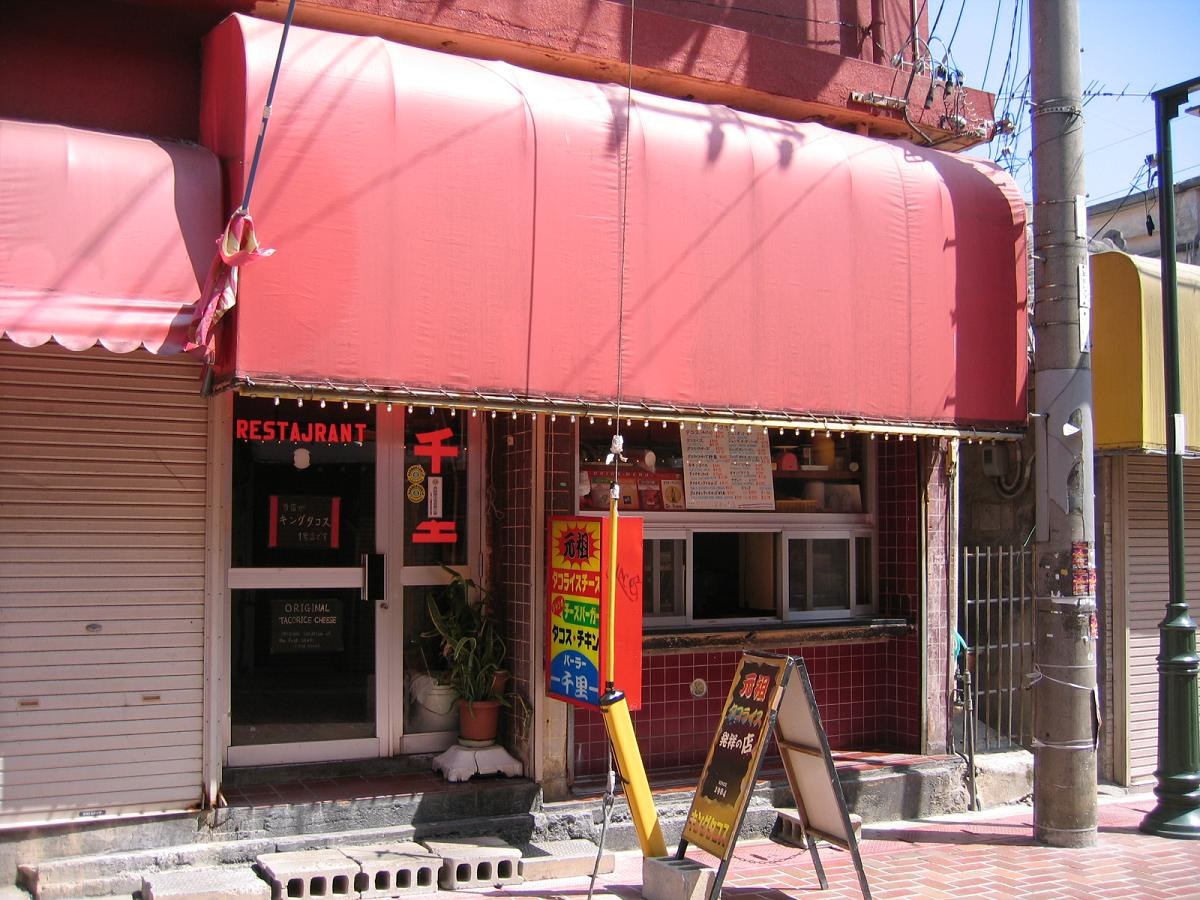
Kin Town’s own tourism portal tells the origin without embroidery. About 1984, at Parlor Senri — a small restaurant in Kin, the town outside Camp Hansen’s gates — the proprietor wanted to feed the base’s soldiers something cheap and filling, and set the fillings of a Mexican taco on white rice. Rice, the portal notes, was easier to get and cheaper than tortillas; the soldiers took to it at once. The tourism-association record names the man: Gibo Matsuzo, Parlor Senri’s founder, who opened the specialist house King Tacos the following year, in 1985.
The economics were the recipe. A strong yen had thinned the Marines’ pay packets in town; a plate that cost little and filled completely — meat, fat, starch, crunch, heat — was a kindness engineered as a menu item. Parlor Senri served it until the building aged out and the shop closed in 2015; the line Gibo founded carries it still, at King Tacos’ Kin main shop a few dozen metres from where the pink-awninged Parlor stood. This story’s second photograph is Parlor Senri itself, photographed in its working years.
The form: hot rice, cold lettuce
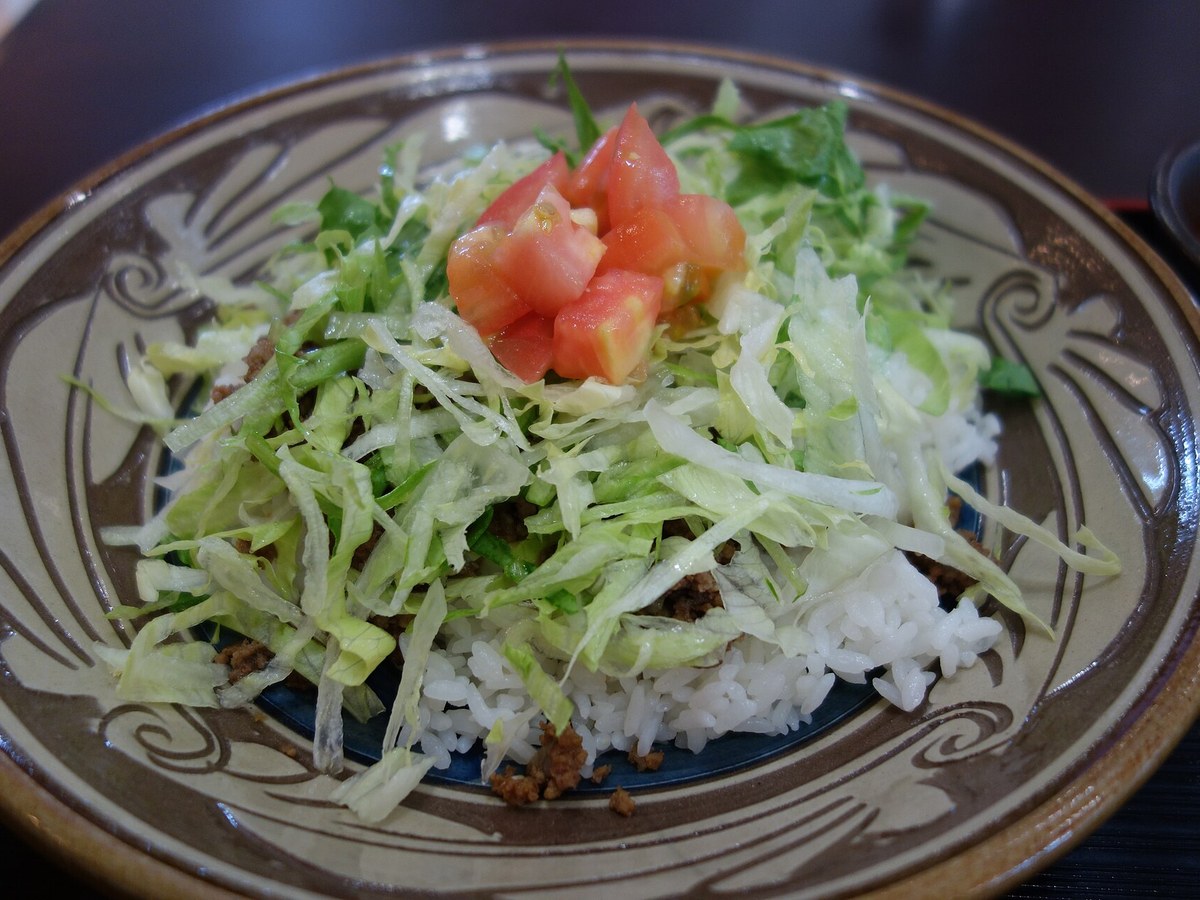
The town portal’s definition is the dish’s constitution: white rice; spiced ground meat; lettuce; cheese; tomato; salsa over all — a taco whose shell became a staple. Its recipe (for two) seasons 200 grams of mixed ground meat with onion, ketchup, Worcestershire sauce, soy sauce and chilli powder — the Japanese pantry bending the Tex-Mex spice rack toward itself — and piles it over rice with shredded lettuce, diced tomato, pizza cheese, salsa and mayonnaise.
The pleasure is engineered contrast, and the portal says so: hot rice and meat against cold, crisp lettuce and juicy tomato; melting cheese between them; salsa’s acidity tightening the plate; the red, green and yellow of it doing the appetising before the first bite. Houses adjust the heat, add a fried egg or avocado, or — at King Tacos — sell the plate in strictly named layers, of which more below. The constitution holds through every amendment: no tortilla, ever.
Chanpuru on a plate
Kin Town files taco rice as the symbol of chanpuru — Okinawa’s culture of mixing — and the filing is exact. An American military presence, a Mexican dish by way of Texas, Japanese rice and a Japanese pantry, an Okinawan shopkeeper’s thrift: the plate is the postwar history of the island served warm. From the Hansen gate it spread to diners and bento shops across Okinawa in the 1980s, to tourist menus in the 1990s, and into the prefecture’s school lunches and convenience stores — the route by which a base-town improvisation becomes a people’s food.
It now has the honours of an institution: a Taco Rice Day (4 November, its creator’s birthday, kept by the Taco Rice Lovers association), a founding family still running the specialist house, and a birthplace town whose portal calls it, simply, a new national food born in Kin. Dishes invented in boardrooms do not get school-lunch contracts. This one did, because it was invented at a counter, for named hungry people, at a price they could pay.
Ordering it in the birthplace, and what it costs
At King Tacos’ Kin main shop, the 2026 field guides agree on the shape of the menu and the trap inside it. Order “taco rice” plainly and you get the stoic original: rice and spiced meat, nothing else. The plate in every photograph — cheese, lettuce, tomato — is a separate menu name, taco rice cheese yasai, and it is enormous: 650 to 700 grams on the guides’ scales. Prices on the same readings: the plain plate about 600 yen, the cheese-yasai about 900 yen, both under a thousand-yen note for a meal built to fill a Marine. The English Okinawa guide puts the prefecture-wide range at 600 to 1,000 yen.
Eat it first in Kin, where the town’s portal sends you to King Tacos’ main shop at the top of the list, then anywhere on the island with the confidence of a local: mix the plate thoroughly — one bite should carry every layer — and let the salsa do its work. The dish’s birthplace closed in 2015, but its founder’s house is still serving his portion sizes a street away. Some monuments you can eat.
Sources — checked 14 November 2026
- Kin Town official tourism portal (Love KIN Life!) — Taco rice, the people’s food born in Kin Town
- 2026 King Tacos field guides and the Kin tourism-association record (read in search)
Checked 14 November 2026 (stored links re-fetched and judged per product): reserved where the page says so, with an editorial review note kept per product. Press, PR and travel use stays outside the grant.
Editorial review 2026-11-14