Order soba anywhere else in Japan and you get buckwheat. In Okinawa the word means something else entirely: thick, flat wheat noodles — not a grain of buckwheat in them — swimming in a clear pork-and-bonito broth under slices of braised pork belly, fish cake and pickled ginger. The name is so much Okinawa's own that when officials questioned it in 1976, the islands negotiated, and won it back on a date they still celebrate every year: 17 October, Okinawa Soba Day.
A soba with no buckwheat
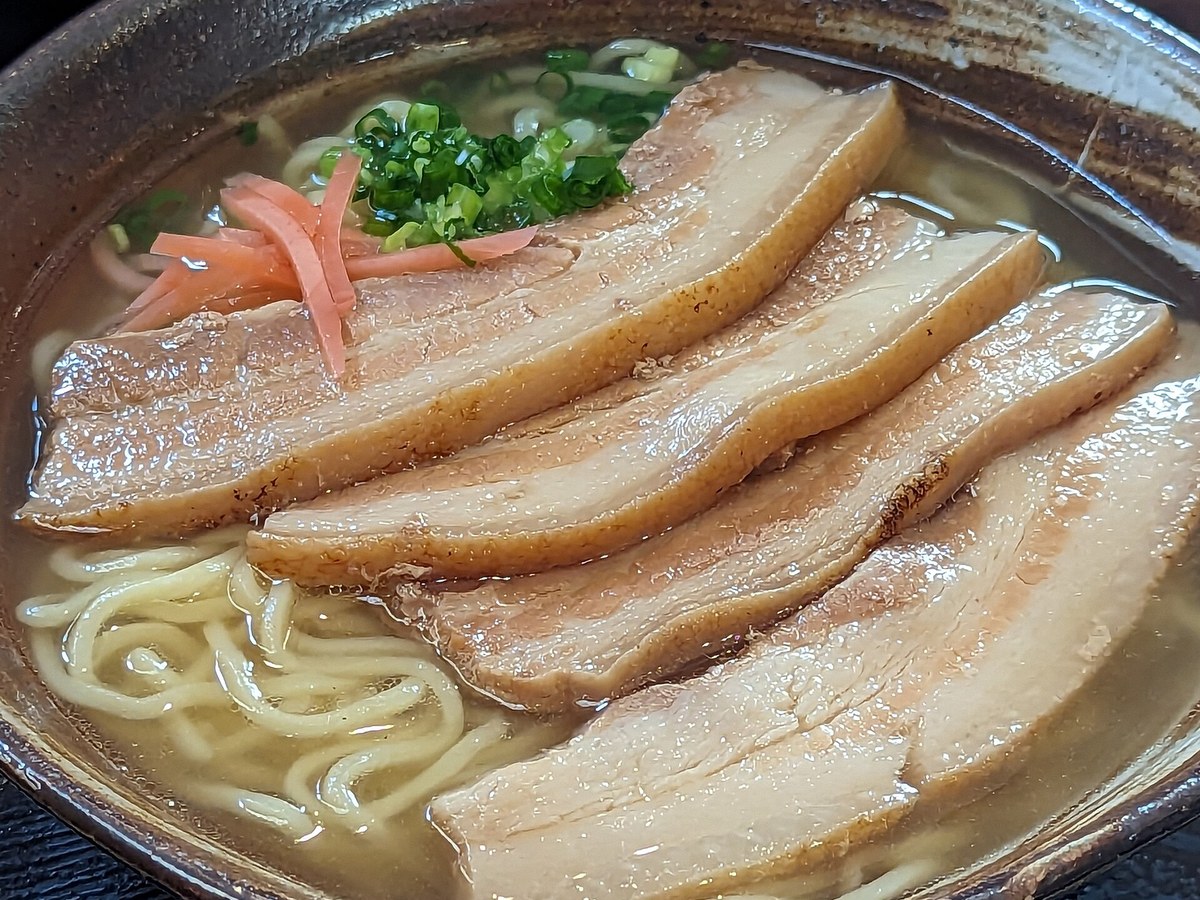
The definition is a paradox the record states flatly. Okinawa soba noodles are made from wheat flour kneaded with kansui, the alkaline water that also gives ramen its spring — some makers still filter the lye through wood ash in the old way — and the finished noodle is thick and firm, closer in family to a Chinese wheat noodle than to the buckwheat soba of the mainland. Locals call it suba, the Okinawan pronunciation, and the standard bowl tops it with sanmainiku pork belly, kamaboko, green onion and beni shoga.
The table condiment completes the signature: koregusu, island chillies steeped in awamori, added by the drop. A bowl is judged by its balance — noodle chew, a broth somewhere on the line between pork body and bonito clarity, pork cooked sweet-salty in soy and sugar — and every shop on the islands sets that balance for itself.
The name fight of 1976–1978
After Okinawa's reversion to Japan, the mainland's labelling rules met the island's noodle — and objected. In 1976 the Fair Trade Commission questioned the use of the name 'Okinawa soba' for a noodle containing no buckwheat at all. The Okinawa Fresh Noodle Cooperative negotiated to preserve the established regional name, and on 17 October 1978 'Honba Okinawa Soba' — genuine Okinawa soba — received formal recognition for use under the fresh-noodle industry's labelling rules.
The cooperative later made the anniversary itself the festival: 17 October has been Okinawa Soba Day since 1997, marked by shops and noodle makers across the prefecture. A second date completes the legal biography — 5 April 1987, when formal approval let Okinawa soba ship to mainland Japan, turning an island bowl into a national souvenir without surrendering the name.
From court dish to corner shokudo
The roots run through the Ryukyu Kingdom. The ministry's children's guide says the noodles came from China some 400 to 500 years ago and became a court dish; scholarly accounts name the channels as Chinese envoys from 1372 or Chinese settlers of the late 14th century. The modern paper trail starts in 1902, with a Naha newspaper advertisement for a Chinese-style noodle shop — the oldest record the Okinawa Industrial Technology Center holds — and the dish became everyday food from the Meiji era onward, spreading widest after the war.
Its flagship variation is younger. Soki soba, topped with braised pork ribs — honsoki bone-in, or nankotsu cartilage simmered until the cartilage itself can be chewed — emerged in Nago in the mid-1970s; the cooperative's timeline lists 1975, and Nago's Gabusoka Shokudo, a butcher family's shop founded in 1966, is the house most often linked with putting its leftover ribs on the noodles.
Eating it in Naha and Nago
This is everyday food at everyday prices. At the shops surveyed for the regional guide on 3 November 2026, a soki soba stood at about ¥950 — Shuri Horikawa in Naha, making its own noodles near Shuri Castle, lists its soki soba at ¥950, and Gabusoka's large soki soba in Nago is listed from ¥950 — while a combination Special Soba with ribs, belly and trotters ran to about ¥1,300. Small shops close when the soup or noodles run out, so the local rule is to arrive before the lunch rush peaks.
Start with the standard bowl in Naha, add koregusu drop by drop — it is chilli in spirits, and it is hot — and pair it the island way with jyuicy, Okinawa's seasoned pork rice. Then argue, as Okinawa does, about whether the rib bowl of Nago or the belly bowl of the capital is the true form. The argument is part of the dish.
Sources — checked 12 November 2026
Original prose and official links only; no source text or maker media reproduced. Photos are credited Creative Commons works, not product photographs.
Editorial review 2026-11-12