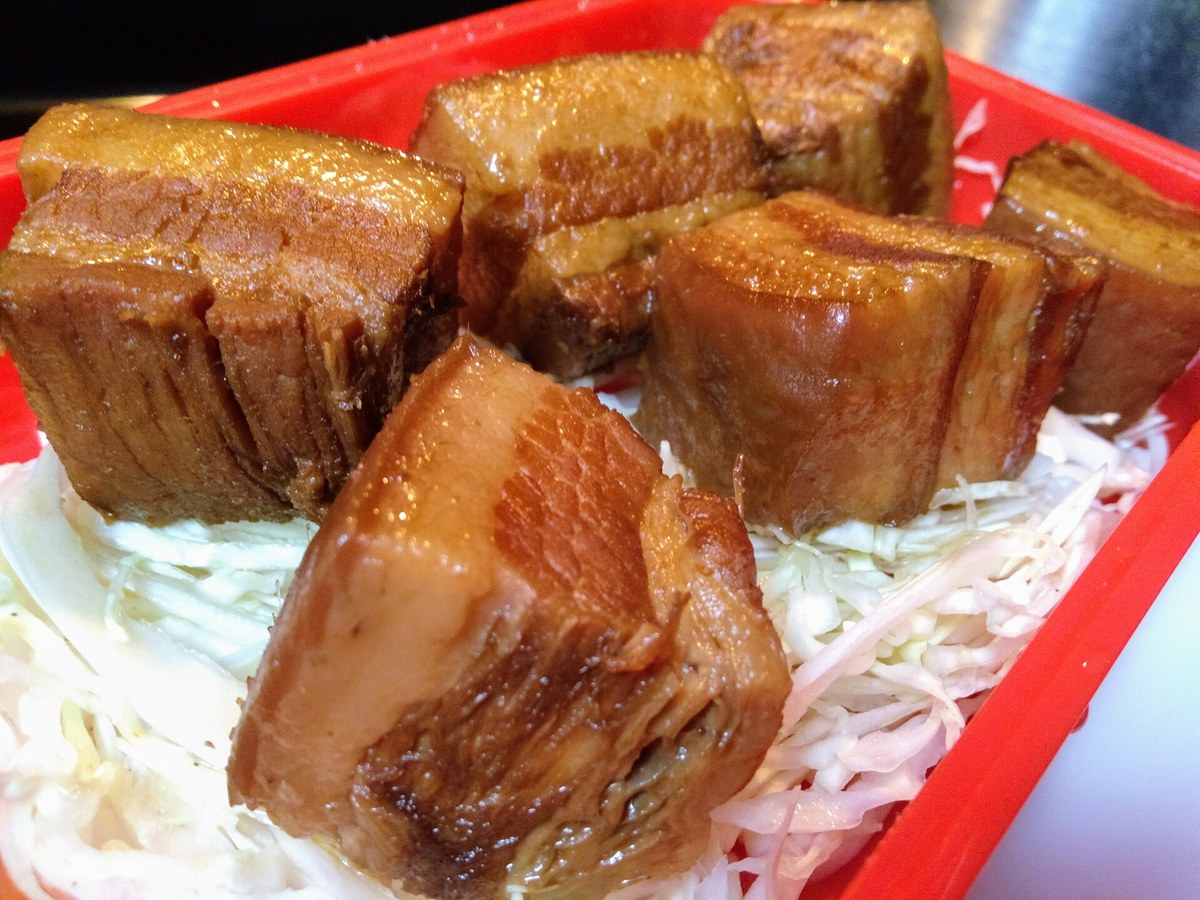
Rafute is the dish Okinawa’s pork culture points to when it wants to prove itself: skin-on pork belly — sanmai-niku, “three-layer meat” — stewed for six or seven hours in katsuo dashi, awamori, sugar and soy until the skin cuts with chopsticks and the whole block shines. It descends from the Ryukyu royal court and from China’s Dongpo pork, it was once a preserved food for a hot island, and it is still the plate Okinawa sets before honoured guests — and before the ancestors.
“Begins and ends with pork”
The agriculture ministry’s Okinawa record opens with the prefecture’s proverb: Ryukyuan cooking begins and ends with pork. Meat, offal, face, ears, even blood are used, and skin-on belly — sanmai-niku — above all. The culture itself is a trade artefact: pork cookery deepened through the Ryukyu kingdom’s long exchange with China, the meat taboo that bound mainland Japan never took root on the islands, and so pork is served in Okinawa even at Buddhist memorial rites, where the mainland would serve none.
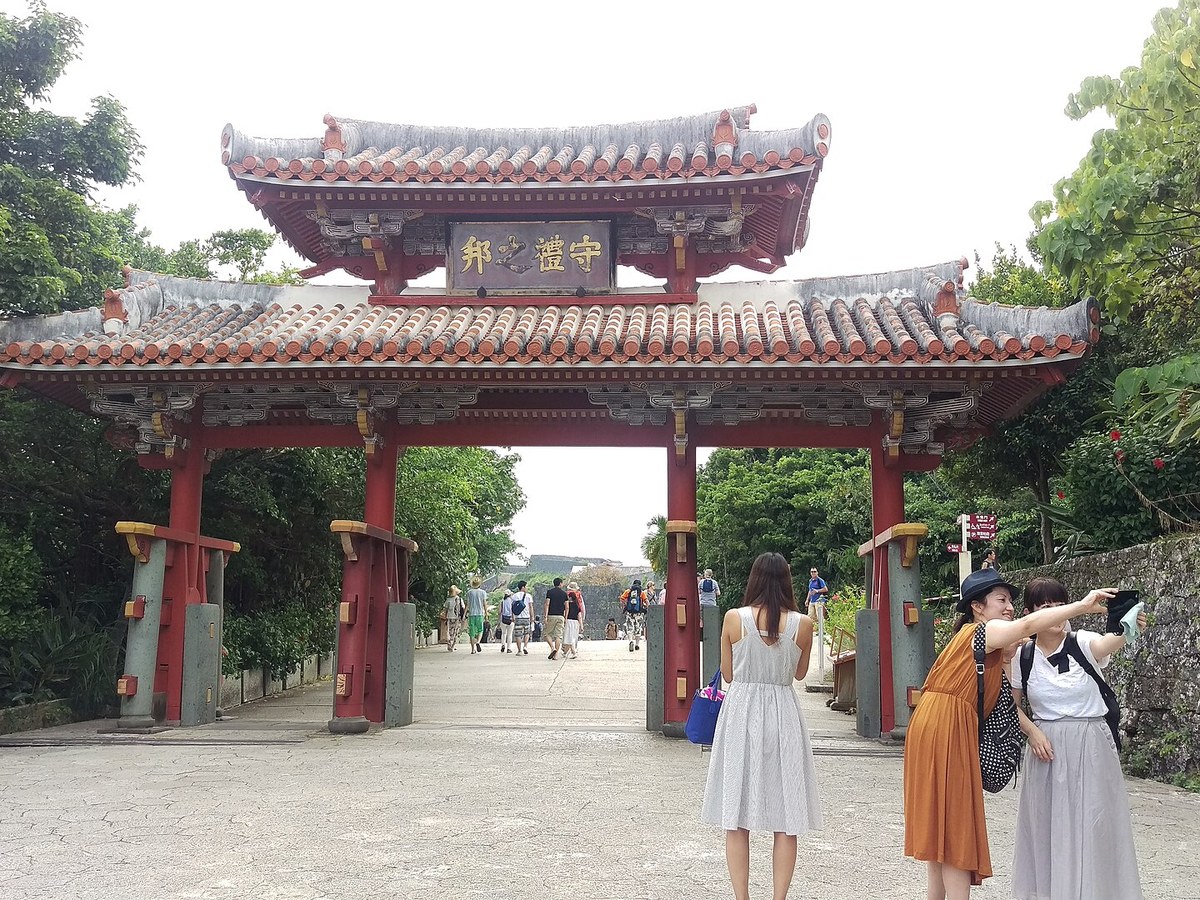
Rafute is that culture’s most famous plate. The ministry’s definition is exact: skin-on belly stewed patiently in sugar, soy sauce and awamori, soft, the skin melting on the tongue, a trace of the liquor left in the aroma. Its prototype travelled the same trade route — China’s Dongpo pork, naturalised at the Ryukyu court — and the dish still also answers to its other name, rafuti. The second photograph is the court it came from: Shuri Castle’s Shureimon gate.
Six or seven hours, by the book
The ministry recipe, provided by the Ryukyuan culinary researcher Ashitomi Junko, is a timetable as much as a method. Sear the skin over direct flame, scald the block, then simmer it whole for about an hour and a half and let it cool in its own liquor — the step that keeps the layers together. Cut it into four-to-five-centimetre blocks. Then the long stew: katsuo dashi and a full cup of awamori for an hour, sugar for an hour, half the soy sauce for an hour, the rest of the soy for two. Six to seven hours in all is ideal, the record says, and the test is tactile: done when the skin cuts with chopsticks.
Nothing in the method is decoration. The flame-searing cleans and firms the skin; the awamori is solvent, perfume and preservative at once; the sugar goes in before the soy so the gloss sets before the salt; the two-stage soy keeps the colour deep without hardening the meat. Home cooks shorten it. The record does not pretend they should: rafute is the dish Okinawa makes when time is the ingredient it is spending.
From preserved food to the guest plate
Before refrigeration, rafute was preservation: a strongly seasoned, thoroughly stewed block that kept in a hot climate, made ahead and sliced as needed. As the islands got colder cupboards the seasoning lightened, and the dish moved up the table — from storehouse staple to kyakuzen, the guest plate, served at celebrations and, in Okinawa’s pork-everything logic, at memorial rites as well. It remains a feast food: New Year, weddings, the honoured visitor, the ancestors’ table.
Today it is also everyday infrastructure. Restaurants and izakaya across the prefecture plate it as a set piece; Okinawa soba shops lay a slice on the noodles; and the retort pouch — the ministry notes them in every supermarket and souvenir shop — has made rafute the prefecture’s most exportable hour-intensive dish, six hours of stewing folded into a shelf-stable packet. The form travels; the definition, belly with skin in awamori and sugar, stays Okinawa’s.
Retort prices, honestly small
The pouch is the easiest way in. Okinawa Hormel’s “Honba-jikomi” rafute — 125 grams of belly stewed in awamori, Okinawa brown sugar, Kume Island salt and sugarcane-bagasse powder, finished in Okinawa by the traditional method — sells at Yodobashi at 427 yen including tax, in stock, forty seconds in the microwave in its pouch. Beside it on the same shelf: Okiham’s seared rafute, 160 grams at 756 yen including tax, and JCC’s Rokkakudo rafuti, 280 grams at 1,510 yen.
In Okinawa itself, order it where the menu is Ryukyuan and the pot has clearly been on all day; the plate should arrive glossy, layered and trembling, with the skin as the point rather than the obstacle. Buy the pouches by the maker’s address: the ones stewed and packed in Okinawa, like the Hormel pouch above, are the ones that carry the court’s recipe rather than its silhouette.
Sources — checked 14 November 2026
- MAFF, Our Regional Cuisines — Rafute (Okinawa)
- Yodobashi — Okinawa Hormel “Honba-jikomi no Okinawa Rafute” 125 g
Checked 14 November 2026 (stored links re-fetched and judged per product): reserved where the page says so, with an editorial review note kept per product. Press, PR and travel use stays outside the grant.
Editorial review 2026-11-14