No Japanese textile shouts like bingata: vermilion, yellow and indigo laid in stencil-sharp flowers over a dyed ground, in combinations the mainland would call impossible. Okinawa's fifth story is the dyeing of Shuri — court cloth for a small kingdom, destroyed almost completely in 1945, and rebuilt stencil by stencil from what its founding houses had saved.
The kingdom's own cloth
The craft account places the dyeing around Shuri, Okinawa, with origins in the fourteenth to fifteenth centuries — it notes there is no clear origin record, though a description thought to be of bingata survives in fourteenth-century documents — when Ryukyu sat at a relay point of East China Sea trade and dyeing techniques arrived from China, India, Indonesia and beyond, to be assimilated into a textile found nowhere else. What it made was court dress: the ladies of the royal family and the families of the warrior class wore Ryukyu bingata, and its materials, patterns and colours varied according to age, gender and social class.
The kingdom guarded its cloth as an asset. Bingata was protected by the Ryukyu royal government, became a valuable article of commerce, and was presented to China and to the Edo shogunate — a small state's diplomacy in dyed silk and cotton. The prefecture's craft centre calls it the only dye technique in Okinawa extolled as the epitome of dynastic culture, worked on silk, hemp, basho banana fibre and cotton alike.
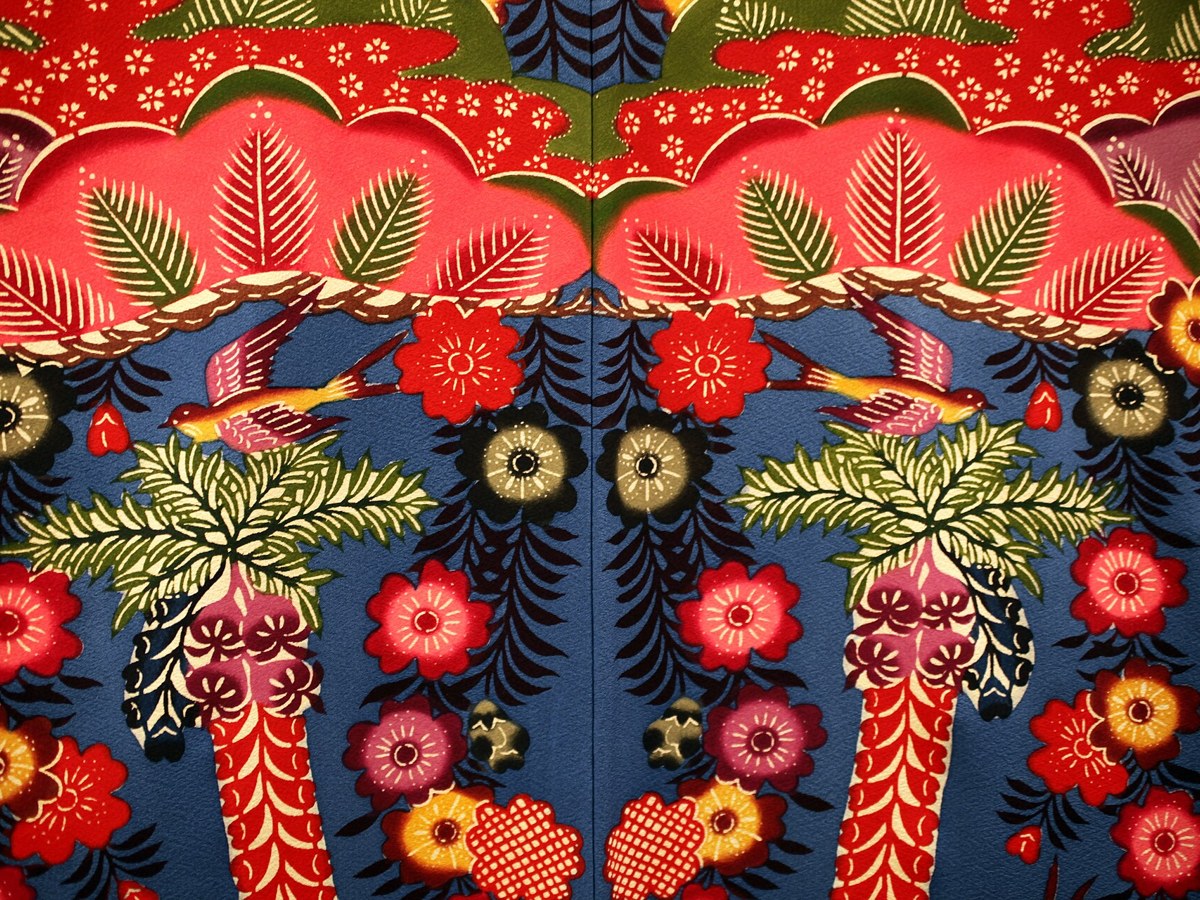
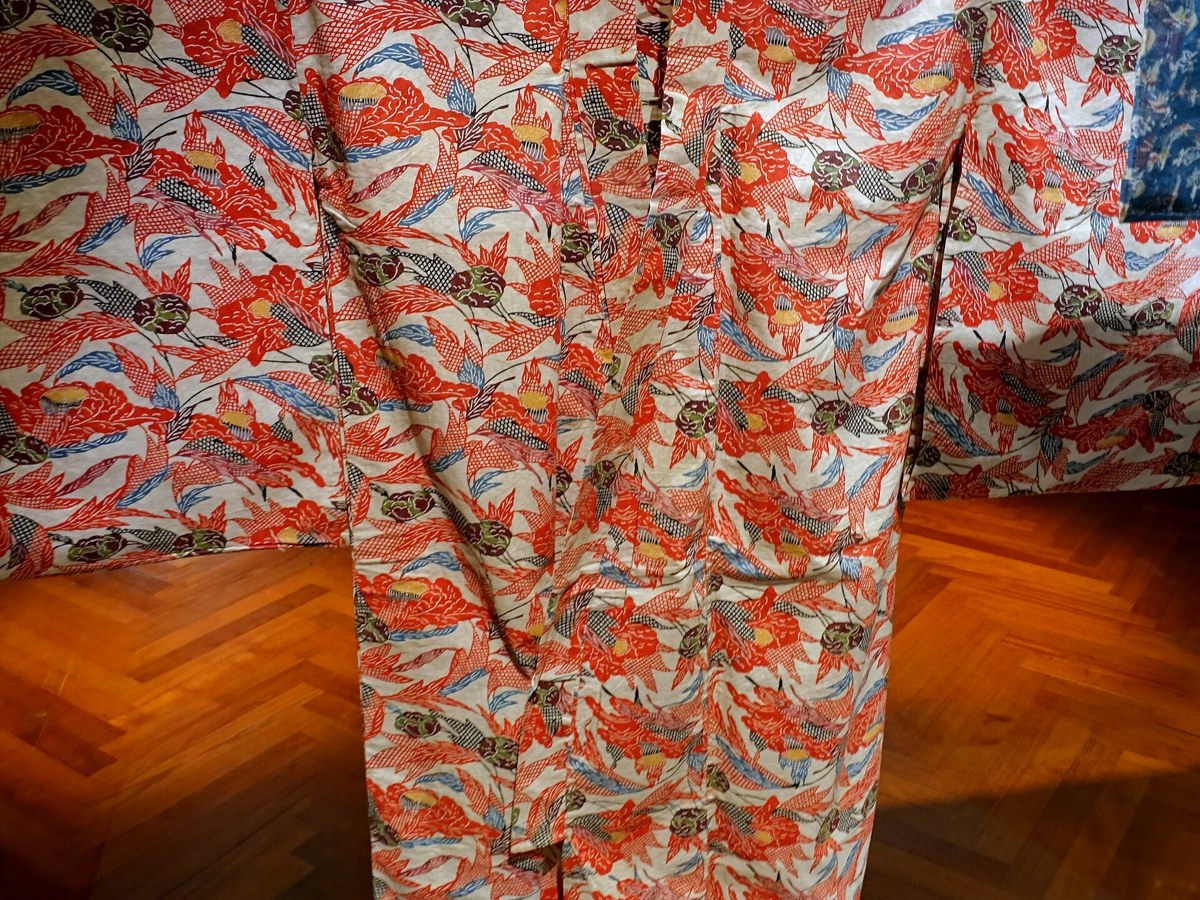
Pigment on a stencil, shading by hand
Bingata's sharpness is carved, not drawn. The pattern is cut into shibugami — layers of Japanese paper hardened with persimmon tannin — by the tsukihori push-carving method; the stencil is laid on the cloth and a resist paste of glutinous rice and rice bran is spread through it with a spatula. Before colouring, a fixing coat of gojiru, soy milk and starch, prepares the cloth, and the colours go on light first.
Two families of work divide the craft: the bright multicolour bingata and the indigo-dyed aigata. Stencil work — katatsuke — serves kimono cloth and obi, while freehand tsutsuhiki draws the great tableau curtains and furoshiki. What makes the colour sing is that the patterns are pigments, sitting as particles on the surface over plant-dyed grounds, shaded by the kumadori gradation the sources call unique to Ryukyu bingata; the cloth is then steamed for up to an hour and washed. The Chinen house counts the whole road at more than ten distinct steps, its resist paste still hand-made from glutinous rice and rice bran, and notes that Ryukyu's own indigo dyes a deeper, more intense blue than the mainland's.
Three houses, one abolished kingdom, one war
Production was hereditary at the top. A checked profile of the Chinen house — whose tenth-generation head also serves as vice-director of the Ryukyu Bingata Business Cooperative — records that in the Ryukyu dynasty bingata was crafted as tribute for the royal family by three bingata master families: the Shirogane family, the Takushi family and the Chinen family. The wider trade worked beneath them, in the towns the designation table still names.
The patronage ended twice. When the tributary system was abolished in 1879, the craft centre records, the industry lost much of its political favour and entered a long decline. Then Okinawa was severely damaged in the Second World War, and many of the bingata patterns and tools were destroyed — the design archive of four centuries, largely gone in one battle.
Rebuilt from the houses' own archives
The revival is documented as an act of retrieval: intense efforts during postwar reconstruction rebuilt the craft on historical archives owned by the founding houses of bingata and on records retrieved from outside Okinawa. The organisation followed the cloth back — a preservation association in 1950, the Okinawa Traditional Bingata Preservation Association in 1973, and the Ryukyu Bingata Business Cooperative Association on 27 August 1976.
The designations closed the recovery. Okinawa made bingata a prefectural traditional craft on 11 June 1974, and the national Traditional Craft designation followed on 31 May 1984; the designation table fixes manufacture to Naha, Ginowan, Urasoe, Itoman, Tomigusuku and Nanjo, with Shuri as the historic core. The workshop record below shows the craft's present price of patience: a half-width obi of unbleached cotton tsumugi, some 360 to 390 centimetres long, hand-dyed and reversible, is one of a kind — the workshop shifts a colour somewhere at every dyeing, even within one pattern — and takes two to four months to make to order.
Sources — checked 11 November 2026
- KOGEI JAPAN: Ryukyu Bingata
- Okinawa Craft Industry Promotion Center: Ryukyu Bingata designation record
- Ryukyu Bingata workshop (WORK goods): hand-dyed half-width obi
Original prose and official links only; no source text or maker media reproduced. Photos are credited Creative Commons works, not product photographs.
Editorial review 2026-11-11