Osaka’s kushikatsu is a skewer, a batter, a bath of sauce — and one law. In 1929, in the Shinsekai district under the Tsutenkaku, Momono Yoshie began frying beef, seafood and vegetables on bamboo sticks, cut small so day labourers could eat well for coins. The sauce sat in a shared bath on every counter, and the rule she is remembered for still governs the city’s counters: dip once, deeply — and never, ever dip a bitten skewer again. No double-dipping is not a slogan in Osaka. It is the etiquette the dish is served under.
1929: Yoshie’s skewers for the men of Shinsekai
Shinsekai, Osaka’s pleasure district built around the Tsutenkaku tower, ran on day labour. In 1929 (Showa 4) Momono Yoshie opened the house that became Kushikatsu Daruma there, and her idea was portion engineering: beef was expensive, so she cut it small, threaded it on bamboo, battered and fried it, and sold nourishment by the stick at a labourer’s price. Seafood, vegetables and everything else in the market followed the beef onto skewers; the menu has never really closed since — quail eggs, lotus root, asparagus, cheese, red ginger, mochi and dozens more.
For three generations Daruma was one small shop on the site its Shinsekai main shop still occupies; it now runs fourteen shops across Osaka and beyond. But the dish escaped its inventor long ago, the way Osaka food does: kushikatsu counters multiplied through Shinsekai, Dotonbori and Umeda until the fried skewer became the city’s standing-bar standard, and Daruma became first among equals — the house whose name and rule everybody quotes.
The law of the sauce bath
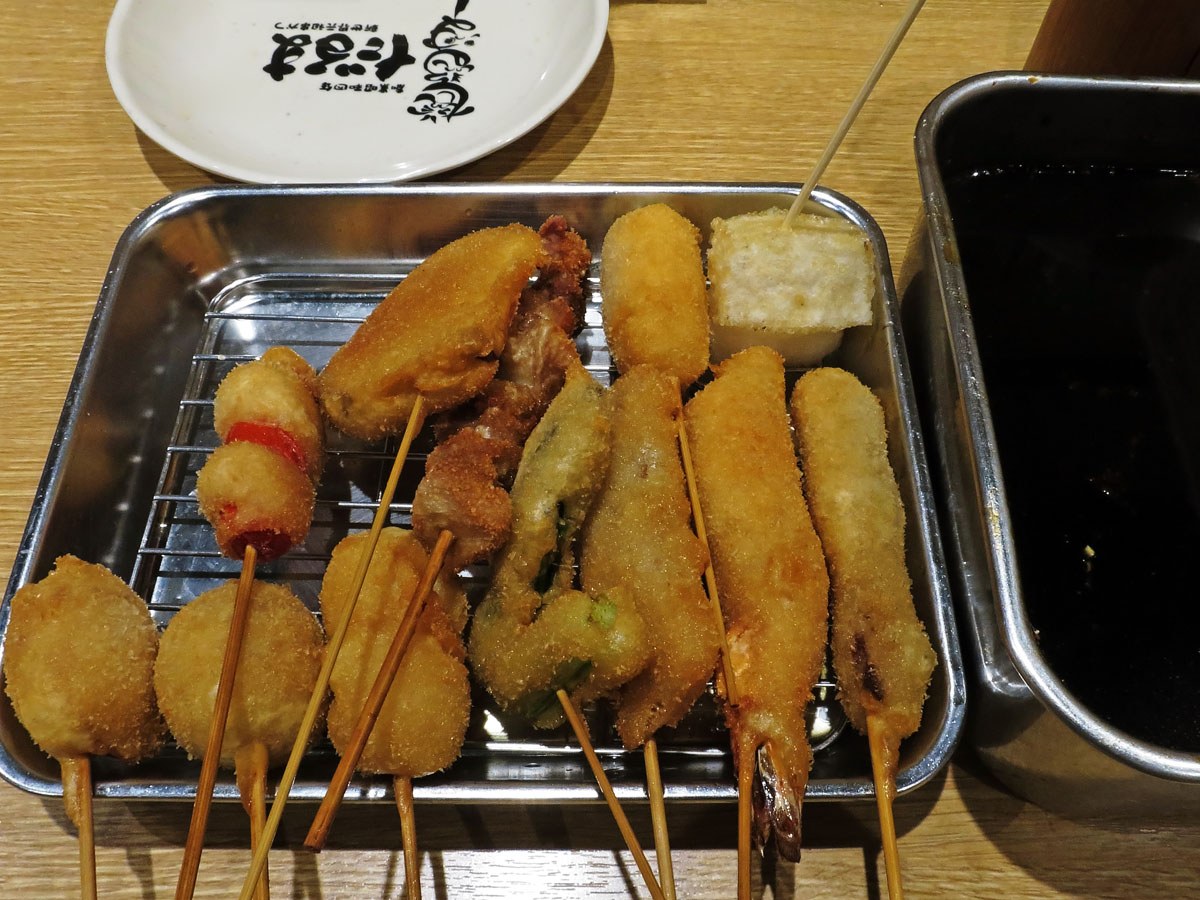
The classic counter carries the sauce in a deep shared bath, thin and fruity-savoury, built to coat rather than cling. The form is: take the skewer, plunge it once — Daruma’s own guidance is to dip more deeply than feels polite — and eat. Then the law: a skewer that has been in a mouth never re-enters the communal sauce. The house’s mascot, modelled on a former president, holds the sign; the spoken formula is “no second dip, please”. If you want more sauce, the garnish cabbage is the licensed spoon — scoop with an unbitten leaf.
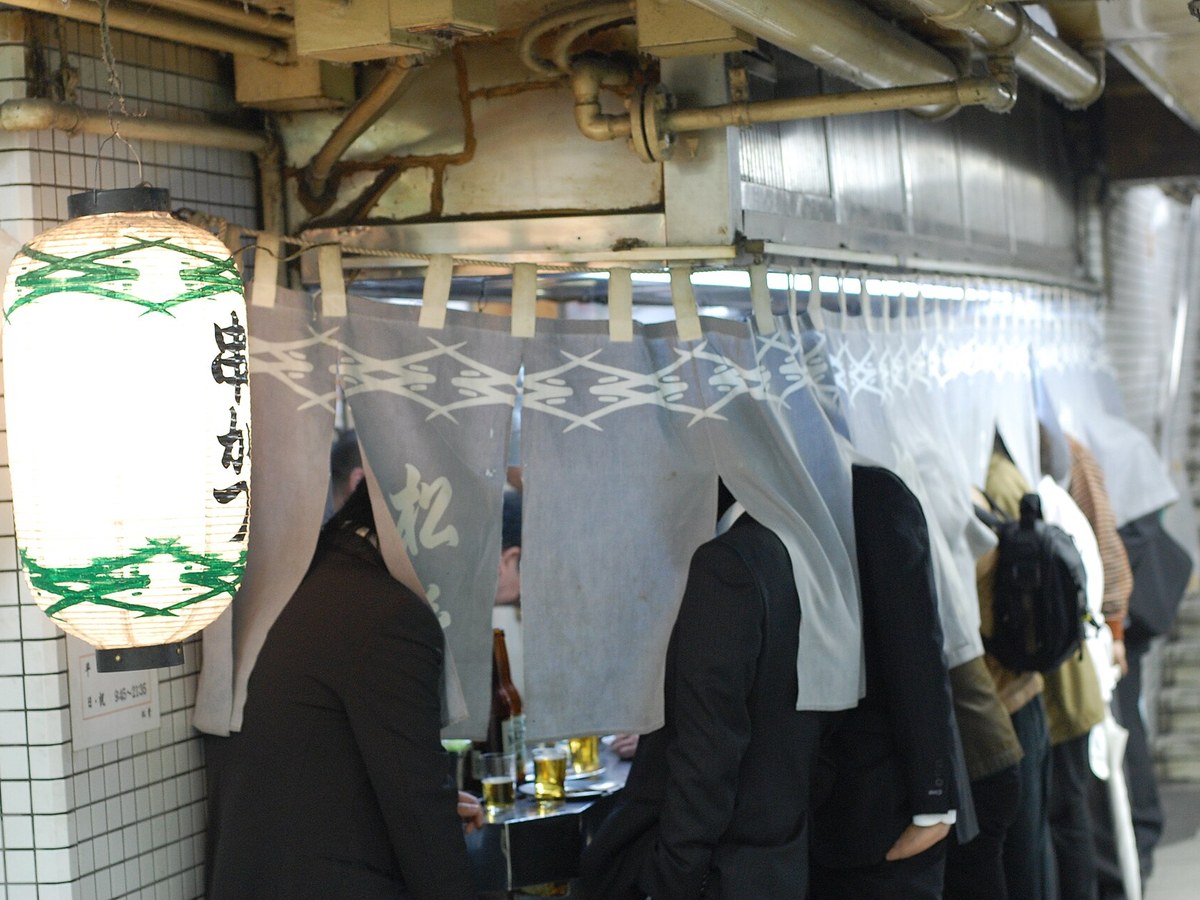
Since the pandemic years the shared bath itself has largely retired: Daruma and its peers now pour from bottles or serve individual dipping dishes, and the sauce recipe and the rule survived the plumbing unchanged. This story’s photographs hold both ends of the culture — a Daruma tray of mixed skewers beside the black sauce bath as it was, and Matsuba’s Umeda shopfront, lantern and noren over the queue, one of the old independent counters the dish built.
Beef first, batter fine
Two technical points separate Osaka kushikatsu from fried food generally. First, the lead skewer is beef: the ganso kushikatsu, the original stick, is thin beef wound on the bamboo, and it heads every Daruma menu and set — in Tokyo the word katsu defaults to pork, in Osaka’s skewer shops it defaults to beef. Second, the batter: fine, thin, almost a crumb veil, fried to a pale gold that shatters quietly, so a dozen sticks stay lunch rather than ballast.
Eat standing, eat in rounds. Counters serve a stick or two at a time so nothing cools; cabbage is free and constant; doteyaki — beef tendon simmered in white miso — is the standing side. The districts are a walking map of the dish: Shinsekai for the origin, Janjan Yokocho for the old counters, Umeda for Matsuba’s basement institution, Dotonbori for the queues.
A stick, priced
Daruma’s own menu prices the original stick at labourer money, on purpose. The house menu (the official menu PDF, read this run) lists the ganso kushikatsu — the beef skewer — at 130 yen, 143 yen including tax. Skewers run upward from there through the standard sticks to the premium selection at 300 yen (330 yen including tax) and 400 yen (440 yen including tax), and the sets are assembled from the same sticks: the Chayamachi set at 2,450 yen, 2,695 yen including tax.
That base price is the dish’s founding document in numerical form: 1929’s promise — a working person eats well for coins — kept on the menu of a house that now queues tourists from three continents. Order the ganso first, dip it once and deep, and you have performed the whole culture correctly.
Sources — checked 14 November 2026
- Kushikatsu Daruma — the house record (founded 1929, Shinsekai)
- Osaka kushikatsu — skewered cutlets and the no-double-dip rule (JEEPE Osaka guide)
- Kushikatsu Daruma — official menu (house menu PDF)
Checked 14 November 2026 (stored links re-fetched and judged per product): reserved where the page says so, with an editorial review note kept per product. Press, PR and travel use stays outside the grant.
Editorial review 2026-11-14