Ikameshi is two squid and a wartime idea. In 1941, at Mori Station on Hokkaido’s Hakodate Main Line, rice was rationed and the station-bento maker’s wife, Abe Shizuko, looked at the squid landing in mountains at Funka Bay and did the arithmetic of scarcity: stuff the rice inside the squid, and a small amount of staple becomes a whole meal. Eighty-five years later the same red box — two small surumeika simmered in sweet soy, each pregnant with mochi and uruchi rice — is still Japan’s most famous station bento, and still made by the same house.
1941: rice inside the squid
The maker’s record is precise about the birth. Ikameshi was launched in 1941 by Abe Bento-ten — today Ikameshi Abe Shoten — the bento maker of Mori Station in Mori Town, Hokkaido, and it was devised by Abe Shizuko, the proprietor’s wife. Wartime food control made rice the bento’s scarcest ingredient, while surumeika squid was landing in abundance in nearby Funka Bay; stuffing the squid with rice stretched the staple without shrinking the meal. Shizuko trialled fillings of potato, pumpkin and corn and rejected them all — “no fun to eat” — and the name was her call too: ikameshi, country-plain, over the politer ikagohan, because, she said, this was country food.
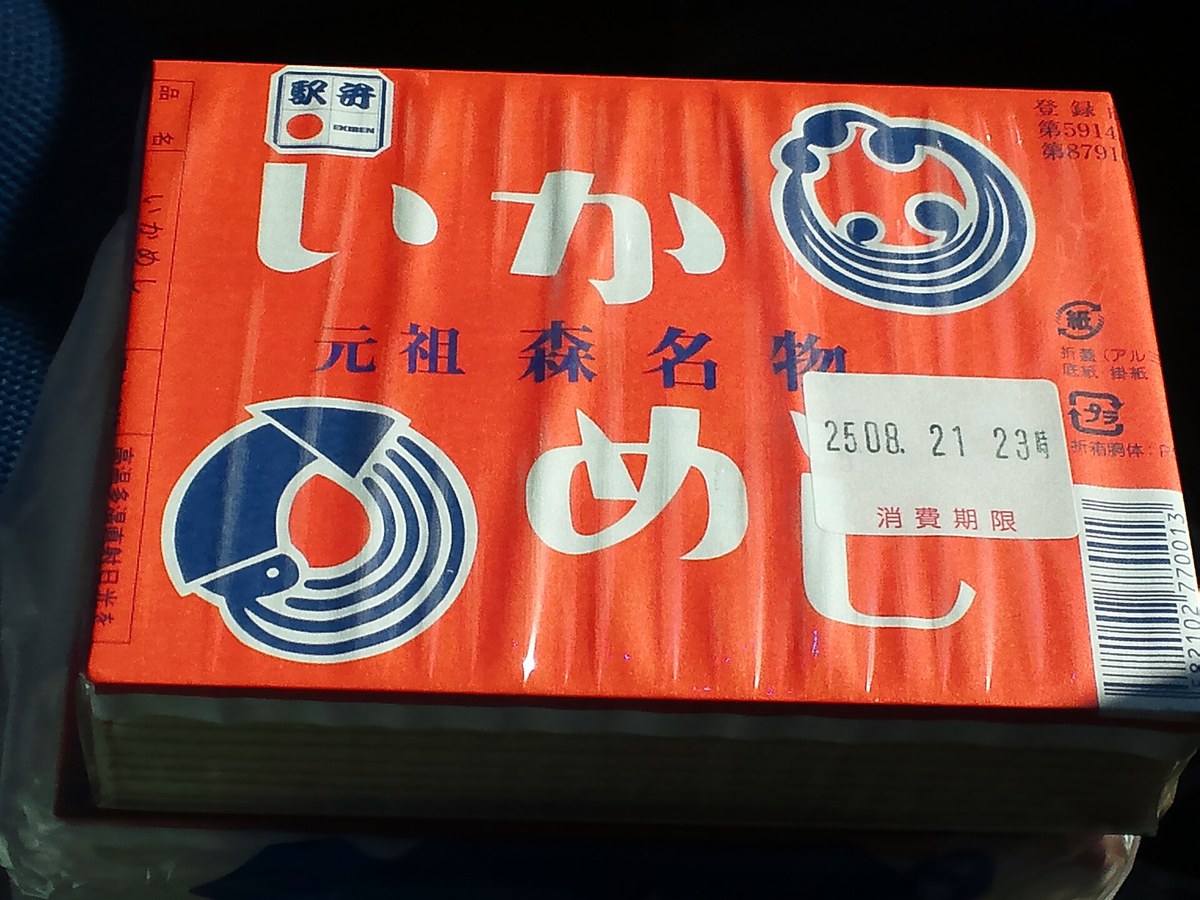
The form she fixed is the form today: small surumeika, cleaned whole, stuffed with a blend of mochi rice and uruchi rice, closed and simmered in the house’s sweet-soy tare until the squid is tender and the rice inside has taken the liquor. Two squid to a box. The red wrapper — Ganso Mori Meibutsu Ikameshi, “the original Mori speciality” — is this story’s second photograph, and it has been the dish’s face at every ekiben fair in Japan.
The ekiben fair made it national
Mori is a small town three hours from Sapporo, and ikameshi would be a local secret without one institution: the Keio department store’s great ekiben fair, running since 1966, where Abe Shoten’s box became a perennial best seller and, repeatedly, the fair’s number one. Department-store fairs and station retail carried the red box across Japan; the summer platform standing sales at Mori Station itself — the maker selling through train windows in high summer, a scene this story’s spare photograph keeps — became the dish’s living postcard.
Two adaptations kept it travelling. Since the 1970s the squid has been sourced from New Zealand, chosen on the maker’s judgement because it stays tender after simmering and cooling — a bento is eaten cold, and toughness is the cold squid’s failure. And since 2016 a vacuum pack has stretched the box’s life from one day to three months, putting Mori’s bento into Hokkaido’s main stations and airports without changing the simmer.
Cut it and see the rice
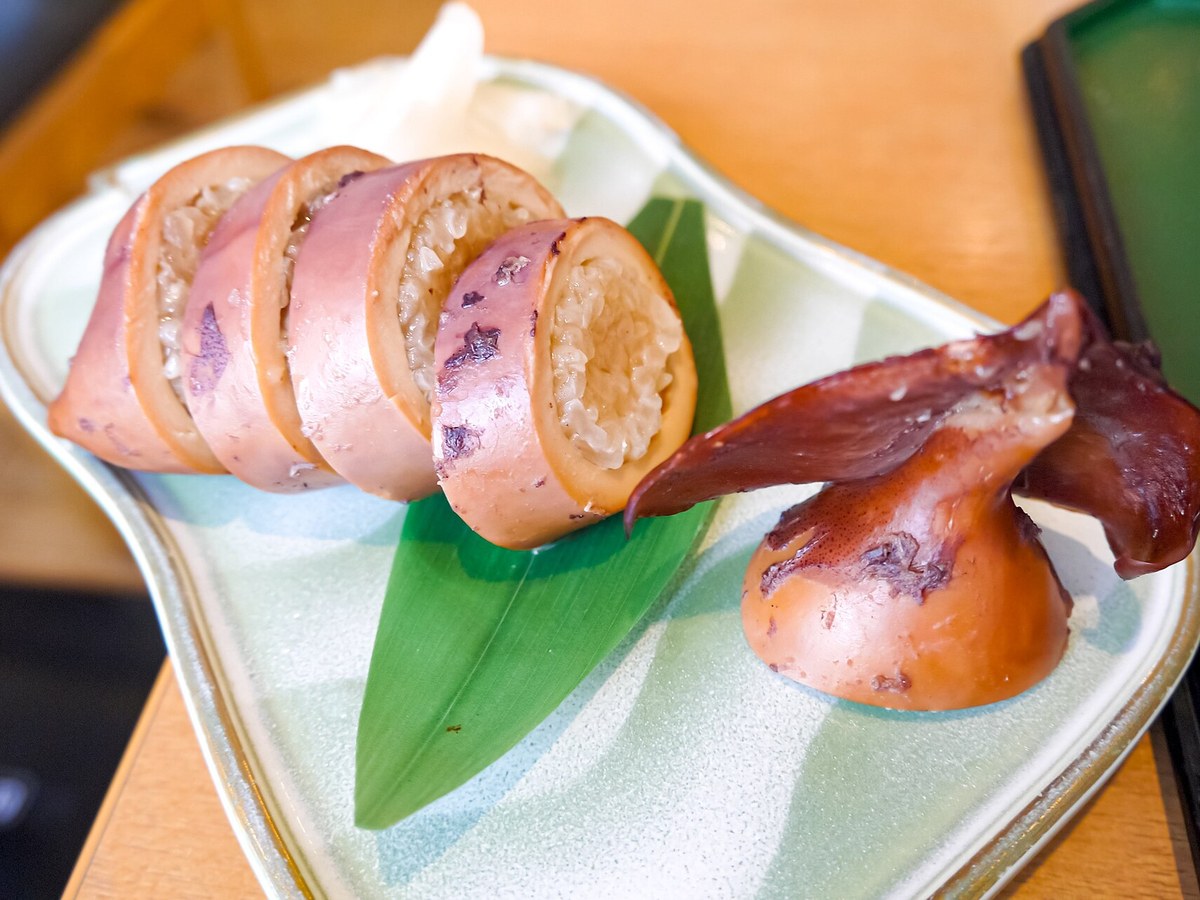
Ikameshi is eaten sliced, and the slice is the proof: this story’s first photograph shows the rounds on their plate, each one a ring of tender squid around a core of seasoned rice, the head beside them. Warm it gently and the tare gloss returns; eat it at room temperature, as the fair crowds do, and the chew is the point — squid, rice and sweet soy in a single bite-sized cylinder, engineered in 1941 to be satisfying on a train and unchanged because the engineering was right.
Buy the box where the maker’s name is on it: Abe Shoten’s own shop at Mori Station and its station-front store are the pilgrimage serve, still with platform sales in high summer; elsewhere, the ekiben fairs and the vacuum packs are the documented routes. The one-squid box exists for the hesitant — the maker sells a single at a lower price beside the canonical pair.
¥350 to ¥1,450: the price of a squid
Ikameshi’s price history is Japan’s seafood history in one line. The box cost 350 yen in the 1980s and 400 yen in 1983; the surumeika catch then collapsed — Japanese squid landings have fallen to record lows — and the maker has raised the price in steps rather than shrink the squid or change the recipe, reaching 1,450 yen as of January 2026 on both the maker’s recorded history and TBS’s January 2026 reporting from the Tokyo fairs, where the boxes are still made by hand on site and still sell out. A one-squid box at 880 yen stands beside the pair for buyers who balk.
It remains, even at 1,450 yen, the cheapest famous ekiben in its class — and the price is the honest part of the story: a wild-caught squid dish cannot pretend the sea has not changed. What Abe Shoten sells, at every step of the rise, is the refusal to let the 1941 form change with it.
Sources — checked 14 November 2026
- Ikameshi Abe Shoten — the maker’s record (Mori Station, Hokkaido)
- TBS News DIG, January 2026 — the Ganso Mori ikameshi at ¥1,450
Checked 14 November 2026 (stored links re-fetched and judged per product): reserved where the page says so, with an editorial review note kept per product. Press, PR and travel use stays outside the grant.
Editorial review 2026-11-14