Akumaki is the amber mochi Kagoshima boils in ash lye: glutinous rice soaked overnight in wood-ash water, wrapped in bamboo skin and boiled for three hours until it sets like tortoiseshell. It tastes of almost nothing — and that is the point: the kinako, sugar and salt you shake over it do the talking.
Rice, ash lye and bamboo skin
The making is a soak, a wrap and a long boil. Glutinous rice rests overnight in aku — the lye drawn from wood ash, hardwood ash prized — and is then wrapped in the skin of mosochiku bamboo, itself soaked overnight, tied with strips torn from the same skin, and boiled in lye for more than three hours. Inside its tough parcel the rice swells and sets by its own pressure into a single mass; the strong alkali gelatinises the starch and browns it, Maillard-deep, to a tortoiseshell amber.
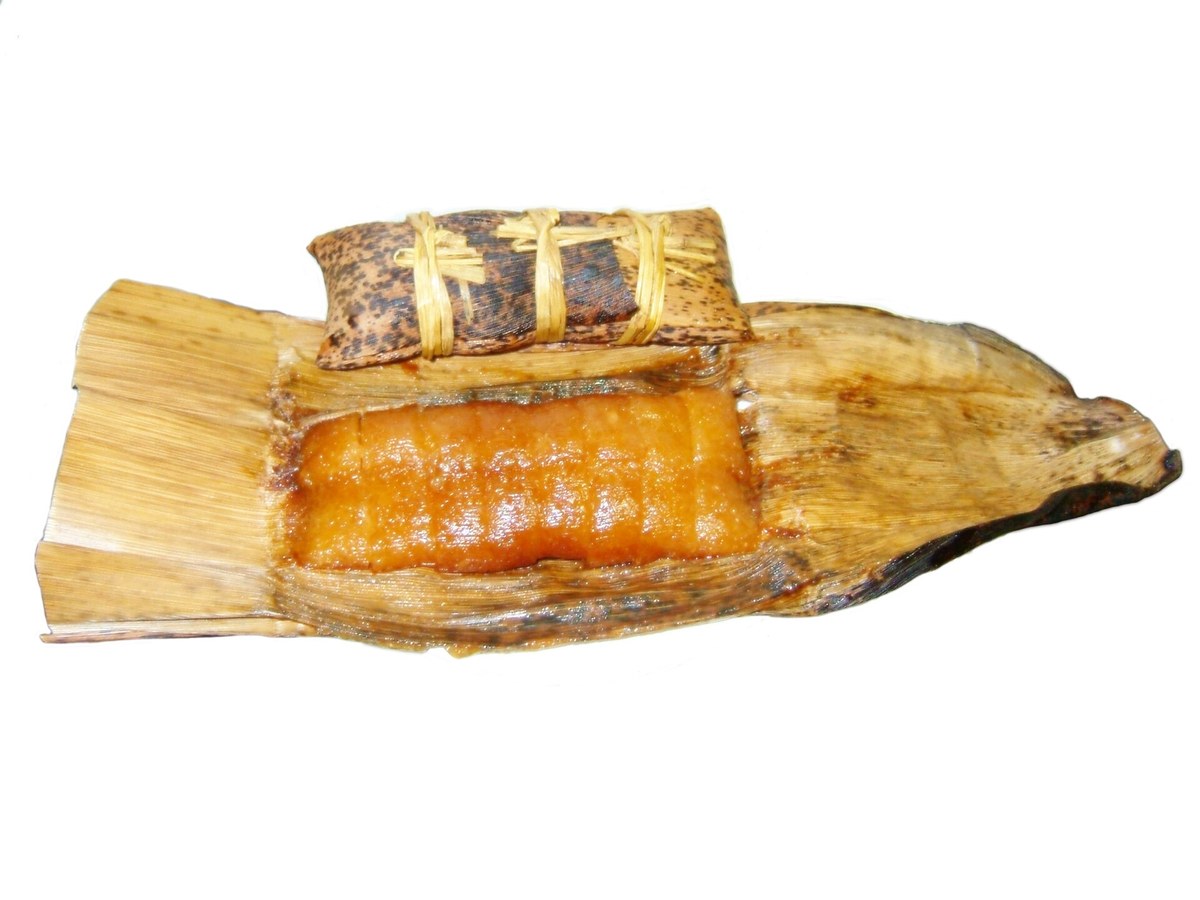
The texture is the surprise: moist and soft, barely sticky, the grains just visible, and — unlike ordinary mochi — it does not harden as it cools. Most akumaki run to just under the size of a 500-millilitre bottle. Our first photograph is the encyclopedia’s own frame: the parcel in its skin above, and below it the unwrapped akumaki cut the proper way, with a thread.
A sweet that is not sweet
On its own an akumaki is almost flavourless, with a faint astringent edge that divides people until habit converts them. So the eater seasons it: kinako mixed with sugar and a pinch of salt is the standard, with brown-sugar powder, kuromitsu syrup or sugar-soy sauce behind it, and honey, tamari or even cocoa claimed by their partisans. It is eaten at room temperature, or chilled, which softens the edge for the unconverted.
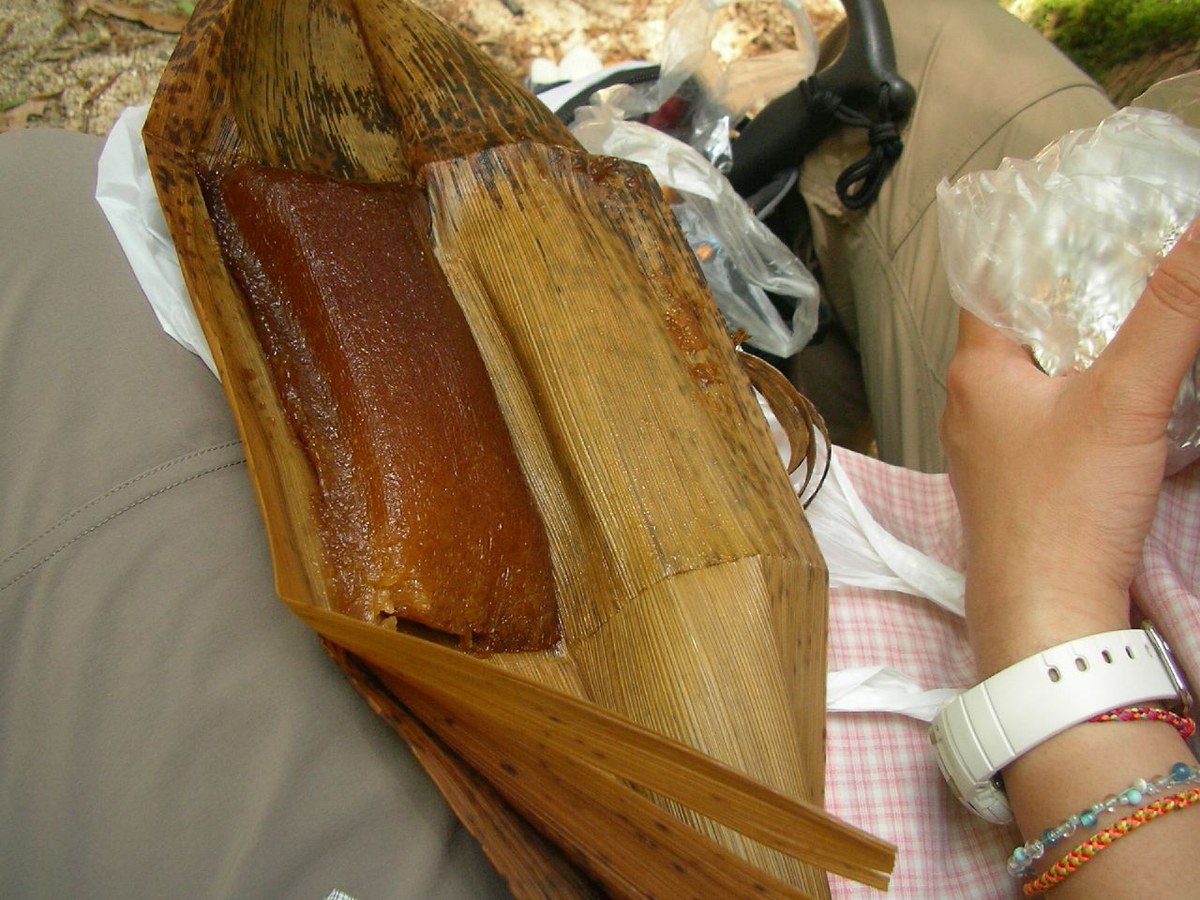
Cutting is part of the ritual and knives are banned by physics: the mass is too soft and clings to any blade. The tying string — a strip of the bamboo skin itself, or kite string — is looped around the akumaki, wetted and pulled, and slices it cleaner than steel. Our second photograph catches the moment before: the skin peeled back on an akumaki opened for lunch, a cut piece already in hand.
War rations and the Boys’ Festival
Akumaki is the sweet of Tango no Sekku, the Boys’ Festival, across its home ground — Kagoshima at the centre, with Miyazaki and southern Kumamoto around it. The origin traditions are military: one line ties it to Satsuma’s armies, as a ration that kept, at the Korean campaigns of 1592 or at Sekigahara in 1600; in 1877 Saigo Takamori’s men carried it through the Seinan War, and that campaigning spread it beyond Satsuma. Other tellings give it to farming households as a planting-season preserve, or to fallen Heike warriors in hiding.
The keeping is engineered, four defences deep: the long boil sterilises, the wood ash and the bamboo skin are antibacterial, and the alkaline body of the sweet itself discourages spoilage — about a week at room temperature, two in the refrigerator, for a food with no preservative in it. On Tanegashima and Yakushima the island form is tsunomaki, smaller and triangular, with azuki beans folded into the rice.
Buying it
In season — from mid-April toward the festival — akumaki fills Kagoshima’s wagashi shops, supermarkets and souvenir counters, and the supermarkets also sell the makings: bottled lye, ash and bamboo skins for households that still boil their own. Out of season it was once nearly unfindable outside the prefecture; vacuum-packed and mail-order production has changed that, and some Kagoshima shops now sell it all year.
The measured mail-order anchor this run is a four-piece set with kinako at ¥3,780 on the Kauche listing, sold by a Miyazaki shop that presents the sweet as the two prefectures’ shared tradition. Makers differ and Kagoshima people hold loyalties: Miyata Shouten of Izumi, for one, boils its akumaki four hours over a wood fire. Buy it with its kinako, cut it with thread, and expect the first bite to puzzle you and the third to make sense.
Sources — checked 15 November 2026
- Akumaki — encyclopedia record (the lye method, the thread cut, the war-ration traditions, the fourfold keeping)
- Akumaki four-piece set — Kauche listing, and Miyata Shouten’s Izumi set record (the ¥3,780 set, the four-hour wood-fired boil)
Checked 15 November 2026 (stored links re-fetched and judged per product): reserved where the page says so, with an editorial review note kept per product. Press, PR and travel use stays outside the grant.
Editorial review 2026-11-15