Every other pancake in Japan holds its shape. Tokyo's refuses to. Monjayaki arrives as a bowl of chopped cabbage floating on a batter so thin it pours like soup — roughly twelve parts liquid to one of flour — and it is cooked on the table's iron plate by the people who will eat it: solids fried and chopped, pushed into a ring, batter poured into the middle, and the whole spread scraped up bite by bite with a spatula the size of a spoon. It is the shitamachi's dish, born in candy shops, and Tsukishima's Monja Street is its capital.
A pancake that never sets
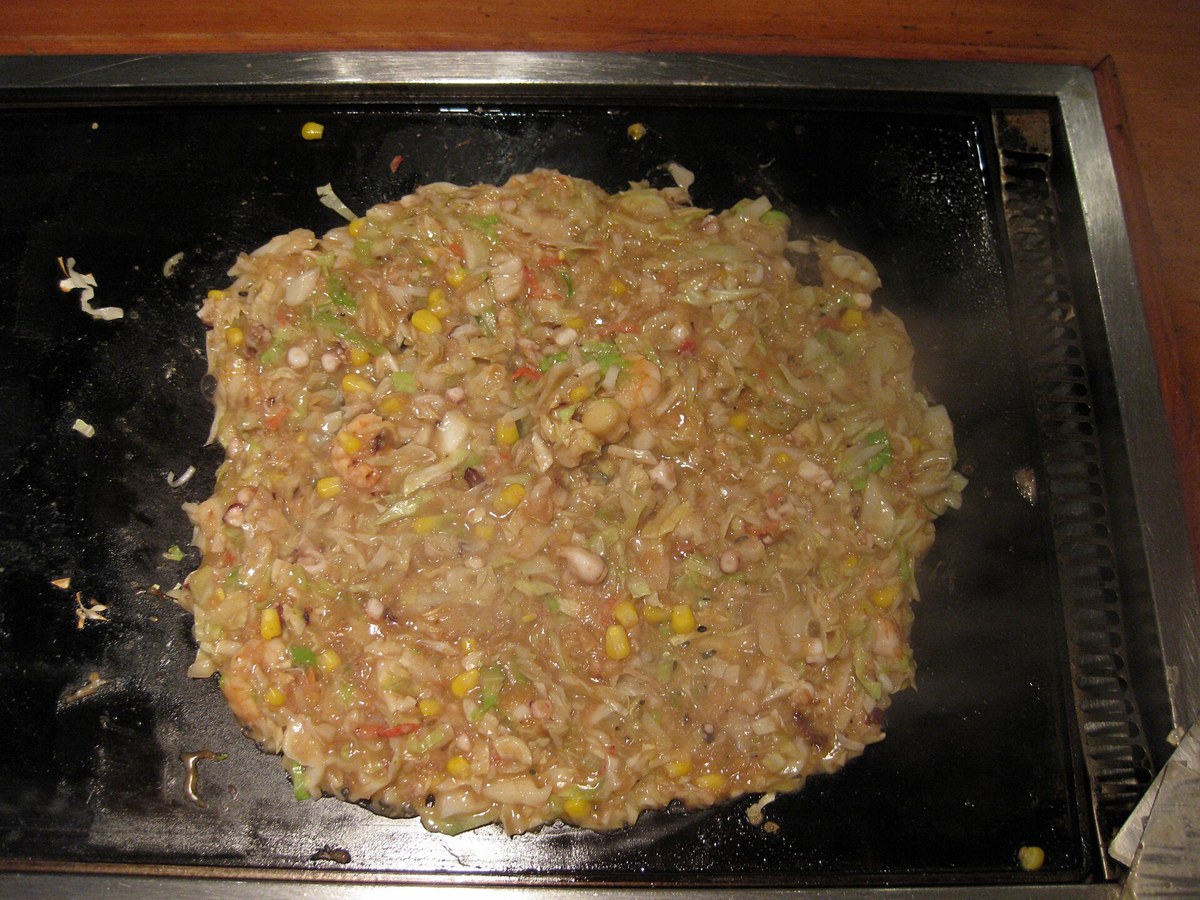
The form is a technique before it is a recipe. The cook lifts the cabbage and toppings out of the batter bowl and fries them on the oiled teppan, chopping them fine with two spatulas as they soften. Then everything is pushed into a ring — the dote, a little embankment — and the thin batter of flour, dashi and Worcestershire sauce is poured into the hollow. It bubbles, thickens at the edges, and is spread thin so the underside browns into okoge, the crisp layer everyone quietly competes for.
Nothing is ever flipped and nothing reaches a plate. Each diner works from the cooked edge inward with a hagashi, pressing a small scrap against the hot iron for a few seconds so its underside crisps, then lifting it straight to the mouth. The centre stays frankly gooey; that contrast — molten middle, cracker-crisp base, sweet cabbage against the sharp tang of sauce — is the dish, and it exists only while the iron is hot.
Letters on a hot plate
The name carries its own origin story. The Ministry of Agriculture, Forestry and Fisheries explains monjayaki through mojiyaki, 'letter grilling': people wrote characters on a hot plate with flour batter, and moji softened over time into monji and then monja. The Tsukishima Monja Promotion Association places the dish's development in Tokyo's shitamachi from the mid-Meiji period, though how closely the old letter game matches today's cabbage dish is, the guide concedes, hard to document.
The postwar record is firmer. From the late 1940s into the 1950s children widely enjoyed a simple version — thin batter with soy sauce or even syrup — at dagashiya, the penny-candy shops that kept a hot plate in the corner. As Japan grew richer the bowl grew with it: cabbage, corn and tempura bits joined, and when the candy shops began to close, a few keepers of the taste reopened it as food for adults with drinks.
Four shops become a street
Tsukishima's fame is younger than the dish. The association's history counts only four monja shops in the area in the years 1955 to 1964; their number rose sharply around the start of the Heisei era in 1989, as the reclaimed island's shopping street, Nishinaka-dori, filled with specialists. In April 1997 the owners of 28 shops formed the group that became the Tsukishima Monja Promotion Association, a cooperative from September 2002, and by June 2019 it counted 54 member shops run by 34 companies.
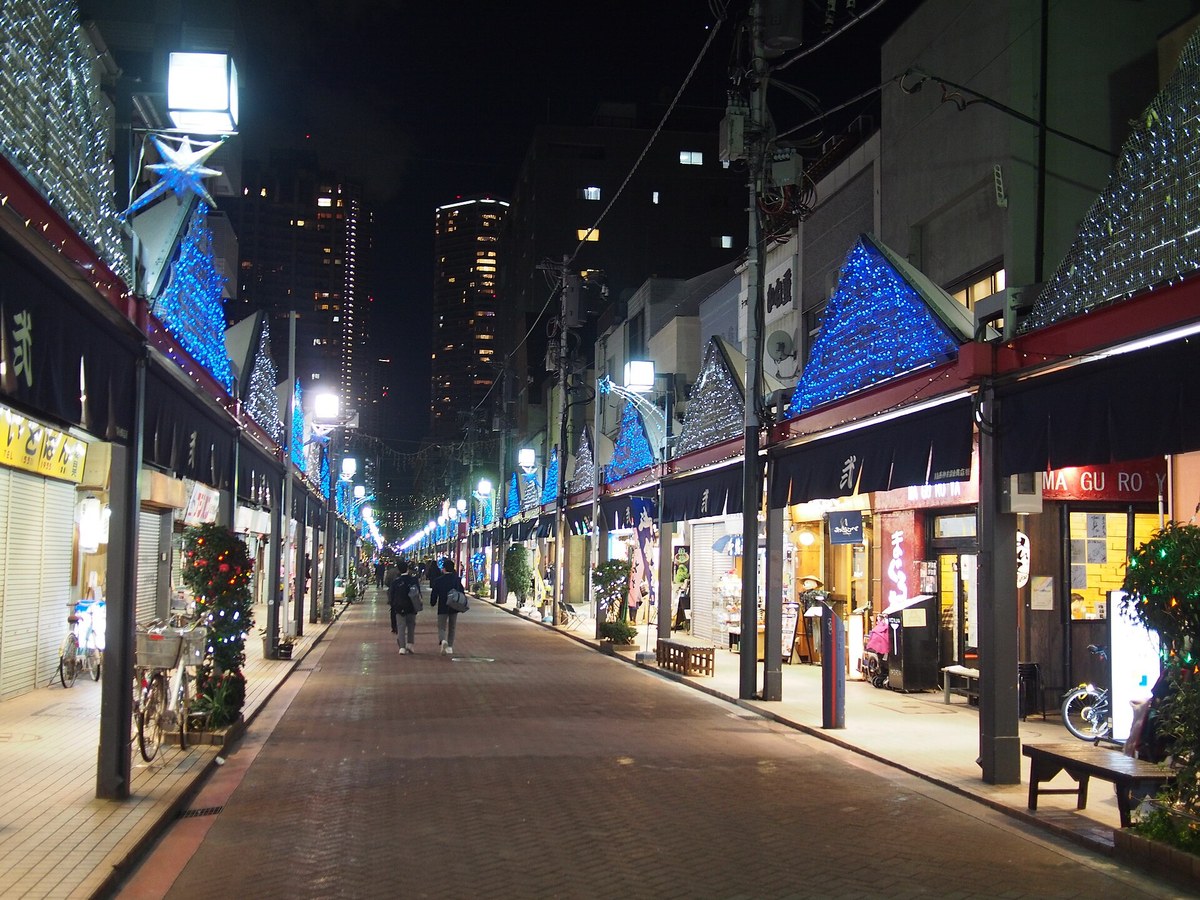
Today the street — about 400 metres from Exit 7 of Tsukishima Station — holds more than fifty monja shops by the guides' count, with the association listing about fifty members. Among them, Monja Kondo is the historian's stop: guidebooks date it to 1950 and say it began in a corner of a dagashiya, which is exactly where the dish itself began.
Eating it on Monja Street
Go to Tsukishima and take Exit 7; the street runs west from the station and its sections are bannered one to four. At the shops the regional guide surveyed in September 2026, one monja order runs about ¥930 to ¥2,000 depending on toppings: Monja Kura prices its monja at about ¥1,430–1,980, Tsukishima Monja Daruma's signature mochi, mentaiko and cheese monja is ¥1,782, Kondo's runs about ¥1,500–1,700, and over in Asakusa, Rokumonsen — serving monja since 1980 — lists ¥930–1,300, with a whole-Camembert monja at ¥1,300. One order, built for two or three to share as a snack, is the unit.
First-timers should let staff cook, or ask — the printed menus on the street walk through the steps — and should start scraping from the edge, not the middle. Popular shops fill on weekends, reservations help for groups, and hours and closing days vary by shop, so check the shop's own page on the day. There is no packaged version to take home: monjayaki is the iron, the ring and the argument over the last crisp patch, and it is eaten where it is cooked.
Sources — checked 12 November 2026
Original prose and official links only; no source text or maker media reproduced. Photos are credited Creative Commons works, not product photographs.
Editorial review 2026-11-12